
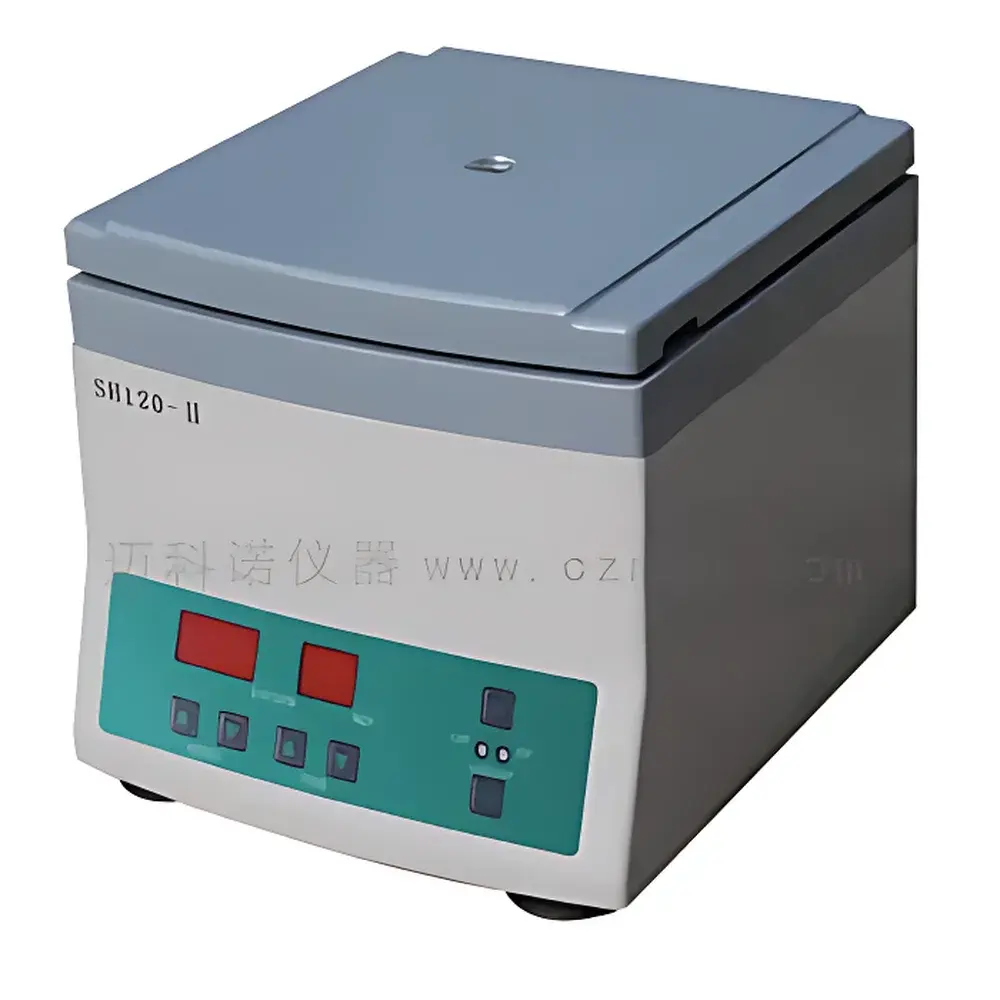
MKN SH120-2 Microhematocrit Centrifuge
| Brand | MKN |
|---|---|
| Model | SH120-2 |
| Power Supply | 110 V / 60 Hz & 220 V / 50–60 Hz |
| Max Speed | 12,000 rpm |
| RCF | 13,500 × g |
| Capacity | 24 × capillary tubes (Φ1.5 mm × 75 mm) |
| Acceleration Time | < 60 s |
| Deceleration Time | < 120 s |
| Timer Range | 0–99 min |
| Speed Control | Continuous variable (0–12,000 rpm) |
| Input Power | 230 VA |
| Output Power | 100 W |
| Dimensions (L×W×H) | 280 × 310 × 265 mm |
| Net Weight | 10 kg |
| Motor Type | Brushless DC motor |
| Compliance | Designed for clinical and research hematology workflows per ISO 15189 and CLSI H26-A3 guidelines |
Overview
The MKN SH120-2 Microhematocrit Centrifuge is a precision-engineered benchtop instrument designed specifically for rapid, reproducible separation of whole blood into cellular and plasma components using capillary tube methodology. It operates on the principle of sedimentation under controlled centrifugal force—applying radial acceleration to accelerate phase separation based on density differentials between erythrocytes, leukocytes, platelets, and plasma. Unlike general-purpose centrifuges, the SH120-2 is optimized for microvolume samples (typically 10–75 µL), making it ideal for point-of-care diagnostics, pediatric testing, and resource-limited settings where venous draw is impractical. Its compact footprint, brushless DC motor architecture, and intelligent touch interface ensure stable rotational dynamics, minimal vibration, and high repeatability across consecutive runs—critical for hematocrit (HCT) determination, packed cell volume (PCV) assessment, and microhematocrit calibration in clinical laboratories and academic research environments.
Key Features
- Brushless DC motor delivering consistent torque and extended service life with zero carbon brush wear or commutation noise
- Intelligent touch-control panel enabling real-time speed adjustment (0–12,000 rpm), timer setting (0–99 min), and immediate parameter recall
- High-efficiency rotor assembly balanced to ISO 21581 standards, supporting simultaneous processing of 24 capillary tubes (1.5 mm diameter × 75 mm length)
- Rapid spin-up (<60 s) and controlled deceleration (<120 s) with automatic brake release to prevent sample resuspension
- Integrated safety interlock system that halts operation if lid is opened mid-run or rotor imbalance exceeds tolerance thresholds
- Thermally stable housing with passive convection cooling—no external ventilation required for continuous operation within ambient lab conditions (15–30 °C)
- Low electromagnetic interference (EMI) design compliant with IEC 61326-1 for co-location with sensitive analytical instrumentation
Sample Compatibility & Compliance
The SH120-2 accepts standard heparinized or EDTA-coated glass or plastic capillary tubes conforming to ASTM E2025–22 specifications for microhematocrit analysis. It supports anticoagulated whole blood, capillary blood from dermal puncture (e.g., earlobe or fingertip), and low-volume biological suspensions such as diluted cerebrospinal fluid (CSF) or synovial fluid preparations. The device is engineered to meet essential performance criteria outlined in CLSI document H26-A3 (Measurement of Hematocrit by Microcentrifugation) and aligns with quality management requirements of ISO 15189:2022 for medical laboratories. While not FDA-cleared as an IVD device, its operational parameters are validated for use in GLP-compliant preclinical studies and internal QC procedures supporting ISO/IEC 17025 accreditation.
Software & Data Management
The SH120-2 operates as a standalone hardware platform without embedded data logging or network connectivity. All operational parameters—including set speed, elapsed time, and final RCF—are displayed in real time on the high-contrast LCD interface and retained in volatile memory until power-off. For traceability in regulated environments, users may integrate the centrifuge into broader laboratory information systems (LIS) via manual entry or external barcode-scanned run logs. The instrument supports audit-ready documentation when paired with standardized SOPs referencing CLSI EP25-A and ISO/IEC 17025 clause 7.7 (Control of Equipment). Firmware updates (if released) are delivered via USB port using vendor-provided configuration utilities—no cloud dependency or remote access capability is implemented.
Applications
- Determination of hematocrit percentage in clinical hematology and veterinary diagnostics
- Preparation of microvolume plasma for subsequent ELISA, electrolyte analysis, or coagulation assays
- Separation of red blood cell layers for osmotic fragility testing and sickle cell screening
- Processing of capillary blood in mobile health units, field clinics, and low-infrastructure laboratories
- Quality control of blood collection devices and anticoagulant efficacy validation
- Research applications requiring rapid phase partitioning of small-volume biological suspensions (e.g., microorganism pellets, exosome-enriched supernatants)
FAQ
What capillary tube dimensions are compatible with the SH120-2?
The centrifuge is calibrated for standard microhematocrit tubes measuring 1.5 mm outer diameter and 75 mm total length. Tubes must be sealed at one end and filled to ≥75% capacity for optimal sedimentation geometry.
Does the SH120-2 support rotor autoclaving?
No—the aluminum rotor is anodized and chemically resistant but not autoclavable. Cleaning is performed with 70% ethanol or isopropyl alcohol; avoid immersion or ultrasonic treatment.
Is speed calibration traceable to national standards?
Yes—factory calibration is performed using NIST-traceable tachometric reference equipment, and a certificate of conformance is supplied with each unit.
Can the SH120-2 be used for non-blood samples?
It may be employed for other low-viscosity suspensions with density differentials >0.02 g/cm³, provided tube compatibility and safety limits are verified per CLSI GP15-A3 guidance.
What maintenance intervals are recommended?
Routine inspection every 6 months includes rotor visual inspection, lid latch function test, and speed verification using an external handheld tachometer; no scheduled lubrication is required due to brushless motor design.



