
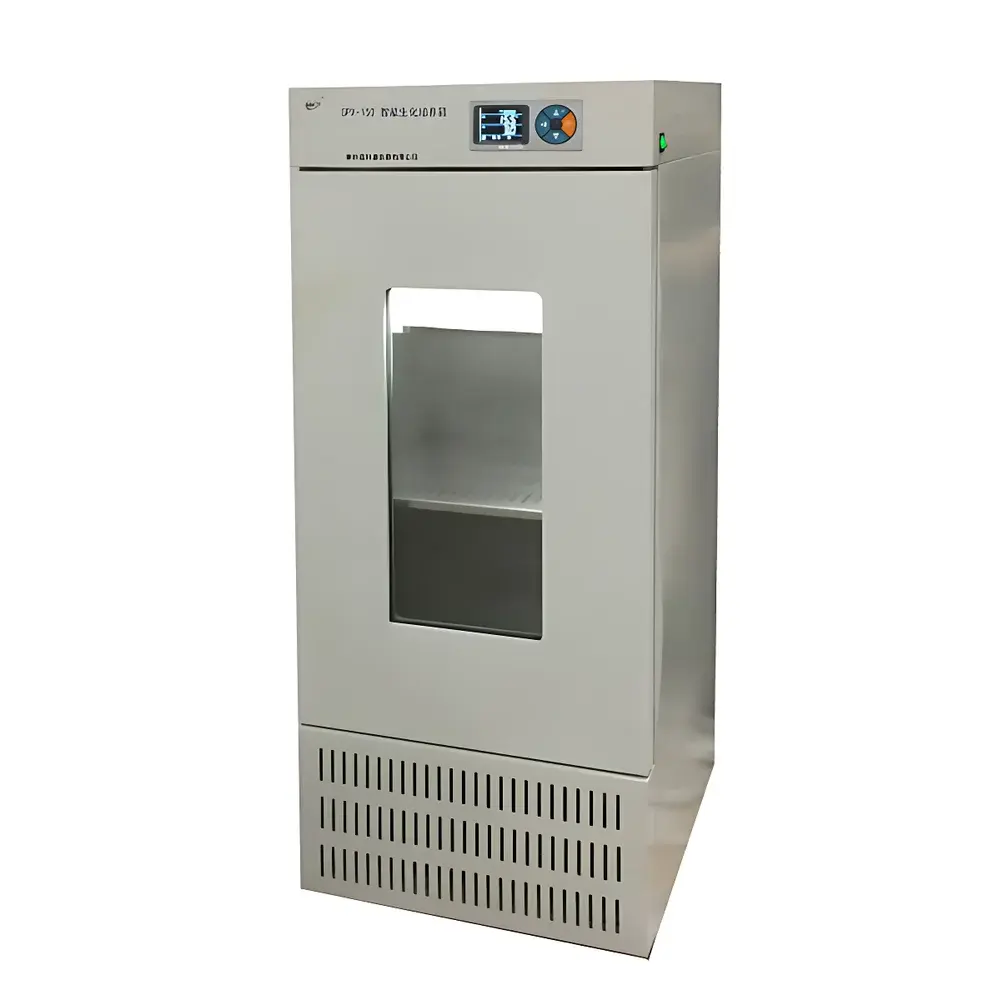
MKN SPX Series Biochemical Incubator
| Brand | MKN |
|---|---|
| Model | SPX Series |
| Origin | Jiangsu, China |
| Temperature Range | 0–50 °C |
| Control Accuracy | ±0.5 °C |
| Temperature Uniformity | ±0.5 °C |
| Chamber Volume Options | 80 L, 150 L, 250 L |
| Power Supply | AC 220 V ±10%, 50 Hz ±2% |
| Rated Power | ≤500 W |
| Operating Environment | 0–40 °C, RH ≤85% |
| Construction | Cold-rolled steel exterior with powder coating, stainless steel interior chamber |
| Insulation | Polyurethane foam |
| Display | LED digital (upgradable to LCD) |
| Air Circulation | Dedicated forced-air system |
| Safety Features | Compressor delay start, power interruption protection |
Overview
The MKN SPX Series Biochemical Incubator is a precision-engineered environmental control instrument designed for stable, long-term temperature regulation in life science laboratories. Utilizing a dual-mode thermoelectric system—comprising both Peltier-based cooling and resistive heating elements—the incubator maintains precise thermal setpoints across its operational range of 0 °C to 50 °C. Its microprocessor-based controller delivers high reproducibility with ±0.5 °C temperature accuracy and uniformity, meeting routine requirements for microbial culture, enzyme kinetics, cell line maintenance, and biochemical assay incubation. The unit operates continuously under standard ambient conditions (0–40 °C, ≤85% RH), making it suitable for GLP-compliant workflows in academic research, clinical diagnostics, environmental monitoring, and pharmaceutical quality control labs.
Key Features
- Microprocessor-controlled temperature regulation with LED digital display (LCD upgrade optional) for real-time monitoring and intuitive parameter adjustment.
- Forced-air circulation system engineered to minimize thermal gradients—ensuring uniform temperature distribution throughout the chamber volume (80 L / 150 L / 250 L options).
- Dual-function thermal management: integrated refrigeration and heating modules enable seamless transition between sub-ambient and elevated setpoints without manual mode switching.
- Robust mechanical architecture: exterior housing fabricated from cold-rolled carbon steel with epoxy-polyester powder coating; interior chamber constructed from electropolished 304 stainless steel for corrosion resistance and ease of decontamination.
- High-efficiency polyurethane foam insulation (≥50 mm thickness) minimizes thermal leakage and supports energy-efficient operation (rated power ≤500 W).
- Compressor protection circuitry includes automatic delay restart (≥3 min) and brownout recovery logic to prevent mechanical stress during power fluctuations.
- Front-access double-glazed tempered glass door with internal illumination facilitates non-intrusive sample observation without compromising chamber stability.
Sample Compatibility & Compliance
The SPX Series accommodates standard laboratory vessels—including Petri dishes, multi-well plates, Erlenmeyer flasks, and test tube racks—within its stainless steel chamber. Its design conforms to general safety standards for Class II laboratory equipment (IEC 61010-1). While not certified for sterile or ISO Class 5 environments, the unit supports routine biosafety level 1 (BSL-1) and limited BSL-2 applications when used with appropriate containment practices. Temperature logging capability (via optional RS-232/USB interface) enables traceable data capture aligned with basic GLP documentation requirements. The incubator does not meet FDA 21 CFR Part 11 criteria out-of-the-box but may be validated for use in GMP-adjacent workflows where electronic records are manually verified and archived.
Software & Data Management
Standard configuration includes local parameter setting via front-panel keypad and real-time LED readout. Optional data logging modules support time-stamped temperature recording at user-defined intervals (1–60 min), exportable as CSV files for post-hoc analysis. No proprietary cloud platform is included; all firmware updates are delivered via offline USB flash drive to maintain network isolation—a critical consideration for regulated lab environments. Audit trail functionality is not embedded but can be implemented externally using validated third-party environmental monitoring systems interfaced via analog voltage output (0–5 V) or Modbus RTU protocol.
Applications
- Microbial growth studies (e.g., E. coli, S. aureus, yeast) requiring controlled mesophilic or psychrotrophic conditions.
- Biochemical reaction incubation for ELISA, PCR pre-amplification steps, and immunoassay plate incubation.
- Plant tissue culture and seed germination assays under defined thermal regimes.
- Environmental simulation for water quality testing (e.g., BOD incubation per ASTM D5210) and soil microbiology assessments.
- Stability testing of reagents, antibodies, and diagnostic kits at accelerated or real-time storage temperatures.
- Supporting QC/QA protocols in food safety labs conducting aerobic plate counts (ISO 4833-1) or coliform enumeration (ISO 4832).
FAQ
What is the minimum operating temperature of the SPX Series incubator?
The unit achieves stable operation down to 0 °C, supported by active refrigeration—not passive cooling—and verified across all chamber volumes.
Is the incubator suitable for CO₂-dependent cell cultures?
No. This model provides only temperature control; it lacks gas mixing, humidification, or CO₂ sensing capabilities. For mammalian cell culture, consider dedicated CO₂ incubators.
Can the temperature sensor be calibrated in-house?
Yes. The device supports two-point calibration using NIST-traceable reference thermometers (e.g., platinum RTD probes) via service menu access—full procedure documented in the technical manual.
Does the unit include validation documentation?
Factory-assembled IQ/OQ documentation is available upon request at time of order; PQ execution remains the responsibility of the end-user laboratory per ISO/IEC 17025 guidelines.
What is the warranty coverage period and scope?
MKN provides a 12-month limited warranty covering material and workmanship defects under normal laboratory use; exclusions include damage from improper installation, environmental exposure beyond specified operating limits, or unauthorized modification.
Related Products





