
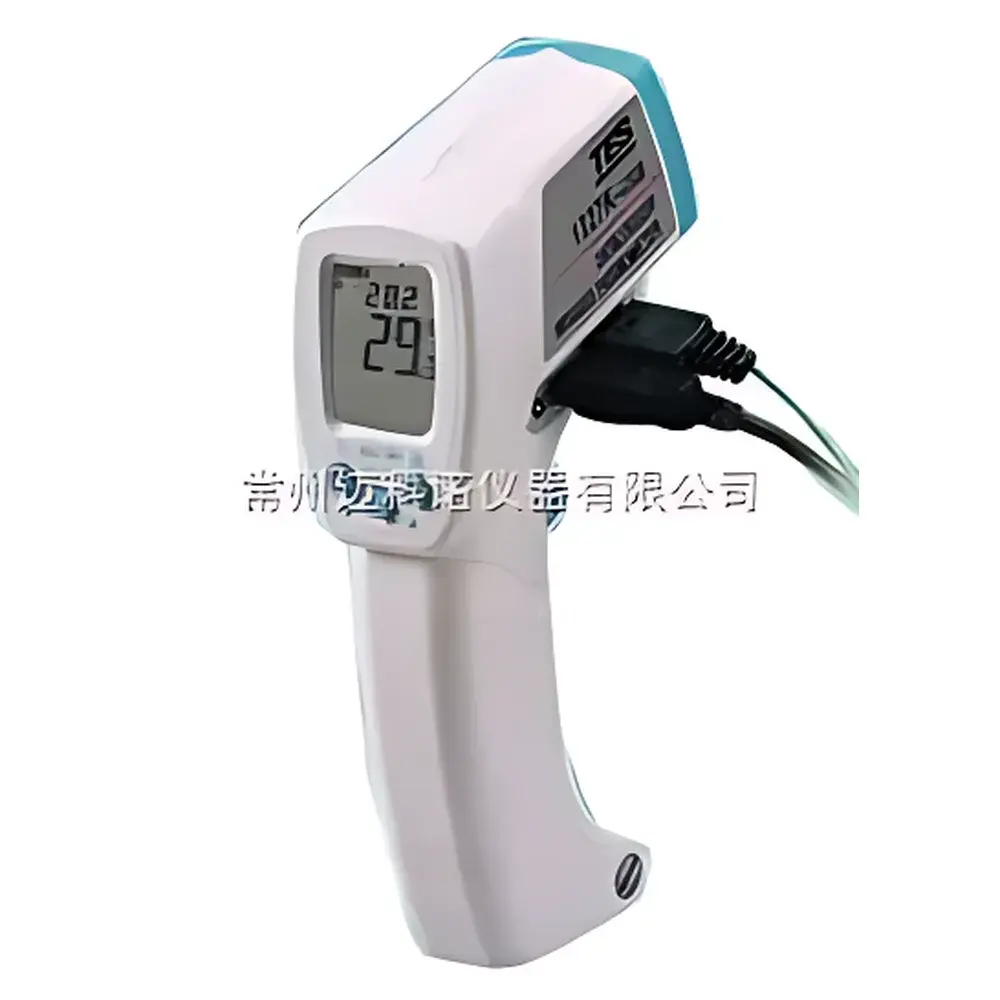
MKN TES-1327K-USB Infrared Thermometer with Data Logging
| Brand | MKN |
|---|---|
| Model | TES-1327K-USB |
| Measurement Range | −35°C to 500°C (−31°F to 932°F) |
| Resolution | 0.1°C / 0.2°F |
| Accuracy | ±2% of reading or ±2°C, whichever is greater |
| Spectral Response | 6–14 µm |
| Distance-to-Spot Ratio | 12:1 (min. target diameter: 25 mm) |
| Emissivity Adjustment | 0.17–1.00 |
| Laser Targeting | Class II, ≤1 mW |
| Memory Capacity | 21,000 continuous readings + 99 manual records |
| Display | Backlit LCD with dual-temperature & dual-unit (°C/°F) capability |
| Alarm Function | Configurable high/low temperature thresholds with audible beep |
| Interface | USB 2.0 for data export and firmware/software interaction |
| Power | 9V alkaline battery (approx. 100 h continuous operation) |
| Operating Environment | 0–50°C, <80% RH |
| Storage | −10–60°C, <70% RH |
Overview
The MKN TES-1327K-USB Infrared Thermometer is a non-contact, portable thermal measurement instrument engineered for precision surface temperature assessment across industrial maintenance, HVAC diagnostics, electrical infrastructure inspection, and laboratory process monitoring. It operates on the principle of passive infrared radiation detection—capturing emitted mid-infrared energy (6–14 µm spectral band) from object surfaces and converting it into calibrated temperature values using Planck’s radiation law and built-in emissivity compensation. Its 12:1 optical distance-to-spot ratio ensures reliable targeting of objects as small as 25 mm in diameter at 300 mm working distance, minimizing measurement uncertainty caused by background radiation or spatial averaging. Designed for field robustness and operational transparency, the device features real-time dual-display output (simultaneous °C and °F), adjustable emissivity (0.17–1.00), and integrated Class II laser targeting for precise point-of-measurement alignment—critical for repeatable thermographic surveying under variable ambient conditions.
Key Features
- Non-contact temperature measurement over an extended range of −35°C to 500°C (−31°F to 932°F), suitable for both cryogenic surface checks and high-temperature industrial components.
- High-resolution backlit LCD display with dual-unit readout and simultaneous max/min value tracking—enabling rapid identification of thermal anomalies during live scanning.
- Configurable high/low temperature alarm thresholds with audible buzzer feedback, supporting preventive maintenance workflows and safety-critical thermal monitoring.
- Dual memory architecture: 99 manually triggered readings accessible directly on-device via LCD navigation, plus 21,000 timestamped continuous log entries stored internally for post-acquisition analysis.
- USB 2.0 interface enables direct connection to Windows-based PCs for bulk data export, report generation, and software-assisted calibration verification using included CD-based utility suite.
- Emissivity compensation across 0.17–1.00 in 0.01 increments supports accurate measurements on diverse materials—including oxidized metals, painted surfaces, plastics, and ceramics—without requiring external reference sources.
Sample Compatibility & Compliance
The TES-1327K-USB is compatible with stationary or slow-moving solid surfaces exhibiting stable thermal emission characteristics. It is not intended for transparent media (e.g., glass, thin plastic films), highly reflective bare metals without surface treatment, or rapidly moving targets exceeding 1 m/s. While not certified to ISO/IEC 17025 or ASTM E1933, its optical design and signal processing conform to widely accepted principles outlined in ASTM E1256 (Standard Test Methods for Radiation Thermometers). The device meets CE marking requirements for electromagnetic compatibility (EMC Directive 2014/30/EU) and low-voltage safety (LVD Directive 2014/35/EU). Laser emission complies with IEC 60825-1:2014 Class II limits (≤1 mW visible red diode). No FDA 510(k) clearance or medical device classification applies, as it is designated for industrial and technical use only.
Software & Data Management
The bundled Windows-compatible software provides raw data visualization, statistical summary (mean, std. dev., min/max), time-series graphing, and CSV export functionality. All logged entries include embedded timestamps, emissivity settings, and unit configuration metadata—supporting traceability in quality control documentation. Audit-ready data exports can be integrated into LIMS or CMMS platforms. Although the device does not support 21 CFR Part 11 electronic signature or audit trail features natively, exported datasets retain full integrity for inclusion in GLP-compliant reports when paired with validated acquisition protocols and controlled file handling procedures.
Applications
- Electrical distribution systems: Hot-spot detection on busbars, circuit breakers, transformer bushings, and fuse connections.
- Mechanical maintenance: Bearing temperature trending, motor winding thermal profiling, and steam trap functionality verification.
- HVAC commissioning: Duct surface uniformity checks, coil frost detection, and radiant floor system validation.
- Manufacturing process control: Mold surface monitoring in injection molding, curing oven uniformity mapping, and conveyor belt component thermal stability assessment.
- Research & education: Introductory thermal physics experiments, emissivity comparison studies, and environmental chamber boundary condition verification.
FAQ
What is the minimum measurable target size at 1 meter distance?
At 1 m, the spot diameter is approximately 83 mm (based on 12:1 D:S ratio), so the smallest reliably measurable target should exceed this dimension for optimal accuracy.
Can the device measure through glass or plastic enclosures?
No—standard silica-based glass and most polymers are opaque in the 6–14 µm band; measurements will reflect the enclosure surface temperature, not the internal object.
Is calibration traceable to NIST or other national standards?
The instrument ships with a factory calibration certificate referencing internal blackbody references; third-party NIST-traceable recalibration services are available through authorized MKN service centers.
Does the USB interface support real-time streaming mode?
No—the USB port is designed exclusively for batch download of stored logs; live serial output is not implemented in firmware.
How does ambient temperature affect measurement stability?
Internal temperature compensation algorithms mitigate drift within the specified operating range (0–50°C); prolonged exposure above 50°C may require thermal stabilization before critical measurements.




