
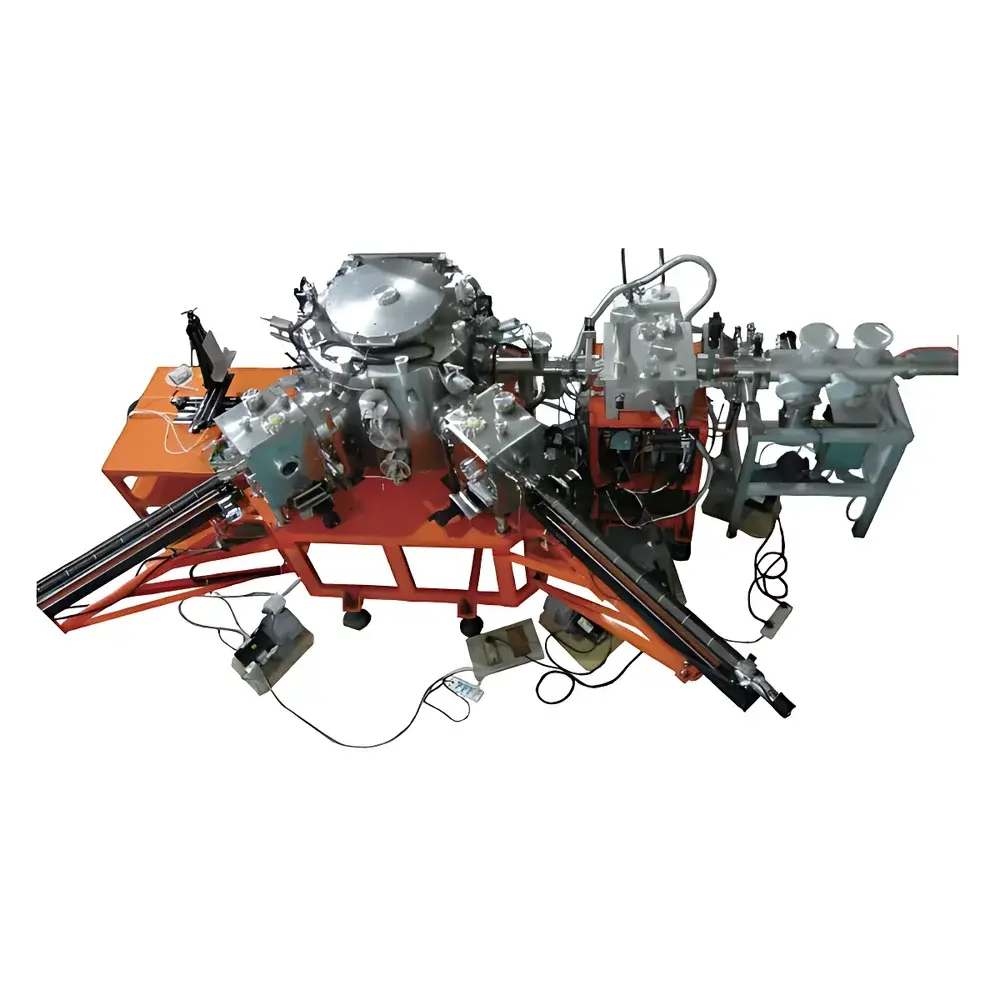
MKW-3000 Single-Particle Effect (SPE) Analysis System
| Brand | Makeway |
|---|---|
| Model | MKW-3000 |
| Origin | Shanghai, China |
| Detector Type | Multi-probe EDS-compatible |
| Energy Resolution | 120 eV |
| Operating Environments | High Vacuum & Ambient Air |
| Maximum Beam Scan Area | 60 × 60 mm² |
| Sample Positioning | 4-axis Motorized Stage (Vacuum & Air) |
| Beam Control | Motorized Variable Aperture & Remote Focusing |
| Compliance | Designed for ISO/IEC 17025-aligned radiation effects testing workflows |
Overview
The MKW-3000 Single-Particle Effect (SPE) Analysis System is a purpose-engineered platform for radiation-induced soft-error characterization of microelectronic devices under controlled ion beam irradiation. Unlike conventional electron microscopy or energy-dispersive X-ray spectroscopy (EDS) systems, the MKW-3000 integrates particle beam delivery, real-time fault logging, and spatially resolved detection within a dual-environment architecture—supporting both high-vacuum irradiation (≤1×10⁻⁵ Pa) and atmospheric-pressure testing. Its core measurement principle relies on controlled heavy-ion or proton beam irradiation to induce single-event effects (SEEs), including single-event upsets (SEUs), latch-ups (SELs), and transients (SETs), while synchronizing detector response with device electrical monitoring. The system is not an imaging microscope per se but a functional test station co-located with EDS-capable detection hardware—enabling correlation between ion strike location, energy deposition (via LET calibration), and observed circuit-level anomalies.
Key Features
- Dual-environment operation: Seamless transition between atmospheric and high-vacuum modes via a dedicated auxiliary pre-pump chamber and rapid-sample exchange mechanism—reducing chamber venting/pumping cycles by >70% compared to conventional single-chamber designs.
- Motorized 4-axis precision stage: Integrated into both vacuum and air modules; provides ±0.5 µm repeatability in X/Y/Z/θ for sub-millimeter alignment of device active areas relative to beam centroid.
- Beam scanning and shaping: Electrostatic or magnetic raster scanning over 60 × 60 mm² field-of-view; motorized variable slit assembly enables dynamic control of beam spot size (1–500 µm FWHM) and fluence rate (1×10³–1×10⁷ ions/cm²/s).
- Multi-probe detection architecture: Supports simultaneous acquisition from up to four independent solid-state detectors—including silicon drift detectors (SDDs) with 120 eV Mn-Kα energy resolution—enabling coincident energy, timing, and position tagging of incident particles.
- Fully remote operation: All positioning, aperture adjustment, beam focusing, and data acquisition are controllable via TCP/IP-based API or GUI client, compliant with IEEE 1627-2018 standards for remote radiation test infrastructure.
Sample Compatibility & Compliance
The MKW-3000 accommodates standard JEDEC trays (MO-255, MO-263), wafer fragments (up to 200 mm), and packaged ICs (QFP, BGA, CSP) with optional thermal chuck (-40°C to +125°C). Mechanical interfacing follows SEM-compatible flange standards (CF-63, CF-100). For regulatory traceability, the system logs all irradiation parameters—including beam species, energy, fluence, LET spectrum, and environmental pressure—with timestamped metadata compliant with ISO/IEC 17025 clause 7.7 (result reporting) and NASA-HDBK-4002A (radiation test documentation). While not certified to FDA 21 CFR Part 11, audit trails support GLP-compliant test record retention when deployed with validated third-party LIMS integration.
Software & Data Management
The MKW-3000 Control Suite (v4.2+) runs on Linux RT kernel and includes three tightly coupled modules: BeamScheduler (for LET-optimized irradiation sequencing), EventCorrelator (synchronizes ion arrival timestamps with digital pattern generator outputs and oscilloscope waveforms), and SPE-Analyzer (performs statistical analysis of upset cross-sections σ vs. LET using Weibull or log-normal fitting per JEDEC JESD89A). Raw data is stored in HDF5 format with embedded NeXus-compatible metadata schemas. Export options include CSV, MAT, and MIF (Microelectronics Irradiation Format) for interoperability with SPICE-based fault injection tools such as FaultSim or RAD-TK.
Applications
- Single-event effect (SEE) susceptibility mapping of advanced node ICs (28 nm to 3 nm FinFETs, GAA transistors, and MRAM/ReRAM memory arrays).
- LET threshold determination and cross-section modeling for space-grade ASIC qualification (ECSS-Q-ST-60-15C, MIL-STD-883 Method 1019.8).
- Beam-induced charge collection efficiency (CCE) profiling in radiation-hardened photodiodes and image sensors.
- Validation of TCAD simulations for ion track structure and charge diffusion dynamics in SOI and bulk CMOS substrates.
- Development and calibration of ground-based accelerated radiation test protocols aligned with CERN-EN/SPS and TIARA facility benchmarks.
FAQ
Does the MKW-3000 include an integrated ion accelerator?
No—the MKW-3000 is a beamline endpoint system designed to interface with external electrostatic or cyclotron accelerators (e.g., 10–100 MeV/u light/heavy ions). It does not generate primary beams.
Can it perform real-time SEE detection during irradiation?
Yes—when synchronized with external digital test equipment (e.g., logic analyzers, BERT scopes), it captures time-correlated event triggers with <10 ns jitter relative to beam pulse onset.
Is EDS functionality native or add-on?
EDS capability is embedded via integrated SDD detectors; however, full spectral quantification (ZAF correction, matrix effects) requires optional Microanalysis Module licensed separately.
What vacuum pumping configuration is used?
Turbomolecular pump (2000 L/s) backed by dry scroll pump; base pressure ≤5×10⁻⁶ Pa achievable within 15 minutes after sample load.
How is beam energy calibrated?
Via upstream Faraday cup current integration and reference foil transmission measurements, traceable to NIST SRM 2133 (ion beam dosimetry standards).





