
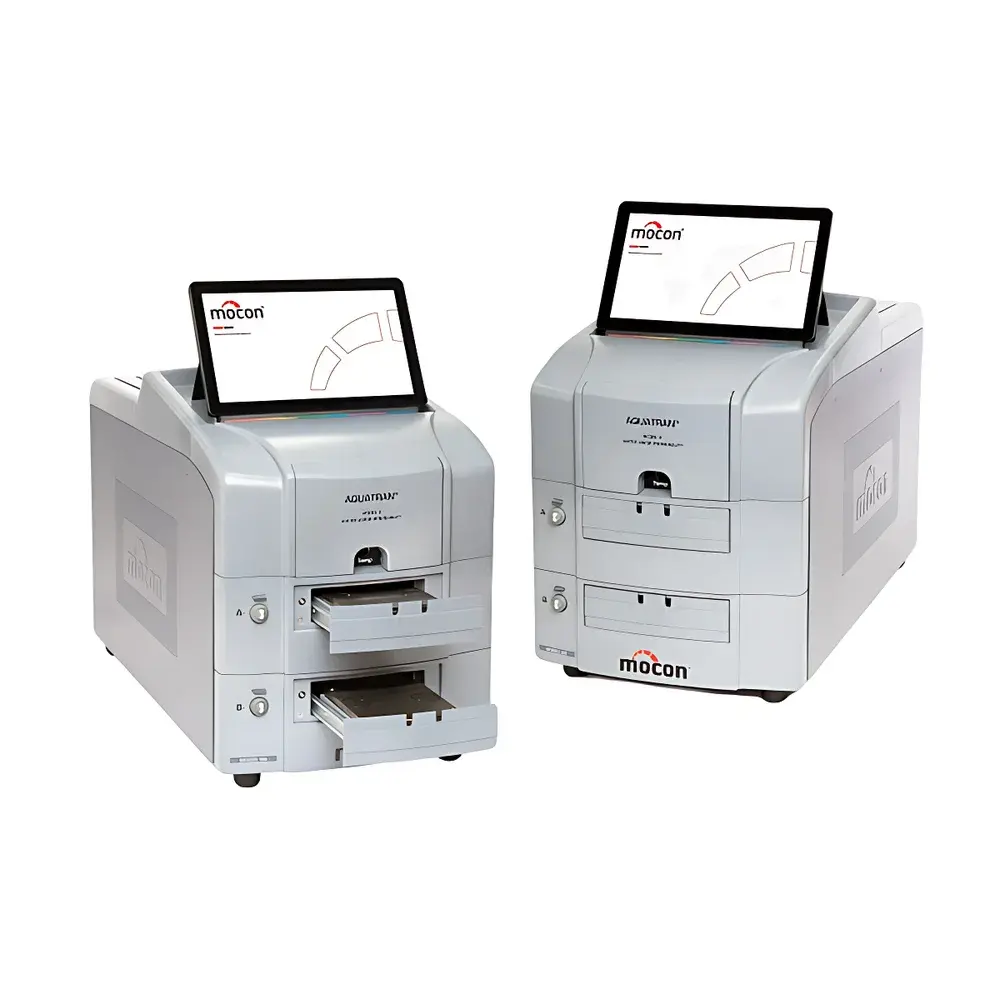
Mocon AQUATRAN® Model 3 Ultra-High-Precision Water Vapor Transmission Rate (WVTR) Analyzer
| Brand | Mocon |
|---|---|
| Origin | USA |
| Model | AQUATRAN® Model 3 |
| Test Range (Film) | 0.00005–5 g/m²·day |
| Test Range (Container) | 0.00000025–0.025 g/pkg·day |
| Resolution | 0.00001 g/m²·day |
| Repeatability | ±0.00005 g/m²·day |
| Temperature Range | 5–50 °C (±0.2 °C at 100% RH) |
| Humidity Range (Detector Gas) | 5–90% RH & 100% RH |
| (Carrier Gas) | Dry |
| Test Chamber Options | Dual 50 cm² chambers |
| Compliance | ASTM F3299, ISO 15106-3, GB/T 21529-2008, YBB00092003-2015 |
Overview
The Mocon AQUATRAN® Model 3 is an ultra-high-precision water vapor transmission rate (WVTR) analyzer engineered for laboratories requiring trace-level permeation measurement of barrier materials used in pharmaceutical packaging, medical device pouches, flexible electronics encapsulation, and high-end food packaging. It employs a patented coulometric sensor based on Faraday’s Law of Electrolysis — a primary measurement principle that delivers absolute, calibration-free quantification of water vapor molecules traversing a test specimen. Unlike conventional relative humidity sensors or infrared detectors, the coulometric cell generates an electrical current directly proportional to the molar flux of H₂O, eliminating drift, baseline instability, and periodic recalibration. This fundamental metrological advantage ensures long-term data integrity across instrument lifecycles and inter-laboratory comparisons — a critical requirement for regulatory submissions (e.g., FDA IND/NDA, EMA CTD), supplier qualification, and global supply chain harmonization.
Key Features
- Coulometric sensor technology: Absolute measurement traceable to SI units; zero calibration required over sensor lifetime.
- Dual independent 50 cm² test chambers: Enables parallel testing of identical or dissimilar samples under identical environmental conditions, improving throughput and statistical robustness.
- Fully automated temperature and humidity control: Precision regulation within ±0.2 °C and ±1% RH across defined operating ranges; optional integration with external climatic chambers supports accelerated aging protocols (e.g., 85 °C / 85% RH per ISO 11607-1 Annex B).
- Intuitive 10.1-inch capacitive touchscreen interface: Graphical workflow navigation, parameter templating, and one-touch test initiation reduce operator dependency and minimize training time.
- Remote monitoring and control via Ethernet/Wi-Fi: Supports secure access through enterprise IT infrastructure; compatible with centralized LIMS integration using standard TCP/IP protocols.
- Modular chamber architecture: Interchangeable test fixtures accommodate films, laminates, coated foils, blister foils, pouches, and rigid containers — including custom geometries via third-party adapters.
Sample Compatibility & Compliance
The AQUATRAN® Model 3 accommodates a broad spectrum of sample formats without compromising measurement fidelity. Standard configurations support flat-sheet specimens up to 50 cm²; optional small-area chambers enable high-resolution mapping of localized barrier defects in thin-film transistor (TFT) substrates or ALD-coated wafers. For package-level validation, container test kits permit direct sealing of vials, syringes, and preformed trays using standardized flange systems compliant with ASTM F2622. All measurement methodologies adhere strictly to internationally recognized standards: ASTM F3299 (coulometric detection), ISO 15106-3 (infrared detection — validated correlation mode), GB/T 21529-2008 (Chinese national standard for pharmaceutical packaging), and YBB00092003-2015 (Chinese Pharmacopoeia packaging guidance). Data audit trails comply with 21 CFR Part 11 requirements when operated with validated software configuration and electronic signature modules.
Software & Data Management
The embedded AQUATRAN Control Suite v5.x provides full GLP/GMP-aligned data governance. Each test record includes timestamped environmental logs, real-time permeation curves, raw coulometric current traces, and automatic calculation of diffusion coefficient (D), solubility coefficient (S), and permeability coefficient (P) per ISO 2528. All data are stored in encrypted SQLite databases with immutable audit trails, supporting retrospective review and FDA inspection readiness. Export options include CSV, PDF reports with digital signatures, and XML schemas compatible with enterprise quality management systems (QMS). Optional IQ/OQ/PQ documentation packages are available for regulated environments requiring formal validation against user requirement specifications (URS).
Applications
- Pharmaceutical primary packaging: Quantifying WVTR of cold-chain blister lidding foils, desiccant-containing sachets, and polymer-coated glass vials.
- Medical device sterilization packaging: Validating microbial barrier integrity of Tyvek®/polyester pouches under ISO 11607-1 accelerated aging conditions.
- Flexible OLED encapsulation: Measuring ultra-low WVTR (<10⁻⁶ g/m²·day) of atomic layer deposited (ALD) Al₂O₃ barriers on display substrates.
- Active and intelligent packaging: Characterizing moisture-triggered release kinetics of humidity-sensitive indicators or antimicrobial agents embedded in multilayer structures.
- Regulatory dossier preparation: Generating reproducible, auditable permeation datasets for ICH Q5C stability protocols and comparability studies during manufacturing site transfers.
FAQ
Does the coulometric sensor require periodic calibration?
No. The sensor operates on Faraday’s Law, making it a primary measurement method with inherent traceability to fundamental physical constants. Calibration is not required throughout its operational lifetime.
Can the AQUATRAN® Model 3 test rigid containers such as HDPE bottles?
Yes — using the optional container test kit, which includes sealed flange assemblies and purge gas manifolds compliant with ASTM F2622 and ISO 15106-3 Annex D.
Is remote data access secure for use in regulated pharmaceutical labs?
Yes. When deployed with TLS 1.2 encryption, role-based user authentication, and electronic signature enforcement, the system meets 21 CFR Part 11 and EU Annex 11 requirements for electronic records and signatures.
What is the lowest detectable WVTR value for film testing?
The instrument achieves a resolution of 0.00001 g/m²·day and repeatability of ±0.00005 g/m²·day, enabling reliable quantification down to 5×10⁻⁵ g/m²·day — suitable for evaluating state-of-the-art SiOₓ- and AlOₓ-coated PET films.
How does temperature and humidity uniformity impact measurement uncertainty?
The dual-zone thermal management system maintains spatial uniformity better than ±0.1 °C across the test area, while humidity gradients are minimized via laminar carrier gas flow and integrated RH feedback loops — both contributing to <1.5% expanded uncertainty (k=2) per ISO/IEC 17025:2017 guidelines.





