
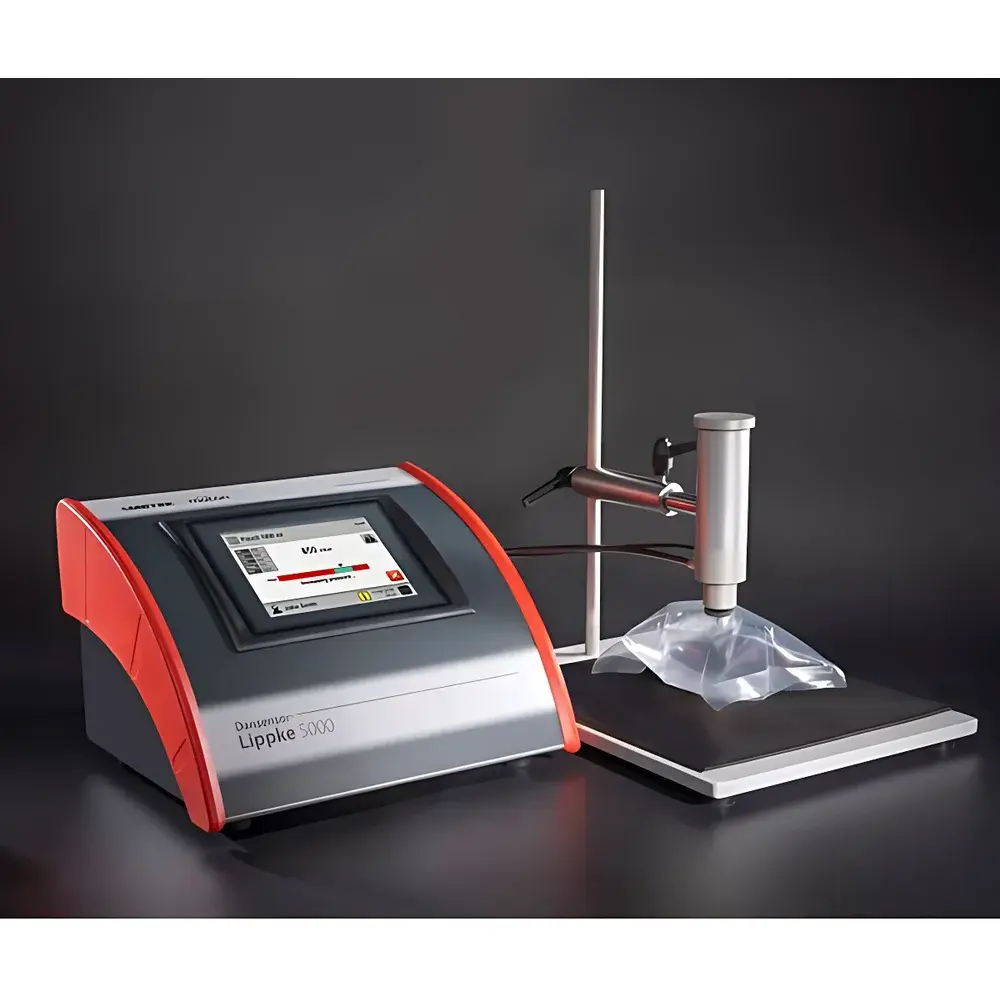
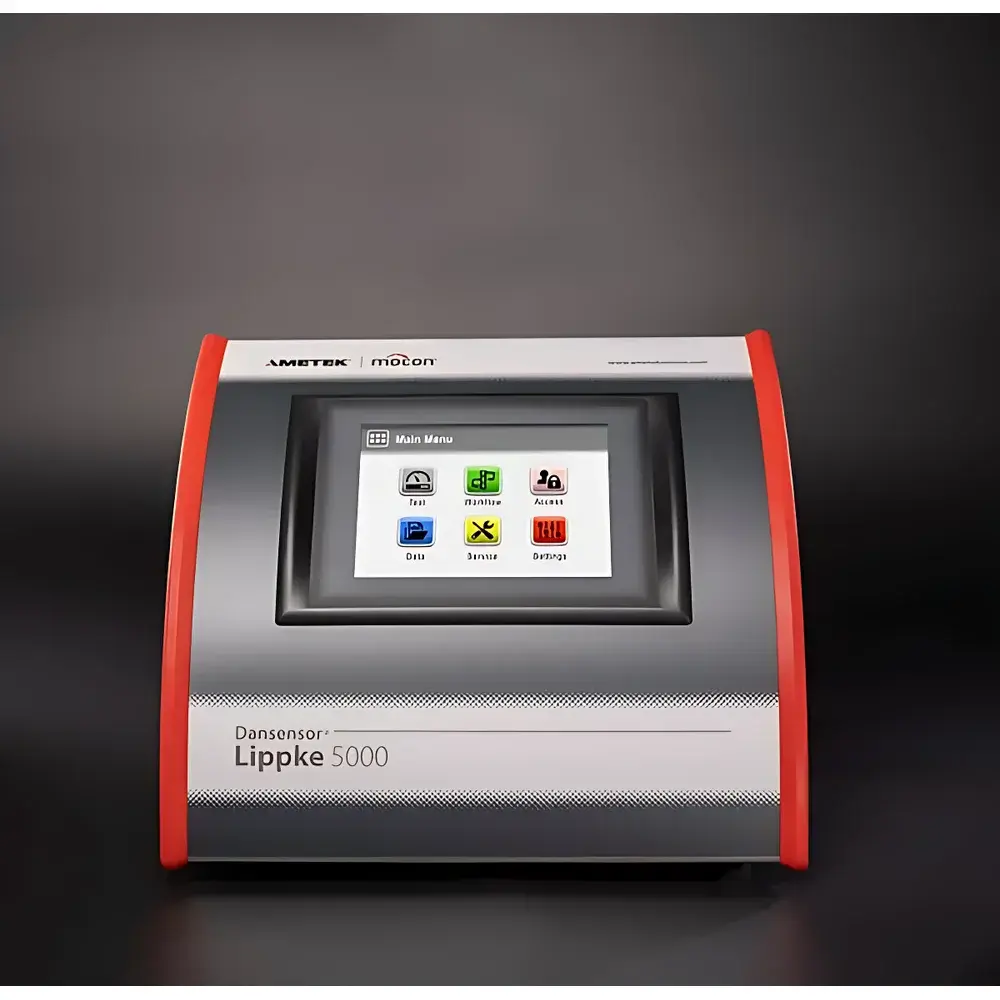
MOCON Dansensor Lippke 5000 Packaging Seal Integrity Tester
| Brand | MOCON (Dansensor) |
|---|---|
| Model | Lippke 5000 |
| Origin | Denmark |
| Application | Medical, Pharmaceutical & Food Packaging Seal Integrity Testing |
| Test Principles | Pressure Decay, Burst, Creep, Bubble, and Combined Testing |
| Compliance | ASTM F1140, F2054, F2095, F2096 |
| Max Test Volume | 90 L |
| Pressure Range | 10–5000 mbar |
| Resolution | 0.1 mbar (0–1000 mbar), 1 mbar (1000–5000 mbar) |
| Accuracy | ±0.5 mbar or ±1% of reading (whichever is greater) |
| Test Duration | 1–500 s |
| Data Storage | >1,000,000 records |
| Interface | USB 2.0 (Host & Device), RJ-45 Ethernet |
| Power | 90–264 VAC, 47–63 Hz, ≤50 W |
| Dimensions | 284 × 236.5 × 185 mm |
| Weight | 3.4 kg |
| IP Rating | IP20 |
| Operating Temp | +2 °C to +25 °C |
| Humidity | 10–90% RH (non-condensing) |
Overview
The MOCON Dansensor Lippke 5000 Packaging Seal Integrity Tester is a benchtop, pressure-based analytical instrument engineered for quantitative, standardized evaluation of seal integrity and mechanical strength in sterile and non-sterile medical device packaging, pharmaceutical primary containers, and food-grade flexible and rigid packaging systems. It operates on four fundamental physical test principles—pressure decay leakage detection, burst pressure measurement, creep deformation analysis, and submerged bubble emission testing—each aligned with internationally recognized regulatory test standards. Unlike tracer-gas-dependent methods (e.g., helium leak testing), the Lippke 5000 relies exclusively on compressed air or nitrogen as the test medium, eliminating the need for specialized gases, gas handling infrastructure, or calibration against reference leaks. Its modular pneumatic architecture integrates high-resolution pressure transducers, precision solenoid control valves, and thermally stabilized flow paths to ensure repeatability across environmental fluctuations. Designed for both quality control laboratories and production floor environments, the system delivers traceable, auditable, and statistically robust data suitable for regulatory submissions under FDA, EMA, and Health Canada frameworks.
Key Features
- Multi-mode testing capability: simultaneous or sequential execution of burst (ASTM F2054), pressure decay leakage (ASTM F2095), creep (ASTM F1140), bubble emission (ASTM F2096), and programmable combined tests (e.g., creep-to-failure + leakage + burst on a single sample)
- Extended volume range: validated performance from micro-pouches up to 90 L containers—including blister cards, pouches, thermoformed trays, Tyvek®-laminated pouches, and polymeric IV bags
- High-fidelity pressure metrology: dual-range transducer with 0.1 mbar resolution below 1000 mbar and ±0.5 mbar absolute accuracy—calibration traceable to NIST-certified references
- Intuitive graphical user interface (GUI): touch-enabled, multilingual (English, German, French, Spanish, Chinese, Japanese) front panel with real-time pressure curve visualization, pass/fail threshold overlays, and on-screen result annotation
- Regulatory-compliant data governance: built-in audit trail, electronic signatures, user access levels, and 21 CFR Part 11–compliant data export via encrypted USB or network transfer
- Expandable hardware ecosystem: optional barcode scanner integration, thermal label printer, handheld test head (for irregular geometries), and needle-probe fixture for edge-seal assessment
- Enhanced operational efficiency: reduced pressurization time (<3 s for 100 mL pouch at 2000 mbar), minimized overpressure overshoot (<±2%), and automated post-test venting with moisture trap protection
Sample Compatibility & Compliance
The Lippke 5000 accommodates diverse packaging architectures—including porous materials (e.g., medical-grade paperboard), multi-layer laminates (PET/AL/PE), foil-backed composites, polymer films (LDPE, PP, PETG), and elastomeric closures—without requiring material-specific adaptation. Its universal sealing interface supports flat, curved, and contoured surfaces through interchangeable test platens and vacuum-assisted clamping. All test protocols are preconfigured to meet mandatory requirements outlined in ISO 11607-1:2019 (Packaging for terminally sterilized medical devices) and ISO 11607-2:2019 (Validation requirements), as well as U.S. Pharmacopeia <661>, <1207>, and <1207.1>. The system supports IQ/OQ documentation packages compliant with GAMP 5 guidelines and includes factory-verified calibration certificates aligned with ISO/IEC 17025. For pharmaceutical applications, it satisfies Annex 1 (EU GMP) expectations for container-closure integrity verification prior to market release.
Software & Data Management
The embedded firmware enables local test method storage (up to 300 unique protocols), real-time statistical process monitoring (SPC), and automatic generation of PDF reports containing pressure-time curves, numerical results, operator ID, timestamp, and environmental metadata. Optional PC-based Dansensor Lippke Suite software extends functionality with advanced analytics: Weibull distribution modeling for burst strength prediction, trend analysis across shifts/batches, custom report templates (CSV, XLSX, PDF), and integration with LIMS via HL7 or ODBC. All data files include cryptographic hash signatures to prevent tampering, and the system maintains immutable audit logs recording every parameter change, test initiation, result modification, and user login event—fully satisfying ALCOA+ (Attributable, Legible, Contemporaneous, Original, Accurate, Complete, Consistent, Enduring, Available) data integrity principles.
Applications
- Medical device manufacturers validating sterile barrier systems per ISO 11607 during design transfer and routine QC
- Pharmaceutical companies performing container-closure integrity testing (CCIT) on vials, syringes, and blister packs under USP <1207>
- Contract packaging organizations verifying seal strength consistency across high-speed form-fill-seal (FFS) lines
- Regulatory affairs teams generating submission-ready datasets for FDA 510(k), PMA, or MDR technical documentation
- Research laboratories investigating seal degradation mechanisms under accelerated aging (ASTM F1980) or transport simulation conditions
- Quality assurance departments establishing SPC baselines for seal process capability (Cpk/Ppk) and detecting subtle drifts in heat-sealing parameters
FAQ
Does the Lippke 5000 require helium or other tracer gases?
No. It uses ambient air or nitrogen as the test medium, eliminating gas supply dependencies and associated safety or cost considerations.
Can test methods be validated per GMP requirements?
Yes. The system supports full IQ/OQ documentation, 21 CFR Part 11 compliance, and provides raw data files with embedded metadata required for validation protocols.
Is bubble testing performed automatically without manual submersion?
Bubble testing requires external water bath immersion; however, the Lippke 5000 fully automates pressurization, dwell time, and pressure monitoring while the sample remains submerged.
What is the maximum allowable test pressure and how is overpressure protected?
Maximum test pressure is 5000 mbar (72.5 psi); the system incorporates redundant pressure relief valves and real-time digital cut-off logic to prevent exceedance.
How is data integrity ensured during USB export?
Exported CSV files include digital signatures and checksums; the instrument logs all export events with user ID, timestamp, and file hash in the internal audit trail.
Are calibration certificates provided with the instrument?
Yes—NIST-traceable calibration certificates for pressure transducers and timing circuits are included at shipment, with recommended annual recalibration intervals per ISO/IEC 17025.





