
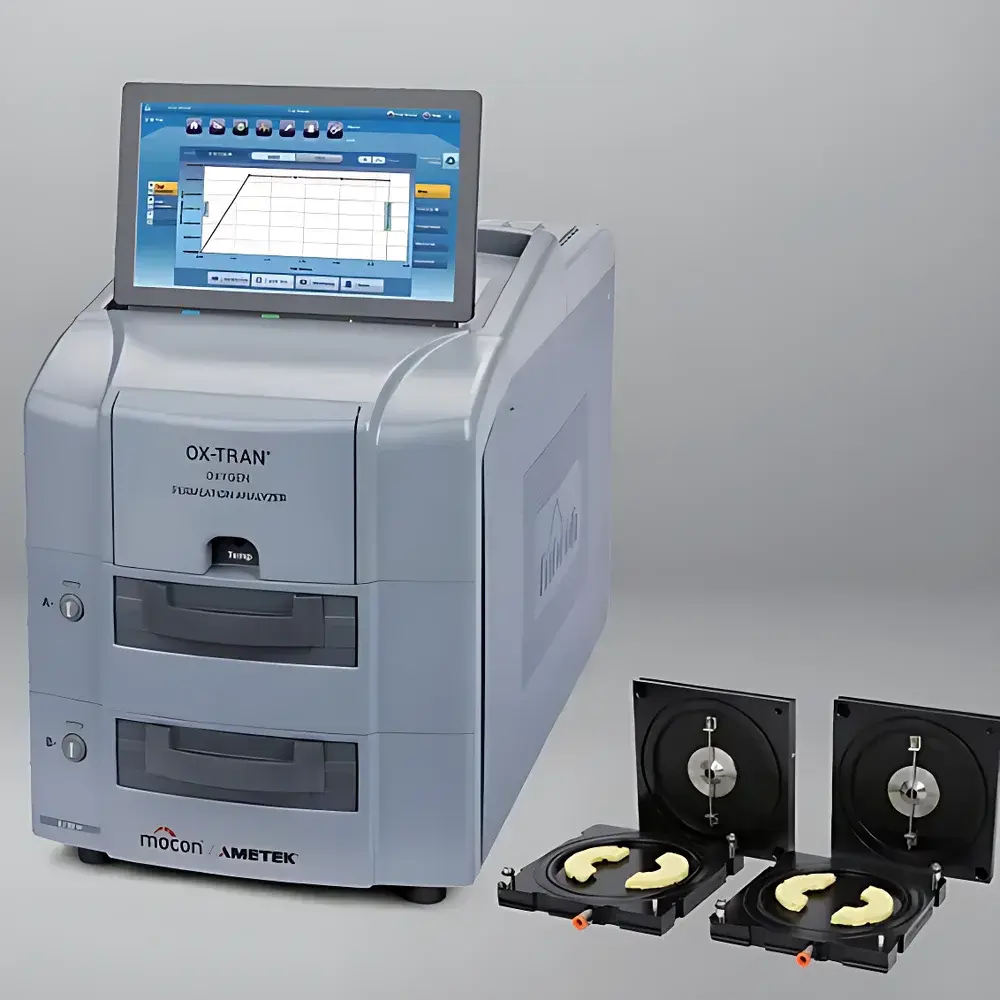
MOCON OX-TRAN® 2/22 H Coulometric Oxygen Permeation Analyzer for Contact Lens Material Dk Measurement
| Brand | MOCON |
|---|---|
| Origin | USA |
| Model | OX-TRAN® 2/22 H |
| Detection Principle | Coulometric Sensor (ASTM D3985) |
| Compliance | ASTM D3985, ISO 18369-4:2017, GB/T 11417.7–2012 |
| Sensor Type | Absolute, Zero-Calibration Coulometric Sensor |
| Measurement Range | Ultra-Low to High OTR (O₂) |
| Application Focus | Rigid Gas Permeable (RGP) & Soft Hydrogel/Silicone Hydrogel Contact Lens Materials |
Overview
The MOCON OX-TRAN® 2/22 H is a high-precision, dual-chamber coulometric oxygen permeation analyzer engineered specifically for the quantitative determination of oxygen transmissibility (Dk) in ophthalmic contact lens materials. It operates on the fundamental principle of coulometric detection—measuring the electrical current generated when oxygen molecules are electrochemically reduced at a cathode within a sealed sensor cell. This absolute measurement method, standardized under ASTM D3985, eliminates reliance on calibration gases or reference standards, delivering traceable, reproducible O₂ transmission rate (OTR) data with inherent accuracy. Designed for regulatory-grade testing environments, the instrument meets the stringent metrological requirements of ISO 18369-4:2017 (Annex A) and GB/T 11417.7–2012 (Section 4.3.4), making it the benchmark platform for Dk validation in Class II and III contact lens development, quality control, and regulatory submission dossiers.
Key Features
- Dual independent test chambers enable parallel analysis of two samples—critical for comparative studies, lot-to-lot verification, or accelerated aging protocols.
- Horizontal, modular test cell design supports rapid exchange of sample holders accommodating diverse geometries: flat disc specimens (e.g., lens blanks), curved lens-shaped inserts, and custom-machined polymer coupons up to 100 mm diameter.
- Proprietary MOCON coulometric sensor provides absolute O₂ flux measurement without periodic recalibration; certified lifetime exceeds 5 years under continuous operation with documented stability per ASTM D3985 Annex B.
- Integrated temperature and humidity control (±0.1 °C, ±0.5% RH) ensures strict adherence to ISO 18369-4 specified test conditions (35 °C / 95% RH for hydrogels; 35 °C / 100% RH for silicone hydrogels).
- Robust mechanical architecture with inert stainless-steel gas pathways and electropolished sensor housing minimizes background drift and cross-contamination risks during high-throughput lab workflows.
Sample Compatibility & Compliance
The OX-TRAN® 2/22 H is validated for use with all major contact lens material classes: conventional hydrogels (HEMA-based), silicone hydrogels (e.g., senofilcon A, comfilcon A), and rigid gas-permeable (RGP) polymers (e.g., fluorosilicone acrylates). Sample thickness range spans 0.05–2.0 mm, with automated thickness compensation applied during Dk calculation (Dk = OTR × thickness). Regulatory compliance extends beyond method standards: the system architecture supports audit-ready documentation required under FDA 21 CFR Part 11 (electronic records/signatures), GLP/GMP-aligned test execution logs, and full traceability of sensor performance history. All firmware and hardware revisions undergo formal change control per ISO 13485:2016 Annex C.
Software & Data Management
MOCON’s Permatran-W® v6.2 software provides fully compliant data acquisition, real-time OTR trending, and automated Dk reporting per ISO 18369-4 Annex A algorithms. Each test generates a timestamped, digitally signed PDF report containing raw coulometric current traces, environmental chamber logs, sensor health metrics, and uncertainty budgets derived from ISO/IEC 17025:2017 guidance. Audit trails record all user actions—including parameter edits, report exports, and sensor diagnostics—with immutable timestamps. Data export options include CSV (for LIMS integration), XML (for eCTD submissions), and encrypted SQLite databases compatible with enterprise data warehousing systems.
Applications
- Regulatory Dk validation for 510(k) and PMA submissions to FDA, Health Canada, and MDR-certified Notified Bodies.
- Material screening during polymer synthesis and formulation optimization for next-generation silicone hydrogels.
- Stability assessment of Dk values following accelerated aging (ISO 10993-12), sterilization (EO, gamma), and extractables/leachables exposure.
- Root cause analysis of batch failures—correlating OTR deviations with FTIR, DSC, or swelling ratio measurements.
- Reference method verification for alternative techniques (e.g., polarographic sensors, fluorescence quenching) in method transfer studies.
FAQ
Does the OX-TRAN® 2/22 H require daily calibration with certified O₂ standards?
No. Its coulometric sensor is an absolute measurement device compliant with ASTM D3985 Section 6.2; calibration is not required. Sensor verification is performed quarterly using a certified zero-gas challenge and documented per ISO/IEC 17025.
Can it measure Dk for toric or multifocal lens geometries?
Yes—provided the sample is mounted in a plano-convex fixture that ensures uniform seal integrity and controlled diffusion path length. Fixture design must be qualified per ISO 18369-4 Annex B.2.
Is the system compatible with laboratory information management systems (LIMS)?
Yes. Permatran-W® supports ASTM E1467-compliant HL7 and ASTM E2500-07 data exchange protocols for seamless integration with major LIMS platforms including LabWare, STARLIMS, and Thermo Fisher SampleManager.
What maintenance is required for long-term sensor stability?
Annual sensor electrolyte replacement and electrode polishing per MOCON Service Bulletin SB-OTR-22H-003; no user-serviceable optical or electronic components exist within the sensor module.
How is measurement uncertainty quantified for Dk reports?
Uncertainty budgets follow GUM (JCGM 100:2008) methodology, incorporating contributions from OTR repeatability (k=2, ≤1.8%), thickness measurement (micrometer traceable to NIST SRM 2191), temperature/humidity control, and sensor linearity (certified ±0.3% of reading).






