
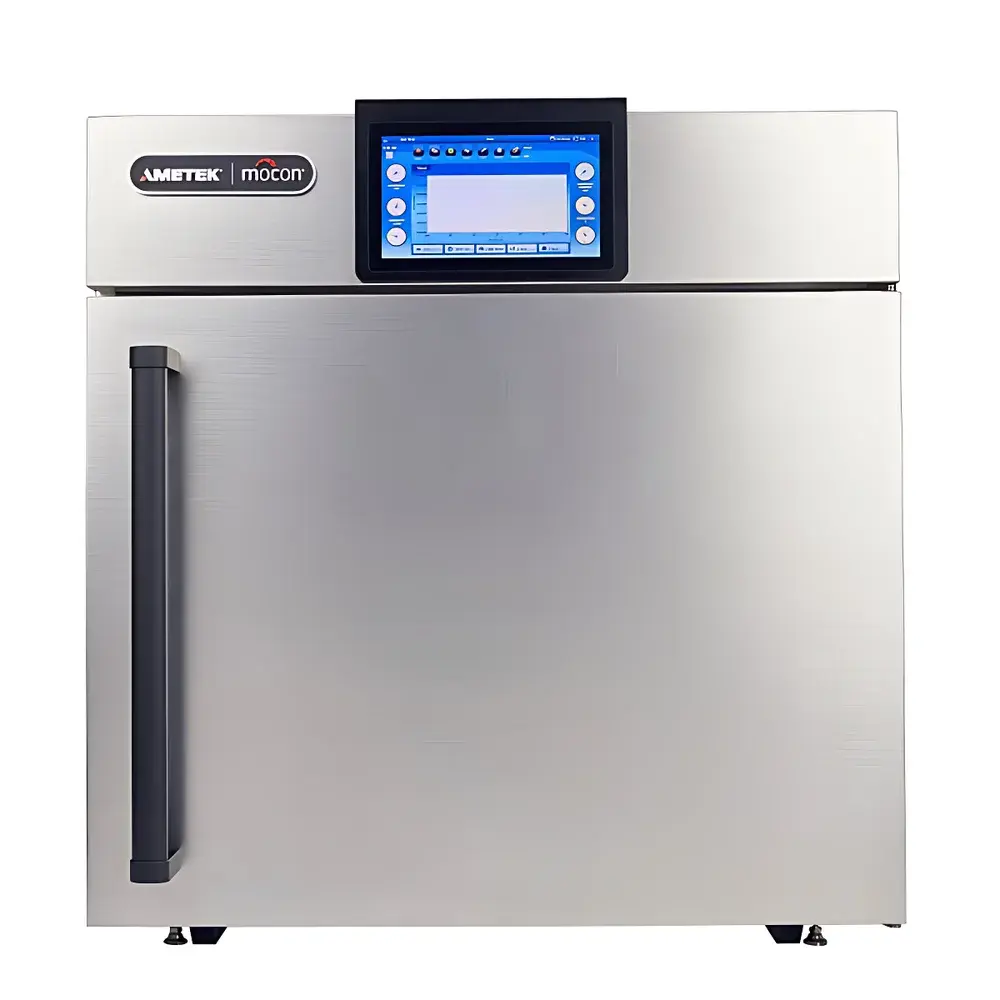
MOCON OX-TRAN® 2/40 Whole-Pack Oxygen Transmission Rate (OTR) Analyzer
| Brand | MOCON |
|---|---|
| Origin | USA |
| Model | OX-TRAN® 2/40 |
| Test Principle | Coulometric Oxygen Detection |
| Sample Type | Whole Packages & Films |
| Standards Compliance | ASTM D3985, ASTM F1927, ISO 15105-2, JIS K-7126, ASTM F1307, GB/T 31354-2014 |
| Temperature Range | 10–50 °C (±0.2 °C) |
| Humidity Range | 5–90 %RH (±4 %RH) |
| OTR Range (Containers, Air) | 0.00025–1.0 cc/pkg·day |
| Resolution (Containers) | 0.0001 cc/pkg·day |
| Repeatability | ±0.0001 cc/pkg·day |
| Test Duration | 30–60 min |
| Sensor Type | Absolute Coulometric Oxygen Sensor (Faraday-based, calibration-free) |
Overview
The MOCON OX-TRAN® 2/40 is a precision-engineered whole-package oxygen transmission rate (OTR) analyzer designed for quantitative permeation measurement of rigid and semi-rigid packaging—such as thermoformed trays, bottles, cups, caps, closures, and blister packs—under rigorously controlled temperature and relative humidity conditions. Unlike conventional film-only OTR systems, the OX-TRAN® 2/40 employs a sealed test chamber with integrated pneumatic sample clamping and nitrogen purge ring technology to eliminate ambient oxygen ingress at the chamber periphery. This architecture ensures stable baseline integrity and eliminates environmental interference during extended-duration measurements. At its core, the system utilizes MOCON’s proprietary coulometric oxygen sensor—a Faraday-law-based absolute detector that quantifies oxygen molecules via electrochemical reduction current. Because the sensor output is directly proportional to the number of oxygen molecules consumed (in accordance with Faraday’s first law of electrolysis), it requires no periodic calibration or reference gas standards, delivering intrinsic metrological traceability and long-term stability across regulatory environments.
Key Features
- Pneumatically actuated, tool-free sample mounting system enabling rapid installation and removal of diverse package geometries—including irregularly shaped containers and oversized thermoformed trays
- Nitrogen curtain purge design actively sweeps chamber edges to suppress ambient O2 diffusion, reducing background noise and shortening equilibration time
- Integrated environmental control module maintains temperature (10–50 °C ±0.2 °C) and relative humidity (5–90 %RH ±4 %RH) independently and simultaneously across multiple test cycles
- Multi-condition automated sequencing: users define up to 16 distinct T/RH setpoints for unattended, sequential testing—maximizing instrument utilization and minimizing operator intervention
- Touchscreen HMI with intuitive workflow navigation, real-time OTR trend visualization, and on-screen pass/fail flagging against user-defined specification limits
- Four independent test stations support concurrent evaluation of up to four whole packages—ideal for comparative shelf-life studies or batch qualification protocols
Sample Compatibility & Compliance
The OX-TRAN® 2/40 accommodates a broad spectrum of commercial packaging formats without requiring destructive sample preparation. Compatible specimens include PET, HDPE, PP, and aluminum-laminated containers; screw-capped bottles with elastomeric liners; vacuum-sealed trays with peelable lidding films; cork-stoppered glass vials; and molded plastic cups with heat-sealed foil membranes. The system fully supports compliance-driven quality assurance workflows: all hardware, firmware, and data handling functions are engineered to meet the documentation and audit requirements of FDA 21 CFR Part 11 (electronic records/signatures), ISO/IEC 17025 (testing laboratory competence), and GMP/GLP environments. Test reports include full metadata—timestamped environmental logs, sensor diagnostics, raw coulometric current traces, and statistical summaries—enabling full traceability from measurement to final certificate.
Software & Data Management
TruTest™ software provides comprehensive instrument control, method configuration, and data governance. Each test generates an encrypted, timestamped data file (.trutest) containing raw sensor output, environmental profiles, calculated OTR values (cc/pkg·day), and uncertainty estimates per ISO/IEC Guide 98-3 (GUM). Audit trail functionality records all user actions—including parameter edits, report exports, and login/logout events—with immutable timestamps and operator ID attribution. Export options include CSV, PDF (with digital signature capability), and XML formats compatible with LIMS integration. Software validation packages—including IQ/OQ documentation templates and protocol-ready test scripts—are available to support regulated site deployments.
Applications
- Accelerated shelf-life prediction for pharmaceutical primary packaging (e.g., blister cards, HDPE bottles, desiccant-containing vials)
- Validation of barrier performance in food packaging subjected to modified atmosphere (MAP) or vacuum conditions
- Comparative evaluation of closure integrity across different liner materials (EPDM, silicone, foil-composite) under variable humidity stress
- Regulatory submission support for FDA IND/NDA filings requiring container closure integrity (CCI) evidence per USP and
- Root cause analysis of premature oxidation in nutraceutical softgels or lipid-rich functional beverages
- Supplier qualification of custom-molded packaging components where geometry-dependent seal integrity must be verified
FAQ
Does the OX-TRAN® 2/40 require daily calibration?
No. Its coulometric oxygen sensor operates on Faraday’s law of electrolysis and delivers absolute, calibration-free quantification of molecular oxygen flux.
Can it test both flexible pouches and rigid containers in the same run?
Yes—provided samples fit within the defined chamber envelope and sealing interface specifications; however, mixing film and whole-package modes requires separate method configurations.
Is humidity control active during the entire test cycle, including equilibration?
Yes. RH and temperature are continuously regulated throughout preconditioning, stabilization, and measurement phases.
How is data integrity ensured for FDA-regulated submissions?
Through 21 CFR Part 11–compliant electronic signatures, role-based access control, permanent audit trails, and cryptographic file hashing embedded in every exported report.
What maintenance is required for the coulometric sensor?
The sensor has no consumables and requires only periodic verification using certified zero-air and span-gas challenges—typically performed annually or per internal SOPs.
Related Products






