
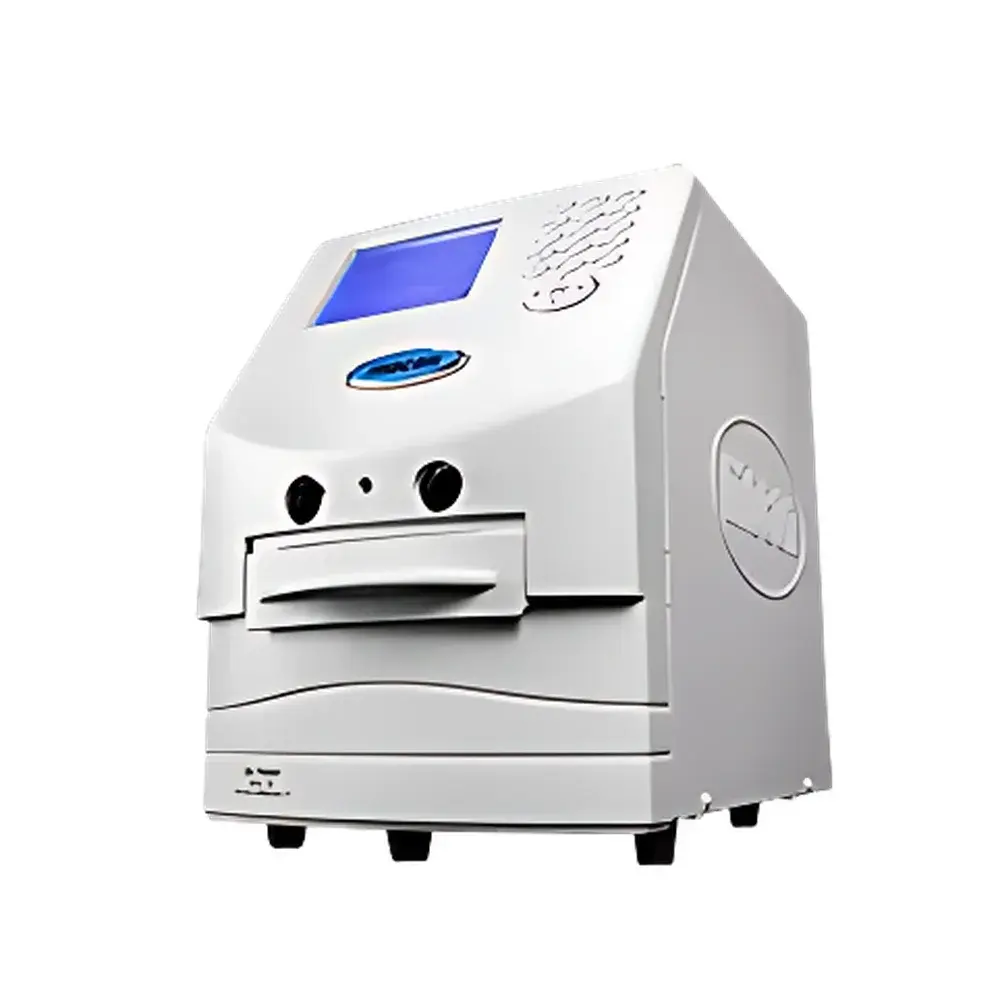
Mocon PERMATRAN-W® 1/50 Water Vapor Transmission Rate (WVTR) Tester
| Brand | Mocon |
|---|---|
| Origin | USA |
| Model | PERMATRAN-W® 1/50 |
| Test Range | 0.1–100 cm³/m²·day |
| Temperature Range | 5–50 °C (W-type configuration) |
| Humidity Range | 35–90 %RH (standard), up to 100 %RH (W-type) |
| Test Area | 2 chambers × 50 cm² |
| Repeatability | ±0.05 g/m²·day or ±3 % of reading (whichever is greater) |
| RH Sensor Accuracy | ±3 %RH |
| Carrier Gas | Dry nitrogen or oil-free compressed air |
| Compliance | ASTM E398, ISO 15106-1, GB/T 30412–2013 |
Overview
The Mocon PERMATRAN-W® 1/50 is a gravimetrically referenced, dynamic humidity-modulated water vapor transmission rate (WVTR) tester engineered for precise and repeatable measurement of moisture barrier performance in flat, flexible packaging materials. Unlike static cup-based methods, it employs a controlled cyclic humidity modulation technique—alternating between low- and high-relative-humidity states within a sealed accumulation chamber—to quantify the time-dependent permeation kinetics of water vapor through film or laminate specimens. The instrument operates on the principle of transient humidity response analysis: as water vapor permeates across the test sample separating the dry carrier gas stream from the accumulation chamber, the resulting rise in relative humidity is monitored in real time using high-stability capacitive sensors. The elapsed time between defined RH thresholds is used to calculate the steady-state WVTR value, ensuring traceability to fundamental thermodynamic and mass transport principles.
Key Features
- Self-contained operation with integrated microprocessor control—no external PC required for routine testing
- Large backlit LCD display showing real-time humidity curves, temperature status, valve actuation events, and test progress indicators
- Onboard storage for up to 99 user-defined test protocols, including custom temperature/humidity setpoints, cycle timing, and pass/fail criteria
- Automatic dual-loop environmental control: PID-regulated heating for temperature stability (±0.3 °C), and precision solenoid-valve-driven dry gas purging for RH modulation (±3 %RH accuracy)
- Redundant safety interlocks: automatic shutdown triggered by out-of-spec temperature excursion, overpressure/underpressure in test chambers, or sensor signal loss
- Factory-calibrated with NIST-traceable standard membranes; field recalibration supported using certified reference films per ASTM E398 Annex A1
- Two independent 50 cm² test cells enable parallel evaluation of replicate samples or comparative testing under identical environmental conditions
Sample Compatibility & Compliance
The PERMATRAN-W® 1/50 accommodates rigid and flexible planar specimens up to 0.5 mm thickness, including coated papers, metallized PET, aluminum-laminated foils, ethylene-vinyl alcohol (EVOH) coextrusions, and biodegradable polymer films. Sealing is achieved via pneumatic clamping against elastomeric gaskets, minimizing edge leakage and ensuring uniform stress distribution across the active test area. All operational parameters—including ramp rates, dwell times, and RH transition thresholds—are programmable to align with material-specific conditioning requirements. The system fully complies with ASTM E398 (Standard Test Method for Water Vapor Transmission of Sheet Materials Using Dynamic Relative Humidity Measurement), ISO 15106-1 (Plastics — Film and sheeting — Determination of water vapour transmission rate — Part 1: Electrolytic detection sensor method), and China’s GB/T 30412–2013 (Determination of water vapour transmission rate for packaging materials — Gravimetric method). Data integrity meets GLP audit requirements, with timestamped event logs, operator ID fields, and immutable test records stored in non-volatile memory.
Software & Data Management
Although designed for standalone use, the PERMATRAN-W® 1/50 supports optional USB data export in CSV format for post-test analysis in Excel or LIMS environments. Each test record includes full metadata: date/time stamp, operator ID, sample ID, chamber assignment, environmental setpoints, raw RH vs. time arrays, calculated WVTR, repeatability metrics, and calibration verification flags. No proprietary software installation is required—data files are human-readable and compatible with common statistical process control (SPC) platforms. For regulated environments, the instrument’s firmware architecture supports 21 CFR Part 11–compliant electronic signatures when paired with validated third-party data management systems.
Applications
This system serves quality assurance laboratories in food, pharmaceutical, medical device, and consumer electronics packaging sectors where moisture sensitivity dictates shelf life and product integrity. Typical use cases include incoming inspection of barrier laminates, formulation screening of new polymer blends, accelerated aging correlation studies, and validation of sterilization pouch integrity. Its robustness and minimal maintenance make it suitable for production-floor deployment in ISO 9001-certified facilities, while its compliance with international standards ensures data acceptance across global supply chains.
FAQ
What carrier gas is required for operation?
Dry nitrogen (dew point ≤ –40 °C) or oil-free compressed air meeting ISO 8573-1 Class 2 purity specifications.
Can the instrument measure at 100 % RH on both sides of the sample?
Yes—the W-type configuration supports saturated humidification of the upstream chamber while maintaining controlled RH modulation downstream.
Is calibration traceable to NIST standards?
Yes—factory calibration uses Mocon-certified reference membranes with NIST-traceable WVTR values; users may perform periodic verification using supplied calibration kits.
How is test repeatability verified?
Per ASTM E398 Section 10, repeatability is assessed via triplicate measurements on identical specimens under identical conditions; reported uncertainty reflects the greater of ±0.05 g/m²·day or ±3 % of mean value.
Does the system support GLP-compliant audit trails?
Yes—internal memory retains all operator actions, parameter changes, and alarm events with UTC timestamps; exported CSV files preserve full chain-of-custody metadata.





