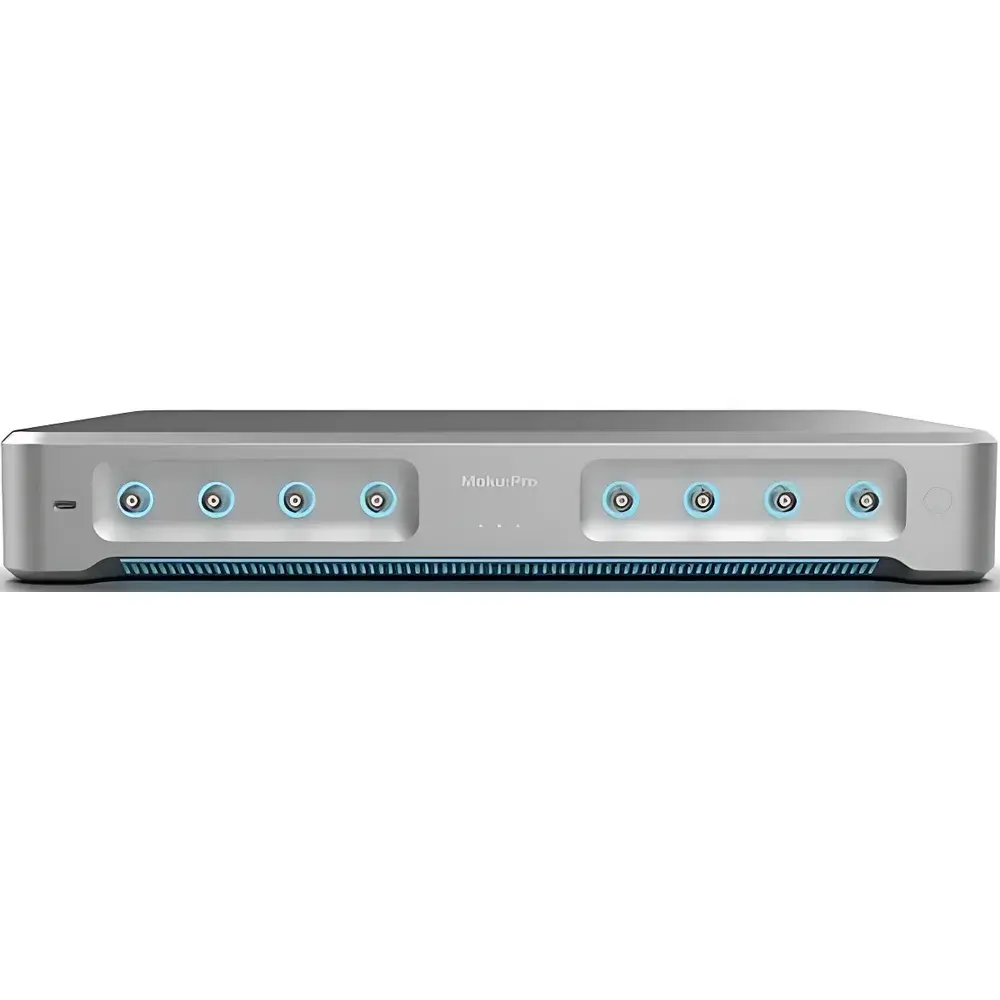
Moku:Pro Lock-in Amplifier
| Brand | auniontech |
|---|---|
| Origin | Australia |
| Manufacturer Type | Authorized Distributor |
| Origin Category | Imported |
| Model | Moku:Pro |
| Price Range | USD $18,500 – $24,500 (FOB) |
Overview
The Moku:Pro Lock-in Amplifier is a high-performance, FPGA-based, software-defined instrumentation platform engineered for precision signal recovery in demanding research and industrial measurement environments. Unlike analog lock-in amplifiers, the Moku:Pro implements digital lock-in detection using real-time, high-resolution digital signal processing (DSP) with fully programmable filter bandwidths, phase-locked loop (PLL) tracking, and dual-phase demodulation (X/Y and R/θ). Its core architecture supports operation from 1 mHz to 600 MHz — covering ultra-low-frequency metrology (e.g., cryogenic sensor readout) through RF characterization (e.g., microwave cavity probing). The instrument’s 120+ dB dynamic reserve enables reliable extraction of nanovolt-level signals buried beneath broadband noise, making it suitable for applications requiring high signal-to-noise ratio (SNR), long integration times, and deterministic latency control.
Key Features
- Dual-phase digital lock-in detection with configurable demodulation bandwidths (1 µHz to 10 MHz), supporting both internal reference generation and external reference synchronization.
- Integrated 4-channel oscilloscope with 1.25 GSa/s sampling rate, 12-bit vertical resolution, and hardware-accelerated triggering — synchronized with lock-in output for real-time validation.
- Built-in data logger capable of continuous acquisition at up to 1 MSa/s with on-device storage and time-stamped metadata export (CSV, HDF5).
- Graphical DSP block diagram interface: users construct custom signal paths via drag-and-drop modules (filters, mixers, integrators, PID controllers) without coding.
- Embedded PID controller with programmable gains (P/I/D), anti-windup protection, and setpoint ramping — deployable directly in the demodulated signal path for closed-loop stabilization (e.g., laser frequency locking, AFM feedback).
- Multi-function coexistence: all nine instruments (lock-in amplifier, arbitrary waveform generator, spectrum analyzer, oscilloscope, data logger, phase meter, PID controller, frequency response analyzer, and wave shaper) operate simultaneously with deterministic inter-module timing.
Sample Compatibility & Compliance
The Moku:Pro accepts differential or single-ended inputs (±10 V full-scale, 50 Ω/1 MΩ selectable), supports TTL, LVDS, and sine-wave external references, and features galvanically isolated auxiliary outputs for driving actuators or modulators. It complies with IEC 61000-6-3 (EMI emission) and IEC 61000-6-2 (immunity) standards. Its firmware architecture supports audit-ready operation under GLP and GMP frameworks: all instrument configurations, calibration logs, and user session metadata are timestamped and exportable. While not FDA-certified as a medical device, its deterministic timing, traceable calibration chain, and reproducible DSP pipeline meet requirements for ISO/IEC 17025-accredited laboratories performing physical property measurements.
Software & Data Management
Control and configuration are performed via the cross-platform Moku:Lab application (Windows/macOS/Linux), which provides live visualization, scriptable automation (Python API), and remote access over Ethernet or USB-C. All acquired datasets include embedded metadata: sample rate, filter settings, reference phase, and hardware timestamps aligned to UTC via PTPv2 (IEEE 1588) when synchronized to a network time server. Export formats include IEEE-compliant CSV, HDF5 (with attribute-rich metadata), and MATLAB .mat. The system supports 21 CFR Part 11–compliant workflows when deployed with third-party electronic lab notebook (ELN) integration — including user authentication, electronic signatures, and immutable audit trails for configuration changes and data exports.
Applications
- Quantum sensing: spin resonance detection (NV centers, SQUIDs), superconducting qubit readout, and low-temperature transport measurements.
- Nanoscale imaging: lock-in amplified scanning probe microscopy (SPM), photothermal spectroscopy, and pump-probe reflectometry.
- Optical metrology: interferometric displacement sensing, cavity ring-down spectroscopy, and Pound–Drever–Hall laser frequency stabilization.
- Materials characterization: impedance spectroscopy (with optional impedance analyzer firmware), thermoelectric coefficient mapping, and piezoelectric response analysis.
- Industrial control: real-time vibration monitoring in rotating machinery, adaptive optical alignment systems, and closed-loop thermal management in semiconductor fabrication tools.
FAQ
What is the maximum demodulation frequency supported by the Moku:Pro lock-in amplifier?
The Moku:Pro supports demodulation frequencies from 1 mHz up to 600 MHz, with optimal SNR performance maintained across the full range using adaptive digital filtering and oversampling techniques.
Can the PID controller be cascaded with the lock-in output for real-time feedback?
Yes — the PID module accepts the X, Y, R, or θ output directly as input; its output can drive analog outputs or be routed internally to modulate waveform generator parameters, enabling fully embedded feedback loops without external hardware.
Is firmware update capability available remotely?
Firmware updates are delivered via the Moku:Lab application and require manual user initiation; all versions are digitally signed and validated before installation to ensure integrity and traceability.
Does the Moku:Pro support trigger synchronization across multiple instruments?
Yes — using the dedicated SYNC port and PPS/TTL trigger inputs/outputs, multiple Moku units can be phase-aligned with sub-nanosecond jitter for distributed measurement systems.
How is calibration traceability maintained?
Each unit ships with a NIST-traceable calibration certificate covering DC gain, frequency response, and noise floor; recalibration services are available through authorized service centers with documented uncertainty budgets per ISO/IEC 17025.