
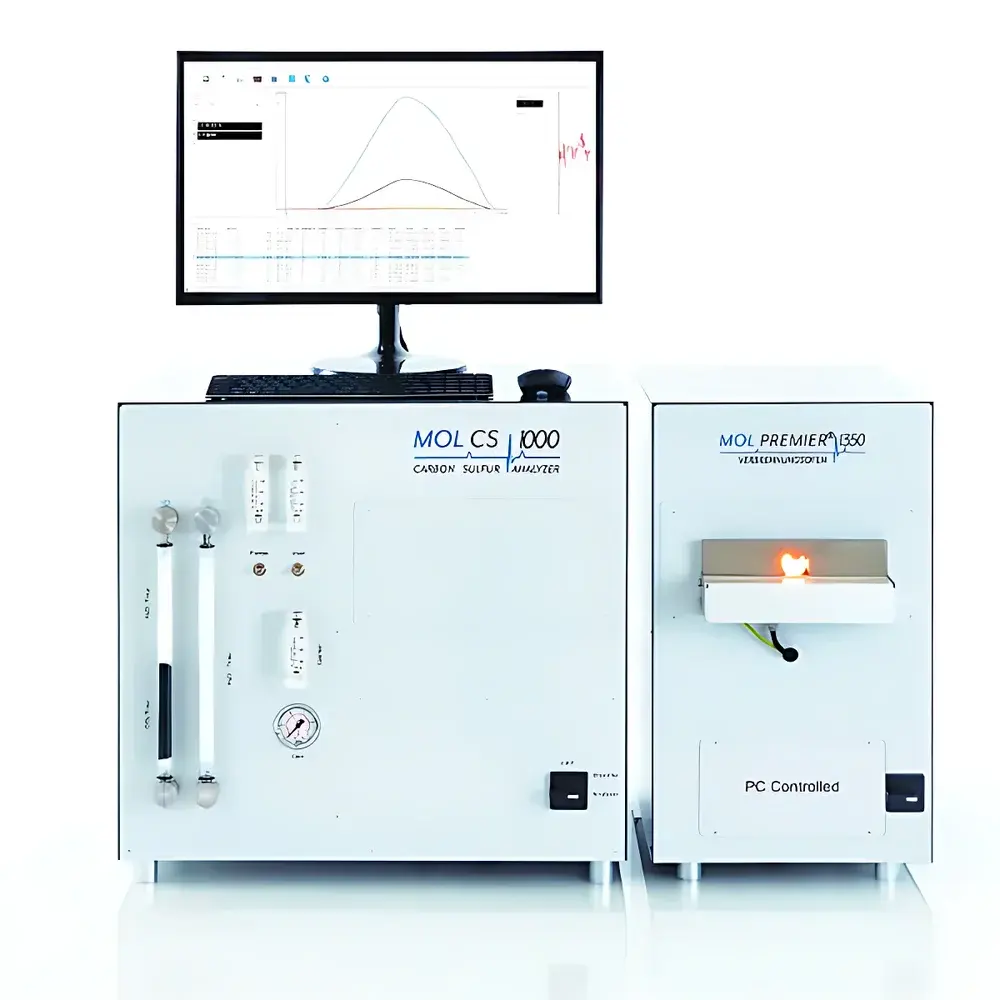
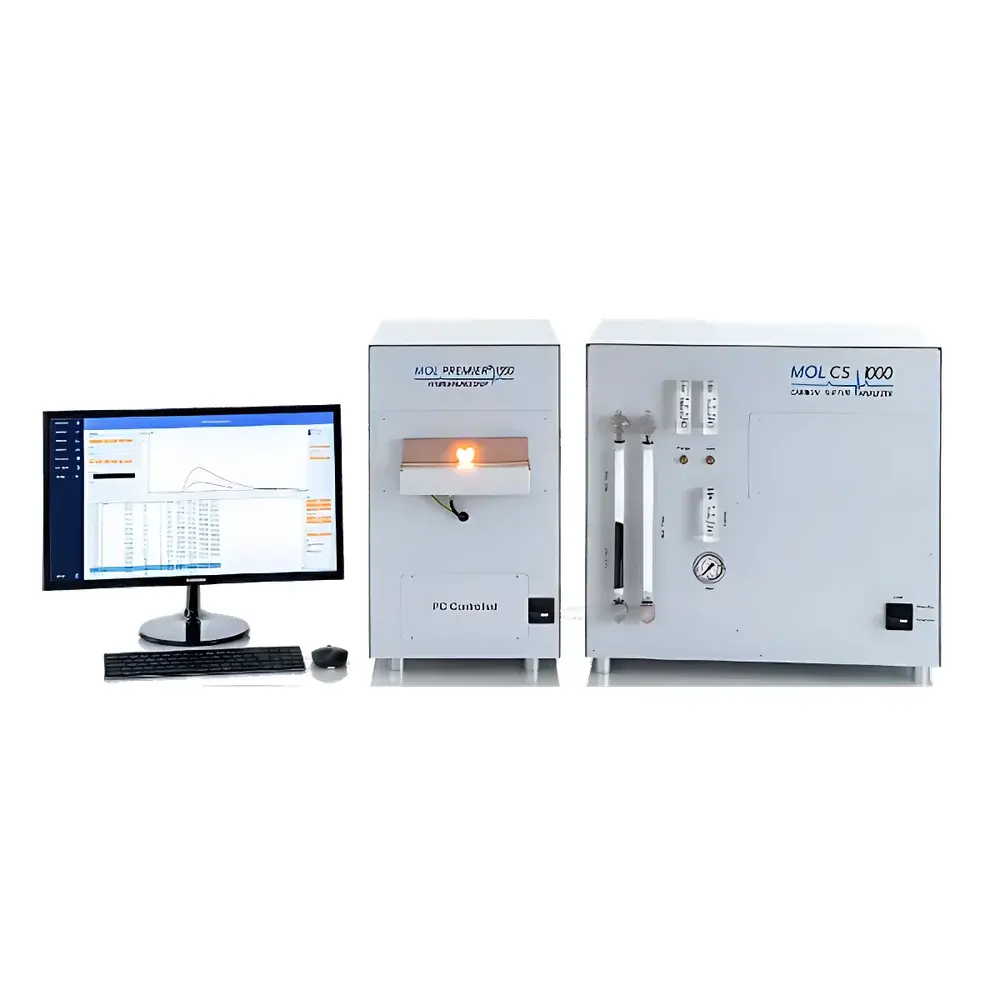
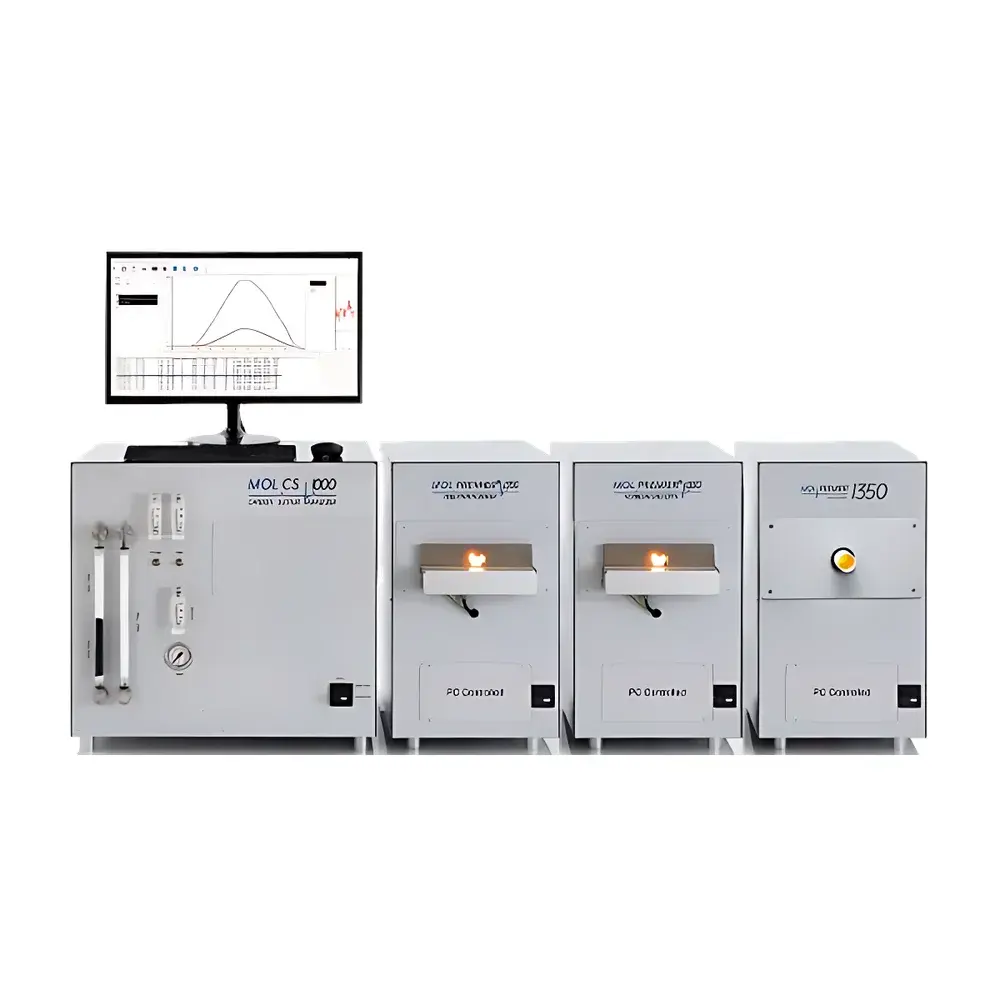
MOL CS1000 Carbon-Sulfur Analyzer
| Brand | MOL |
|---|---|
| Origin | Germany |
| Model | CS1000 |
| Measurement Principle | Non-Dispersive Infrared (NDIR) Absorption |
| Heating System | Resistance Furnace |
| Carbon Range | 0.005–100 wt% |
| Sulfur Range | 0.005–20 wt% |
| Sensitivity | 0.01 ppm |
| Accuracy | ±1% of reading |
| Analysis Time | 60–120 s |
| Furnace Power Output | 1 kW |
| Maximum Furnace Temperature | 1550 °C |
| Detector Configuration | Up to 4-channel NDIR cells |
| Compliance | ASTM E1019, ISO 15350, ISO 4935 |
Overview
The MOL CS1000 Carbon-Sulfur Analyzer is a high-performance, dual-element combustion-based elemental analyzer engineered for precise and reproducible quantification of total carbon (C) and total sulfur (S) in solid inorganic and organic matrices. It operates on the principle of high-temperature combustion followed by non-dispersive infrared (NDIR) detection—a method standardized under ASTM E1019, ISO 15350, and ISO 4935 for metallurgical, geological, and energy-sector applications. Solid samples—ranging from coal and coke to ores, ceramics, and polymer-filled composites—are combusted quantitatively in a pure oxygen atmosphere at up to 1550 °C within a robust resistance furnace. The evolved CO₂ and SO₂ gases are carried through a series of chemical scrubbers (including anhydrous magnesium perchlorate for H₂O removal and copper oxide for residual CO oxidation), then directed into dedicated NDIR cells optimized for each gas’s characteristic absorption bands near 4.26 µm (CO₂) and 7.35 µm (SO₂). This optical architecture ensures minimal spectral interference and long-term baseline stability without moving parts.
Key Features
- Modular 4-channel NDIR detection system—configurable with individual calibration paths for CO₂, SO₂, and optional reference or background channels to support multi-matrix workflows and low-level trace analysis.
- High-stability resistance furnace with programmable thermal profiles: rapid ramp (≤60 s to 1550 °C), multi-step heating sequences, and pre-heat mode compliant with ASTM E1019 Annex A3 for ultra-low-carbon (<0.01 wt%) sample analysis.
- Pulse-modulated infrared source—solid-state emitter with no mechanical chopper or moving optics—eliminates drift associated with aging components and ensures >20,000-hour operational lifetime.
- Low-power, high-efficiency furnace design (1 kW nominal draw) featuring ceramic insulation and thermocouple-controlled feedback loop for ±2 °C temperature uniformity across the crucible zone.
- Integrated gas purification train with automated moisture and halogen removal; includes dual-stage desiccant cartridges and catalytic SO₃-to-SO₂ converter for stoichiometric sulfur recovery.
- Self-diagnostic firmware with real-time gas flow monitoring, pressure stabilization alerts, and detector signal-to-noise validation prior to result acceptance.
Sample Compatibility & Compliance
The CS1000 accommodates a broad spectrum of solid, non-volatile samples—including metallurgical alloys, coal and coke, cement clinker, refractory materials, soil/sediment digests, and catalyst supports—within standard 1–1.5 g mass ranges. Sample introduction uses ceramic or graphite crucibles compatible with both inert and oxidative combustion environments. All analytical protocols adhere to GLP-compliant data integrity requirements: audit trails record operator ID, method version, calibration history, and raw detector voltage outputs. Full 21 CFR Part 11 compliance is supported via optional software module, enabling electronic signatures, role-based access control, and immutable result archiving. Method validation documentation aligns with ISO/IEC 17025 for accredited testing laboratories.
Software & Data Management
The CS1000 is operated via MOL AnalyzeSuite™ v4.2—a Windows-based platform supporting method creation, sequence scheduling, and real-time spectral visualization. Each analysis generates a timestamped .csv and .xml dataset containing peak area integrals, baseline-corrected absorbance ratios, and calculated C/S mass percentages with propagated uncertainty estimates. Data export supports LIMS integration via ASTM E1382-compliant ASCII formats. Calibration curves are stored with polynomial coefficients, weighting factors, and residual error plots. Software modules include automatic blank subtraction, drift correction using internal reference gas pulses, and outlier rejection based on ICH Q2(R2)-recommended robust statistical criteria.
Applications
- Quality control of carbon steel, stainless alloys, and ferroalloys in foundry and metal production.
- Specification testing of coal and petroleum coke per ASTM D3176 and ISO 625 standards.
- Environmental monitoring of sulfur content in fly ash, slag, and contaminated soils for regulatory reporting (EPA Method 505).
- R&D analysis of battery electrode materials (e.g., silicon-carbon anodes) where sub-0.1 wt% carbon quantification impacts cycle life prediction.
- Geochemical characterization of carbonate minerals and sulfide-rich ore concentrates in exploration laboratories.
FAQ
What sample types require pre-oxidation or flux addition before analysis?
Samples with refractory carbides (e.g., TiC, SiC) or sulfides with low oxidation kinetics (e.g., PbS, ZnS) benefit from tungsten or tin flux addition to ensure complete liberation of CO₂ and SO₂ during combustion.
Can the CS1000 measure carbon and sulfur in liquid or powder suspensions?
No—the instrument is designed exclusively for solid, dry, and homogeneous samples. Liquids must be dried and homogenized into pellet form; volatile organics require prior ashing in a muffle furnace.
How often must the NDIR cells be recalibrated?
Factory-calibrated cells retain accuracy for ≥12 months under routine use; annual verification with certified reference materials (CRMs) such as NIST SRM 2782 (steel) or BCS CRM 388/1 (coal) is recommended.
Is oxygen purity critical for accurate sulfur recovery?
Yes—oxygen grade ≥99.995% (with <0.1 ppm hydrocarbons and <0.5 ppm moisture) is mandatory to prevent SO₃ formation and ensure stoichiometric SO₂ yield.
Does the system support remote diagnostics or predictive maintenance alerts?
Yes—via optional Ethernet-enabled service port, firmware logs operating hours, detector signal decay rates, and furnace coil resistance trends to flag component degradation 72+ hours before performance deviation exceeds specification limits.
Related Products





