
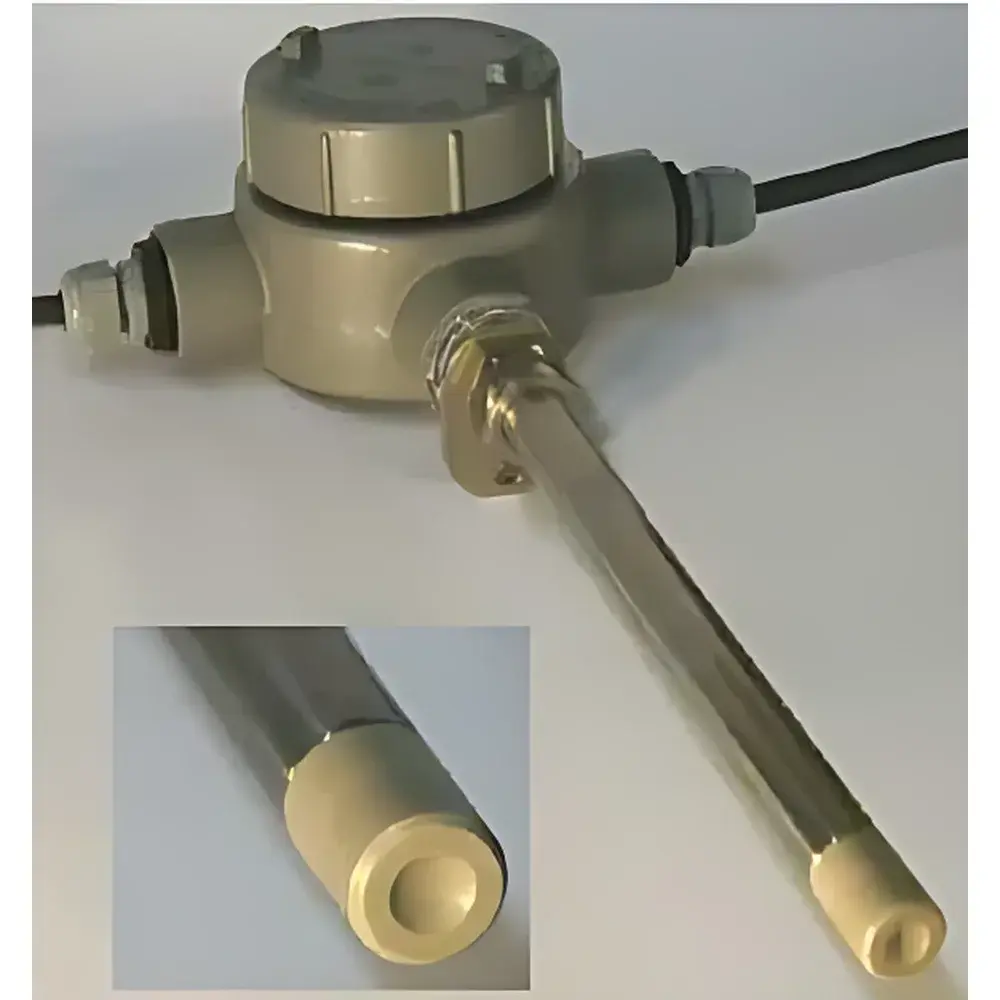
Monitek AS3 Ultrasonic Reflectance Oil-in-Water Analyzer
| Origin | Imported |
|---|---|
| Manufacturer Type | Authorized Distributor |
| Model | AS3 |
| Pricing | Available Upon Request |
Overview
The Monitek AS3 Ultrasonic Reflectance Oil-in-Water Analyzer is a robust, process-integrated analytical instrument engineered for continuous, real-time quantification of hydrocarbon contamination in aqueous streams. It operates on the principle of ultrasonic pulse-echo reflectometry: high-frequency acoustic waves (typically in the 1–10 MHz range) are transmitted into the liquid medium via a piezoelectric transducer embedded in the probe tip; the amplitude and time-of-flight of the reflected signal at the oil–water interface are analyzed to determine dispersed oil concentration. Unlike optical methods (e.g., infrared or fluorescence), this technique is inherently insensitive to color, turbidity, suspended solids, or surface fouling—making it uniquely suited for harsh, unfiltered industrial effluents and condensate return lines where traditional analyzers fail. The system comprises the AS3 sensor probe and the AT3 transmitter unit, which performs digital signal processing, temperature compensation, and linearization against user-defined calibration curves.
Key Features
- Ultrasonic reflectance measurement principle—immune to optical interference from color, dye, or particulate matter
- True non-invasive, in-line operation with zero sample extraction or reagent consumption
- Self-cleaning effect generated by ultrasonic pulsing—minimizes biofilm and deposit accumulation on the PEEK lens surface
- Modular probe design enables hot-tap insertion/removal under process pressure up to 5 bar (PN 40 / ANSI Class 300) using standard 1″ ball valve adapters
- Extended calibration interval—typical recalibration required only once every 24 hours under stable operating conditions
- Wide dynamic range: configurable for 0–10 ppm (low-range condensate monitoring) or 0–10,000 ppm (emulsion-rich wastewater streams)
- IP65 / NEMA 4X enclosure rating; optional ATEX Zone 1 or Zone 2 certification available for hazardous area deployment
- Probe body constructed from ASTM A276 UNS S31603 (1.4401 / 316 stainless steel) or custom alloys (e.g., super duplex 1.4462); lens material: medical-grade PEEK (polyetheretherketone)
Sample Compatibility & Compliance
The AS3 analyzer is validated for use across diverse aqueous matrices including boiler feedwater, turbine condensate, cooling tower blowdown, refinery wastewater, pulp & paper mill effluent, and municipal secondary treatment outfalls. It tolerates temperatures up to 110 °C and accommodates flow velocities typical of pressurized piping (DN ≤ 50 mm / 2″). No chemical conditioning, filtration, or dilution is required. The system supports compliance with ISO 9001, ISO 14001, and ISO/IEC 17025 quality management frameworks. While not a certified reference method per se, its performance aligns with ASTM D7827 (Standard Guide for Monitoring Hydrocarbon Contamination in Water Using Ultrasonic Techniques) and serves as a qualified surrogate for EPA Method 1664A in continuous process control applications. Data integrity meets GLP/GMP requirements when paired with AT3 firmware supporting audit trail logging and user-access controls.
Software & Data Management
The AT3 transmitter integrates a dual-channel 4–20 mA analog output (for primary oil concentration and auxiliary temperature), Modbus RTU/ASCII over RS-485, and optional Ethernet/IP or PROFIBUS DP interfaces. Configuration and diagnostics are performed via the Monitek ConfigTool—a Windows-based PC application enabling multi-point span calibration, unit conversion (ppm, % v/v, EBC, mg/L), alarm threshold setting, and trend logging. All calibration events, parameter changes, and fault logs are timestamped and stored locally with retention ≥30 days. When deployed in regulated environments, the AT3 firmware complies with FDA 21 CFR Part 11 requirements for electronic records and signatures—supporting role-based access, electronic signatures, and immutable audit trails.
Applications
- Steam condensate purity monitoring in thermal power plants and industrial steam systems
- Oil–water separation efficiency verification in API separators and dissolved air flotation (DAF) units
- Real-time detection of hydrocarbon breakthrough in activated carbon or coalescer filter trains
- Process water recycling control in petrochemical and refining facilities
- Effluent compliance monitoring prior to discharge in chemical manufacturing and pulp & paper mills
- Leak detection in heat exchanger bundles and jacketed vessel cooling circuits
FAQ
Does the AS3 require periodic cleaning or lens wiping?
No—ultrasonic pulsing induces micro-vibrations at the PEEK lens surface, providing passive self-cleaning. Manual intervention is only necessary during scheduled maintenance or if mechanical abrasion occurs.
Can the AS3 measure oil-in-water and water-in-oil emulsions simultaneously?
It is optimized for oil-in-water (O/W) dispersions. For water-in-oil (W/O) systems, signal attenuation limits sensitivity; alternative instrumentation (e.g., dielectric or NIR) is recommended.
What is the minimum detectable oil concentration?
Detection limit depends on calibration and matrix: typically ≤0.5 ppm for light hydrocarbons (e.g., diesel, kerosene) in clean condensate; ~2–5 ppm in turbid or high-salinity wastewater.
Is third-party validation data available?
Yes—Monitek provides application-specific validation reports aligned with ISO/IEC 17025-accredited laboratories, including repeatability (±1% FS), linearity (R² > 0.999), and long-term drift (<0.3% per month).
How is temperature compensation implemented?
An integrated Pt100 RTD within the probe body feeds real-time temperature data to the AT3 processor, which applies empirically derived correction coefficients to the acoustic velocity and reflection coefficient models.
Related Products







