
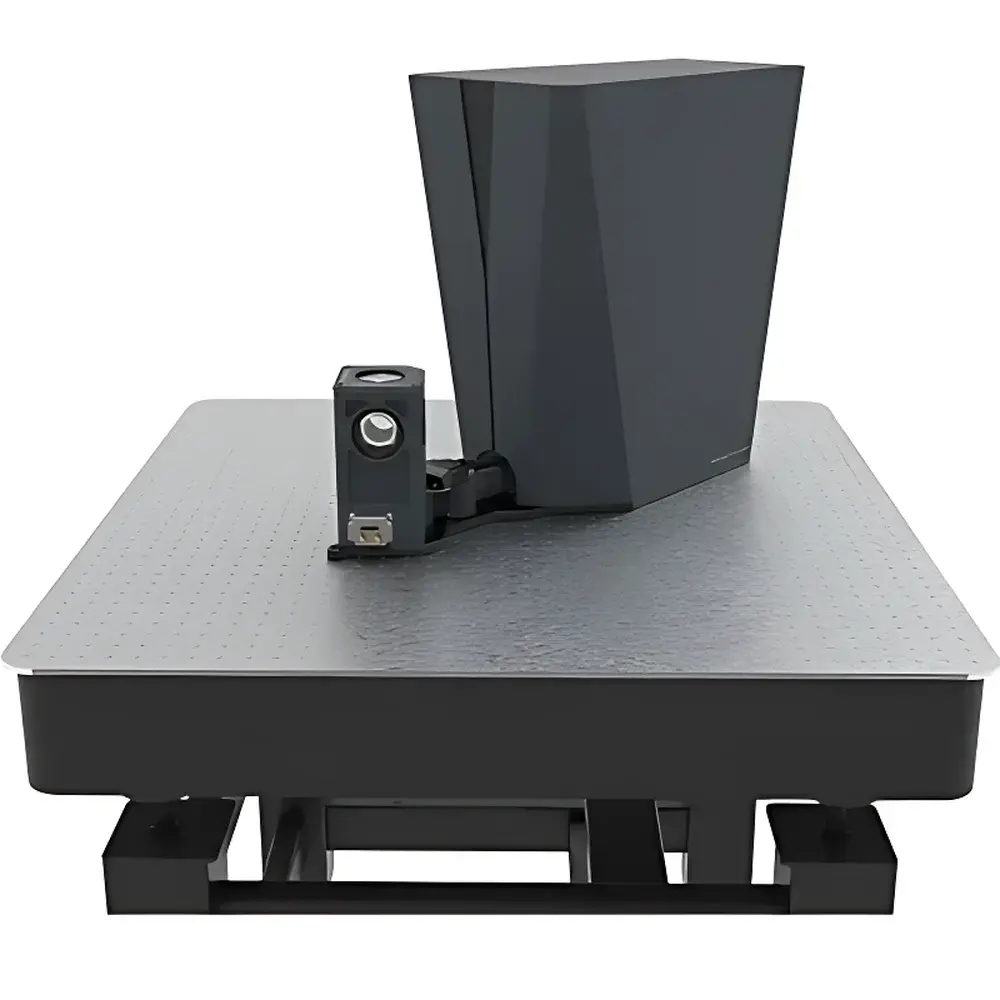
Montana Instruments CryoAdvance™ Series Ultra-Precision Helium-Free Cryogenic Optical System
| Brand | Montana Instruments |
|---|---|
| Origin | USA |
| Model | CryoAdvance™ Series |
| Instrument Type | Vertical Cryostat |
| Temperature Stability | <10 mK (peak-to-peak) |
| Operating Temperature Range | 3.2 K – 350 K (down to <3 K under no thermal load) |
| Working Distance | Horizontal 14.5 mm, Vertical 9 mm (with optional ≤4 mm near-working-distance configuration) |
| Vibration Stability | <10 mK equivalent displacement (peak-to-peak) |
| Form Factor | Benchtop |
| Cooling Method | Closed-cycle cryorefrigeration (no liquid helium consumption) |
Overview
The Montana Instruments CryoAdvance™ Series represents a paradigm shift in cryogenic optical experimentation—delivering ultra-stable, helium-free operation without compromising on quantum-grade thermal or mechanical performance. Engineered for precision low-temperature photonics, quantum optics, and condensed matter physics, the CryoAdvance platform employs a closed-cycle pulse-tube cryocooler integrated with proprietary vibration-damping architecture and multi-stage passive/active thermal stabilization. Unlike traditional liquid-helium-based cryostats, it eliminates dependency on scarce, costly cryogens while maintaining continuous base temperatures as low as 3.2 K and full-range programmability from 3.2 K to 350 K. Its modular, benchtop form factor enables seamless integration into existing optical tables—supporting both vertical and horizontal optical access configurations—and is optimized for applications requiring sub-10-mK temperature stability and sub-5-nm mechanical vibration isolation at cryogenic temperatures.
Key Features
- Helium-free operation: Fully sealed closed-cycle refrigeration system with internal helium gas only—zero liquid helium or gaseous helium replenishment required during routine operation.
- Unmatched thermal stability: <10 mK peak-to-peak temperature fluctuation across the entire operating range; active + passive control ensures stability at every setpoint, reducing drift by up to 20× versus conventional cryocooler systems.
- Nanometer-scale mechanical stability: Proprietary cold-head decoupling and rigid sample-stage mounting achieve <5 nm (CA50) to <15 nm (CA100) peak-to-peak vibration at the sample position—critical for confocal microscopy, single-photon detection, and cavity optomechanics.
- Full-temperature optical alignment integrity: Thermally compensated mechanical design minimizes sample positional drift (<1 µm over 3.2–350 K), preserving optical focus and coupling efficiency without manual realignment.
- Benchtop modularity: Direct-mount compatibility with standard imperial/metric optical tables; supports 0° or 45° orientation relative to table grid; no external water cooling, vacuum pumps, or auxiliary chillers needed.
- Intelligent embedded control: 7-inch touchscreen interface with automated cooldown/warm-up, vacuum sequencing, purge gas management, and real-time monitoring of temperature, pressure, compressor status, and thermal load.
Sample Compatibility & Compliance
The CryoAdvance series accommodates diverse experimental geometries through configurable sample chambers (CA50: Φ50 mm × 80 mm; CA100: Φ100 mm × 116 mm; S200: Φ196 mm × 200 mm), each featuring five standard optical windows (1 top + 4 side) with customizable AR coatings (e.g., 400–1000 nm). Optional configurations include CRYO-OPTIC® integrated room-temperature objectives, MAGNETO-OPTIC® in-chamber electromagnets (up to ±1 T), CryoMOKE™ for magneto-optical Kerr effect, and CryoFMR™ for ferromagnetic resonance. All models support DC/RF/electrical feedthroughs (up to 25 DC + 4 RF channels), fiber optic ports, gas inlets (N₂, He), and motorized XYZ nanopositioners. The system complies with CE marking requirements and adheres to ISO/IEC 17025-aligned calibration traceability for temperature sensors. Vacuum integrity meets UHV-compatible standards (<1×10⁻⁷ mbar base pressure with optional turbomolecular pumping), satisfying GLP/GMP-adjacent lab protocols where environmental reproducibility is auditable.
Software & Data Management
CryoAdvance systems ship with Montana’s proprietary CryoSoft™ control suite, accessible via embedded touchscreen or remote VNC connection. The software implements fully automated vacuum-pump-down, cooldown ramping, hold-point stabilization, and warm-up recovery—with user-defined profiles for repeatable thermal cycling. Real-time telemetry (temperature, vacuum level, compressor frequency, stage position) is logged internally and exportable in CSV/JSON formats. For advanced integration, RESTful API endpoints enable programmatic control in Python, MATLAB, LabVIEW, and C#, supporting synchronized acquisition with spectrometers, lock-in amplifiers, and time-resolved detectors. Audit trails—including operator ID, timestamped parameter changes, error logs, and system health diagnostics—are retained for compliance with FDA 21 CFR Part 11–aligned data governance frameworks. Remote diagnostic capability allows Montana engineers to securely assess firmware status, sensor calibration history, and thermal performance metrics without onsite intervention.
Applications
The CryoAdvance platform serves as a foundational infrastructure for frontier research demanding quantum-limited environmental control. It is extensively deployed in nitrogen-vacancy (NV) center magnetometry—enabling wide-field and single-NV confocal imaging at 4 K with high NA collection optics and microwave delivery. In quantum computing, it hosts ion-trap experiments requiring stable RF/DC electrode biasing, UV laser access (355 nm), and fluorescence readout with >10% photon collection efficiency. For 2D materials science, its rapid cooldown (~2 h to 4.2 K for CA50) and large optical access support variable-temperature Raman, photoluminescence, and micro-MOKE measurements—demonstrated in landmark studies on ultra-flat graphene (Nature, 2020) and valley-polarized excitons in WSe₂. Additional validated use cases include cavity quantum electrodynamics (cQED) with diamond color centers, time-resolved Kerr rotation (TRKR) at <150 fs resolution, spin-phonon spectroscopy in SiC, and Mössbauer spectroscopy using integrated MS96 spectrometers. Over 200 peer-reviewed publications across Nature, Science, and Physical Review journals cite CryoAdvance-derived data—affirming its role as a benchmark platform for reproducible low-temperature optical science.
FAQ
Does the CryoAdvance system require liquid helium or external helium gas supply?
No. It operates exclusively on closed-cycle refrigeration with permanently sealed helium gas inside the cryocooler—no consumables, refills, or dewar handling are necessary.
What is the typical cooldown time from 300 K to base temperature?
Approximately 2 hours for CA50 to reach 4.2 K; ~3 hours for CA100. Actual duration depends on thermal load, vacuum quality, and optional accessories such as magnetic modules or optical objectives.
Can the system be integrated with third-party measurement hardware (e.g., spectrometers, AFMs)?
Yes. Standardized electrical, optical, and mechanical interfaces—including SMA, FC/PC fiber ports, BNC/SHV feedthroughs, and metric/imperial mounting patterns—facilitate plug-and-play integration with commercial and custom instrumentation.
Is remote operation and scripting supported?
Yes. Full RESTful API access enables automation in Python, MATLAB, LabVIEW, and C#. VNC-based GUI remote control is included, and encrypted remote diagnostics are available for technical support.
How is sample exchange performed without breaking vacuum or thermal stability?
The outer vacuum can and radiation shield are manually removable via quick-release clamps. Sample loading occurs at ambient temperature; subsequent pump-down and cooldown are fully automated—eliminating manual venting or bake-out procedures.



