
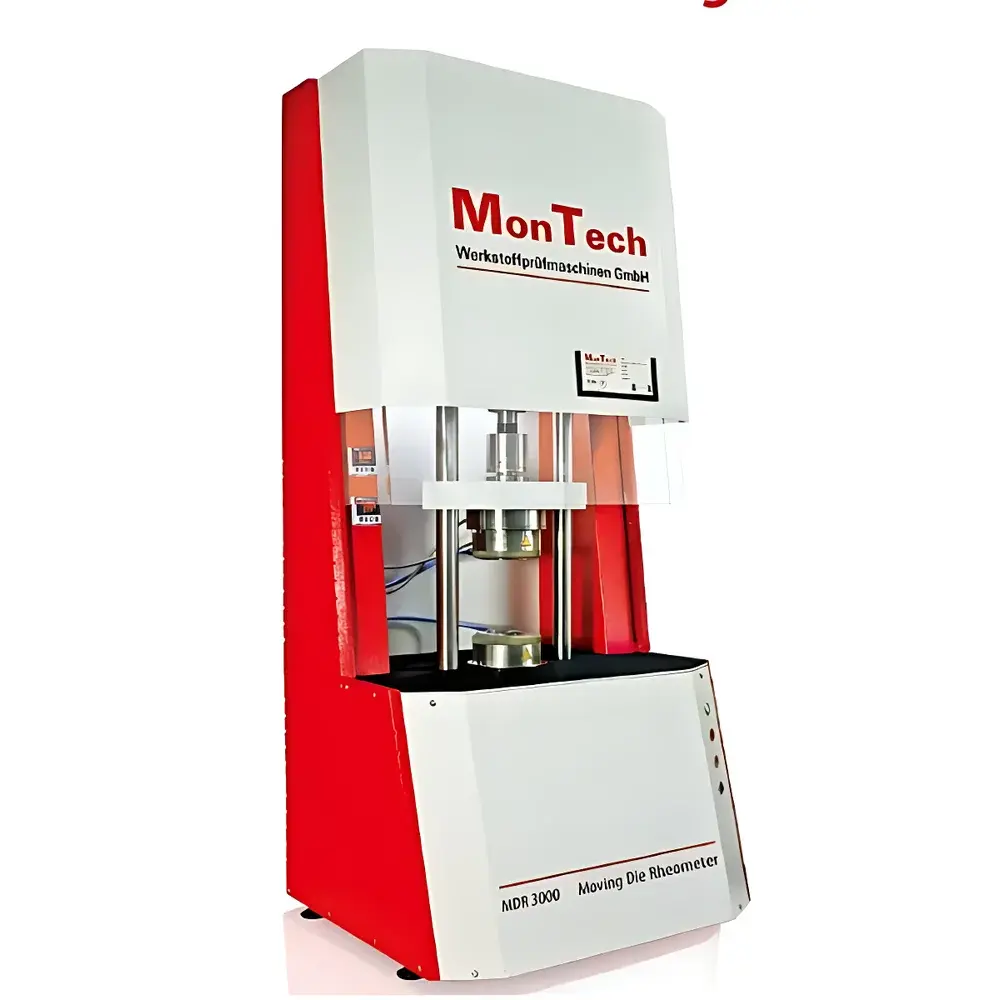
MonTech MDR 3000 Oscillating Disk Curemeter (ODR)
| Brand | MonTech |
|---|---|
| Origin | Germany |
| Model | MDR 3000 |
| Standard Compliance | ISO 6502, ASTM D5289, DIN 53529 |
| Cavity Type | Sealed Dual-Conical |
| Drive System | Direct-Drive DC Servo Motor |
| Oscillation Frequency | 1.667 Hz |
| Amplitude Range | Software-Controlled ±0.01° to 5° (mechanical fixed option: 0.5°) |
| Temperature Range | Ambient to 232 °C |
| Measured Parameters | Torque (dN·m), Temperature (°C), Frequency (Hz), Strain (%), Derived Moduli (S′, S″, S*, tan δ) |
| Cavity Material | Hardened & Polished Stainless Steel |
| Enclosure | Anodized Aluminum Alloy Housing |
| Control Interface | Dedicated PC with MonControl v5.x (32-bit Windows-based Analysis Suite) |
| Data Output | Real-time torque/temperature curves, modulus profiles, cure kinetics (ts1, tc50, tc90), hysteresis analysis |
Overview
The MonTech MDR 3000 is a precision oscillating disk curemeter engineered for quantitative vulcanization characterization of raw rubber compounds, thermoplastic elastomers (TPE), liquid silicone rubber (LSR), and specialty elastomeric formulations. Operating on the principle of controlled sinusoidal oscillation within a sealed, dual-conical cavity, the instrument measures the time-dependent viscoelastic response—specifically torque development—as a function of temperature and time under standardized curing conditions. Unlike rotor-based systems, the MDR 3000 employs a rotorless design where the lower die rotates while the upper die remains stationary and integrates a high-fidelity torque transducer. This architecture eliminates mechanical backlash, minimizes thermal lag, and ensures exceptional repeatability in scorch time (ts₁), optimum cure time (tc₅₀, tc₉₀), and modulus plateau determination. Its compliance with ISO 6502, ASTM D5289, and DIN 53529 positions it as a globally recognized reference instrument for QC laboratories, R&D centers, and production-floor process validation in tire, automotive sealing, medical device, and industrial rubber manufacturing.
Key Features
- Direct-drive DC servo motor mounted coaxially to the lower die—eliminating gear trains, reducing mechanical noise, and enabling micro-radian amplitude resolution (±0.01°–5°) under full software control
- Sealed dual-conical test cavity fabricated from hardened, mirror-polished stainless steel (≥HRC 60) for corrosion resistance, dimensional stability, and uniform heat transfer
- High-speed thermal regulation system achieving ≤1.5 °C/min ramp rates and ±0.1 °C steady-state temperature uniformity across the cavity volume
- Integrated dual-thermocouple monitoring (upper/lower die surfaces) with real-time display and logging of thermal gradients during cure profiling
- Anodized aluminum enclosure with ergonomic lift-column mechanism for safe, tool-free access to the test zone
- Single-button operation mode with multi-color LED status indicators (green = ready, amber = heating, red = error/fault) supporting unattended testing in production environments
- Full digital torque acquisition at ≥1 kHz sampling rate, with hardware-level filtering and auto-zeroing before each test cycle
Sample Compatibility & Compliance
The MDR 3000 accommodates standard ASTM/ISO-compliant test specimens (typically 4.5 g ±0.1 g, preformed or cut from calendered sheet). It supports both uncured stock and pre-scorched compounds, enabling scorch safety assessment, reversion analysis, and post-cure modulus tracking. The instrument meets regulatory expectations for GMP-aligned environments: MonControl software supports user access levels, electronic signatures, audit trail generation (per FDA 21 CFR Part 11 requirements), and GLP-compliant report templates. All firmware and calibration routines are traceable to NIST-certified torque and temperature standards. Routine verification protocols include reference compound testing per ASTM D5289 Annex A1 and cavity geometry certification using certified gauge blocks.
Software & Data Management
MonControl v5.x is a dedicated 32-bit Windows application providing full instrument control, real-time visualization, and advanced rheological data reduction. It enables automated sequence programming (multi-step temperature ramps, variable amplitude sweeps, frequency sweeps), batch processing of up to 99 samples per session, and export to CSV, XML, or PDF formats. Built-in analytical modules calculate dynamic moduli (storage modulus S′, loss modulus S″, complex modulus S*, loss tangent tan δ), crosslink density estimates (via rubber elasticity theory), and kinetic modeling (Arrhenius activation energy from multi-temperature runs). Raw torque vs. time datasets are stored with metadata (operator ID, sample ID, lot number, environmental conditions), ensuring full traceability for internal audits and third-party inspections.
Applications
- Quality control of incoming raw materials (natural rubber, SBR, EPDM, FKM, silicone) against specification limits for scorch safety and cure rate
- R&D formulation optimization—including accelerator package screening, filler dispersion evaluation, and peroxide vs. sulfur cure system comparison
- Production-line process validation for extrusion, molding, and calendaring operations requiring real-time cure state feedback
- Accelerated aging studies correlating MDR-derived modulus changes with long-term compression set performance
- Regulatory submission support for medical-grade elastomers (ISO 10993-12, USP <85>) and automotive OEM specifications (e.g., GMW15635, Ford WSS-M99P1111-A)
- Failure analysis of under-cured or over-cured components through comparative modulus profile overlay
FAQ
What distinguishes the MDR 3000’s direct-drive system from conventional pneumatic or stepper-motor-driven curemeters?
The integrated DC servo motor eliminates gear reduction, backlash, and air-compression variability—resulting in superior torque linearity, sub-degree amplitude fidelity, and signal-to-noise ratios exceeding 80 dB. This directly enhances reproducibility of tc₅₀ values across laboratories.
Can the MDR 3000 perform frequency sweep tests at elevated temperatures?
Yes—within its operational temperature range (up to 232 °C), the instrument supports isothermal frequency sweeps (0.1–10 Hz) when configured with optional firmware licensing, enabling full dynamic mechanical analysis (DMA) capability on vulcanizing systems.
Is remote diagnostics and firmware updates supported?
MonTech provides secure remote maintenance via encrypted VNC tunneling; firmware updates are distributed through MonTech’s customer portal and require validated service credentials.
How is calibration maintained over extended use?
The system includes built-in torque zeroing and thermal offset compensation routines. Annual calibration is recommended using MonTech-certified reference standards; cavity geometry verification is performed using NIST-traceable plug gauges.
Does MonControl support LIMS integration?
Yes—via configurable ODBC drivers and structured XML output, enabling bidirectional data exchange with major laboratory information management systems (e.g., LabVantage, Thermo Fisher SampleManager, STARLIMS).





