
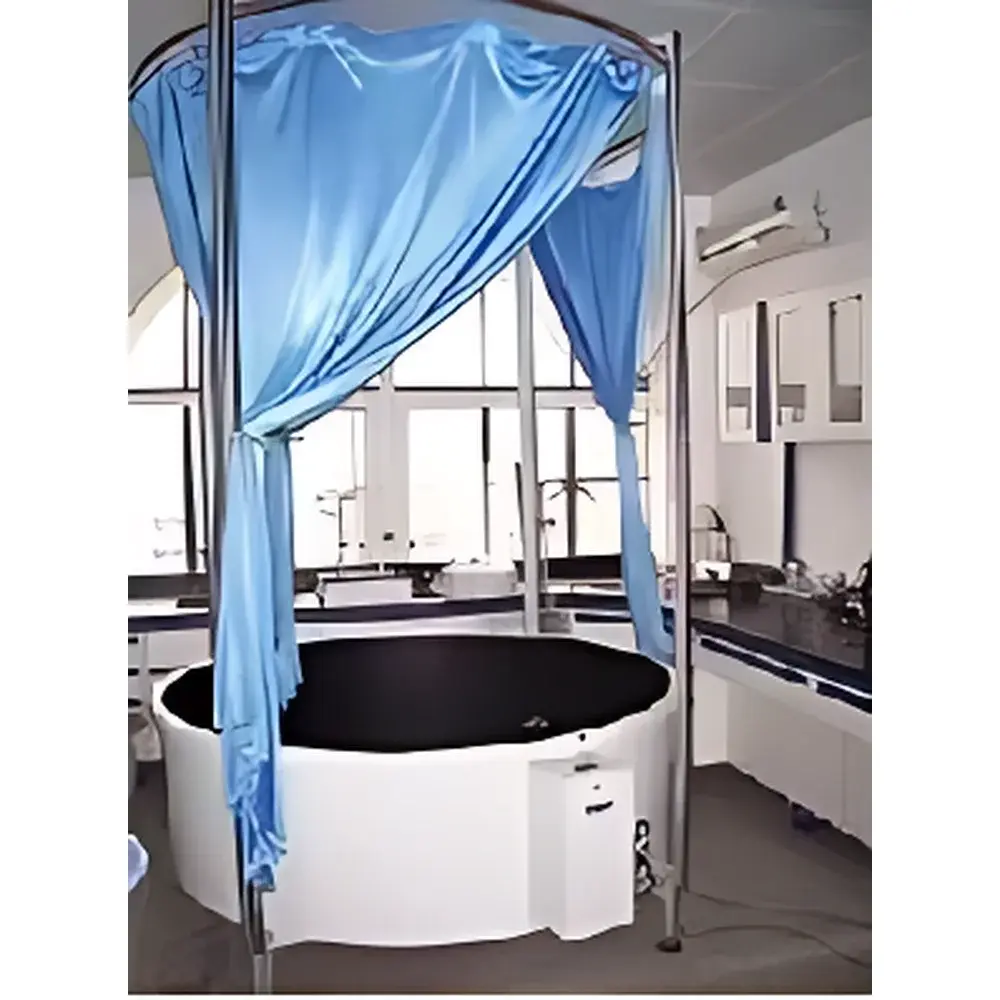
Morris Water Maze and Forced Swim Test System
| Origin | USA |
|---|---|
| Manufacturer Type | Distributor |
| Origin Category | Imported |
| Model | Morris |
| Pricing | Upon Request |
Overview
The Morris Water Maze and Forced Swim Test System is a fully integrated, computer-controlled behavioral phenotyping platform engineered for rigorous preclinical neuroscience research in rodents. It combines two gold-standard paradigms—spatial learning and memory assessment via the Morris Water Maze (MWM), and behavioral despair evaluation via the Forced Swim Test (FST)—within a single hardware-software architecture. The MWM operates on the principle of spatial navigation under mild aversive motivation (water immersion), where subjects learn the location of a submerged escape platform using extra-maze visual cues; performance metrics—including escape latency, path efficiency, time spent in target quadrant during probe trials, and swim speed—are quantified with sub-second temporal resolution. The FST, by contrast, measures immobility duration—a validated ethological proxy for passive coping behavior associated with depressive-like states—in a standardized, non-reinforced swimming context. Both assays are conducted in temperature-regulated, opaque water tanks to minimize non-spatial confounds and ensure high inter-laboratory reproducibility. This system is designed for compliance with NIH behavioral testing guidelines and supports longitudinal study designs across genetically modified, pharmacologically treated, or aged rodent cohorts.
Key Features
- Fully automated video tracking with real-time centroid detection and trajectory reconstruction at 30 fps, supporting both albino and pigmented (black/gray) rodents without dye marking or physical tagging
- Dual-assay modularity: independent configuration of MWM and FST protocols—including adjustable tank dimensions, platform size/positioning, water temperature control (22–25 °C), and session timing parameters
- Configurable data archiving: user-defined experiment folders with metadata tagging (subject ID, genotype, treatment group, date, operator)
- Raw video export capability in AVI format with synchronized timestamp overlay, enabling retrospective re-analysis or third-party validation
- Integrated reporting engine generating standardized PDF reports per trial—including latency curves, quadrant occupancy heatmaps, mobility histograms, and immobility bout segmentation
- Native Excel (.xlsx) output for all quantitative outputs, compatible with statistical packages (e.g., GraphPad Prism, R, SPSS) and GLP-compliant data archival workflows
- Remote analysis support: encrypted project file transfer enables cross-platform data review and collaborative interpretation without requiring local software installation
Sample Compatibility & Compliance
The system is validated for use with mice (C57BL/6, BALB/c, CD-1, etc.) and rats (Sprague-Dawley, Wistar) aged 8–24 weeks. Tank depth, water opacity, and lighting conditions conform to established standards outlined in the *Journal of Neuroscience Methods* (2021, Vol. 352, 109078) and the NIH Office of Laboratory Animal Welfare (OLAW) behavioral testing recommendations. All experimental protocols adhere to the ARRIVE 2.0 guidelines and support audit-ready documentation for institutional animal care and use committees (IACUC). Data acquisition logs include full traceability: operator ID, calibration timestamps, environmental sensor readings (temperature, ambient light), and software version history—enabling compliance with GLP and GCP frameworks where applicable.
Software & Data Management
The proprietary acquisition and analysis suite runs on Windows 10/11 (64-bit) and implements role-based access control, electronic signatures, and audit trail functionality meeting FDA 21 CFR Part 11 requirements for regulated studies. Each experiment generates a self-contained project bundle containing raw video, processed trajectory data (.csv), metadata XML, and report PDFs—structured to facilitate FAIR (Findable, Accessible, Interoperable, Reusable) data principles. Batch processing tools allow parallel analysis of multi-session datasets, while API hooks enable integration with LIMS or electronic lab notebook (ELN) systems. Software updates are delivered via secure, version-locked channels with full change-log documentation.
Applications
- Evaluation of hippocampal-dependent spatial learning deficits in Alzheimer’s disease models (e.g., APP/PS1, 5xFAD)
- Screening cognitive enhancers or neuroprotective agents in chronic stress or aging paradigms
- Pharmacodynamic profiling of antidepressants, SSRIs, and ketamine analogues using FST immobility endpoints
- Genetic screening of synaptic plasticity mutants (e.g., CaMKIIα, CREB, BDNF knockouts)
- Validation of optogenetic or chemogenetic interventions targeting ventral hippocampus or dorsal raphe nuclei
- Behavioral phenotyping in neuroinflammation models (e.g., LPS-induced sickness behavior modulation)
FAQ
Does the system support simultaneous dual-task acquisition (e.g., MWM + FST in one session)?
No—MWM and FST are behaviorally incompatible paradigms and must be conducted as separate, temporally distinct assays per subject.
Can the software distinguish between floating and active swimming in the FST?
Yes—the immobility detection algorithm classifies motion based on pixel displacement thresholds calibrated against validated ethograms, distinguishing brief exploratory movements from true passive floating.
Is thermal regulation of the water tank included as standard equipment?
Water temperature monitoring is standard; active heating/cooling modules are available as optional accessories for labs operating outside ambient 20–25 °C ranges.
What video resolution and field-of-view options are supported?
Standard configuration uses 1080p USB3 cameras with 90° fixed-focus lenses; custom wide-angle or zoom optics can be integrated upon request.
How is data integrity ensured during long-term multi-week studies?
Automatic daily backup to network-attached storage (NAS) with SHA-256 checksum verification, plus optional cloud sync with end-to-end encryption.
Related Products




