
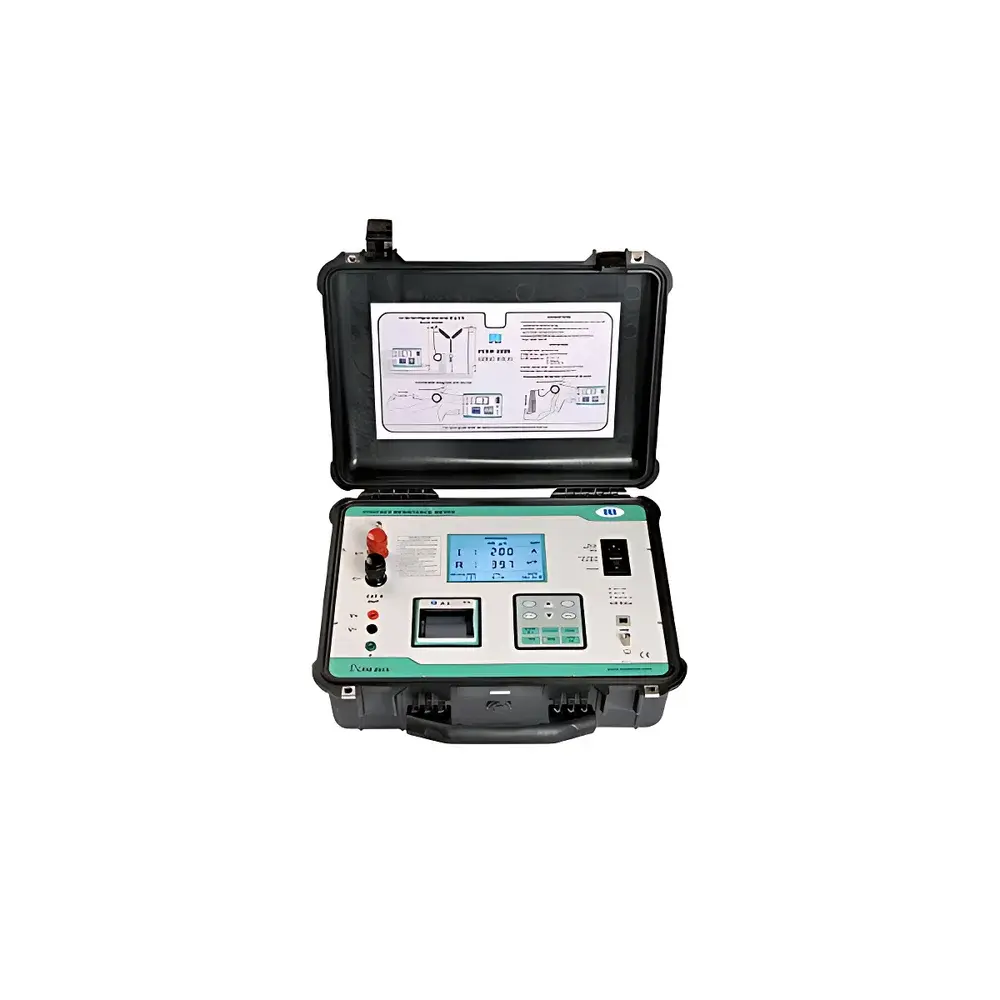
MOTWANE PCRM-200S Digital Micro-Ohmmeter
| Brand | MOTWANE |
|---|---|
| Origin | India |
| Model | PCRM-200S |
| Test Current | 100 A / 200 A DC |
| Measurement Range | 0.1 µΩ to 20 mΩ |
| Minimum Resolution | 0.1 µΩ |
| Accuracy | ±2% of reading |
| Measurement Method | Kelvin 4-wire |
| Display | Backlit 3½-digit LCD |
| Memory Capacity | 199 test records |
| Printer | Built-in thermal printer |
| Interface | USB |
| Power Supply | 230 V AC ±10%, 50 Hz or 12 V / 7.2 Ah rechargeable sealed lead-acid battery |
| Enclosure Rating | IP54 |
| Safety Compliance | EN 61010-1, EN 61326-1, CAT II |
| Operating Temperature | 0 °C to 55 °C |
| Dimensions (L×W×D) | 502 mm × 395 mm × 188 mm |
| Weight | ~14 kg |
Overview
The MOTWANE PCRM-200S Digital Micro-Ohmmeter is a precision low-resistance measurement instrument engineered for high-current, four-terminal (Kelvin) resistance testing in power system maintenance and commissioning environments. It operates on the principle of injecting a stable, high-magnitude direct current—either 100 A or 200 A—across the test object while simultaneously measuring the resulting voltage drop across dedicated potential terminals. This eliminates lead and contact resistance errors, enabling accurate quantification of resistances as low as 0.1 µΩ. Designed specifically for static contact resistance verification of high-voltage circuit breakers, busbar joints, isolator contacts, and grounding connections, the PCRM-200S meets the stringent repeatability and stability requirements of utility-grade field diagnostics. Its robust industrial enclosure, dual-power architecture (AC mains and internal sealed lead-acid battery), and CAT II safety rating support reliable operation in substation yards, switchgear rooms, and outdoor energized equipment zones under variable ambient conditions.
Key Features
- Kelvin four-wire measurement architecture with dedicated current and potential leads to eliminate parasitic resistance effects
- Selectable high-current excitation: 100 A or 200 A DC output, optimized for detecting microstructural anomalies in metallic contacts
- High-resolution display: Backlit 3½-digit LCD showing real-time current, voltage drop (mV), and calculated resistance simultaneously
- Integrated thermal printer for immediate hardcopy documentation of test results—including date, time, current setting, and measured value
- Onboard memory storing up to 199 test records with timestamping; supports traceability for QA/QC audits and preventive maintenance logs
- Three-color LED status indicators for AC power presence, battery operation mode, and low-battery warning
- IP54-rated polypropylene enclosure ensuring protection against dust ingress and water splashes during field deployment
- Dedicated C-clamp test leads with integrated de-oxidation tips (75 mm aperture standard) to ensure consistent contact pressure and surface cleaning prior to measurement
- Automatic calibration expiry alert and built-in self-test functionality prior to measurement initiation
Sample Compatibility & Compliance
The PCRM-200S is validated for use on copper and aluminum conductive interfaces common in medium- and high-voltage power infrastructure. Its measurement range (0.1 µΩ–20 mΩ) aligns with IEEE C37.100.1, IEC 62271-1, and ANSI/NETA ATS-2023 requirements for contact resistance acceptance thresholds in circuit breakers and disconnect switches. The instrument conforms to EN 61010-1 for electrical safety in measurement equipment and EN 61326-1 for electromagnetic compatibility in industrial environments. Its CAT II 600 V overvoltage category rating permits safe use on distribution-level systems (up to 35 kV class equipment) when installed per manufacturer-specified grounding protocols. All factory calibrations are traceable to NPL India standards, and each unit ships with an ISO/IEC 17025-accredited calibration certificate.
Software & Data Management
A Windows-based PC application (compatible with Windows 10/11, 64-bit) enables full data lifecycle management via USB interface. The software supports remote instrument control, real-time data streaming, batch download of stored records, statistical analysis (min/max/avg/deviation), graphical trend visualization, and customizable PDF report generation compliant with ISO 17025 documentation templates. Audit trails include operator ID, test location metadata, calibration status flags, and electronic signatures where required for GLP/GMP-aligned workflows. Data export formats include CSV, XLSX, and XML for integration into enterprise asset management (EAM) or CMMS platforms such as SAP PM or IBM Maximo.
Applications
- Static contact resistance measurement of HV/MV circuit breaker main and arcing contacts
- Verification of bolted busbar joint integrity in switchgear and GIS compartments
- Quality assurance testing of isolation switch contacts before energization
- Weld seam resistance assessment in earthing grid installations
- Periodic maintenance checks of grounding conductor continuity and clamping effectiveness
- Commissioning validation of retrofit or replacement components in live substations
- Factory acceptance testing (FAT) and site acceptance testing (SAT) per IEC 61869-10 and IEEE C57.12.90
FAQ
What is the recommended interval for recalibration?
Calibration is advised annually or after 500 measurement cycles—whichever occurs first—as indicated by the onboard expiry alert. Field verification using certified shunt resistors is recommended prior to critical measurements.
Can the PCRM-200S perform measurements on energized equipment?
No. It is designed exclusively for de-energized, isolated circuits. Measurements must be conducted only after lockout-tagout (LOTO) procedures and verified absence of voltage per NFPA 70E and OSHA 1910.333.
Is battery operation sufficient for full 200 A testing?
Yes—the internal 12 V / 7.2 Ah battery supports continuous 200 A output for ≥60 seconds per test cycle, with adequate recovery time between successive measurements.
Does the software comply with FDA 21 CFR Part 11 requirements?
The software includes configurable user access levels, electronic signature capture, and immutable audit logs—features that support Part 11 compliance when deployed within validated IT infrastructure and documented SOPs.
Are optional test leads calibrated with the instrument?
All standard and optional C-clamp leads are supplied with individual resistance compensation values pre-loaded into firmware; no manual correction is required during operation.






