
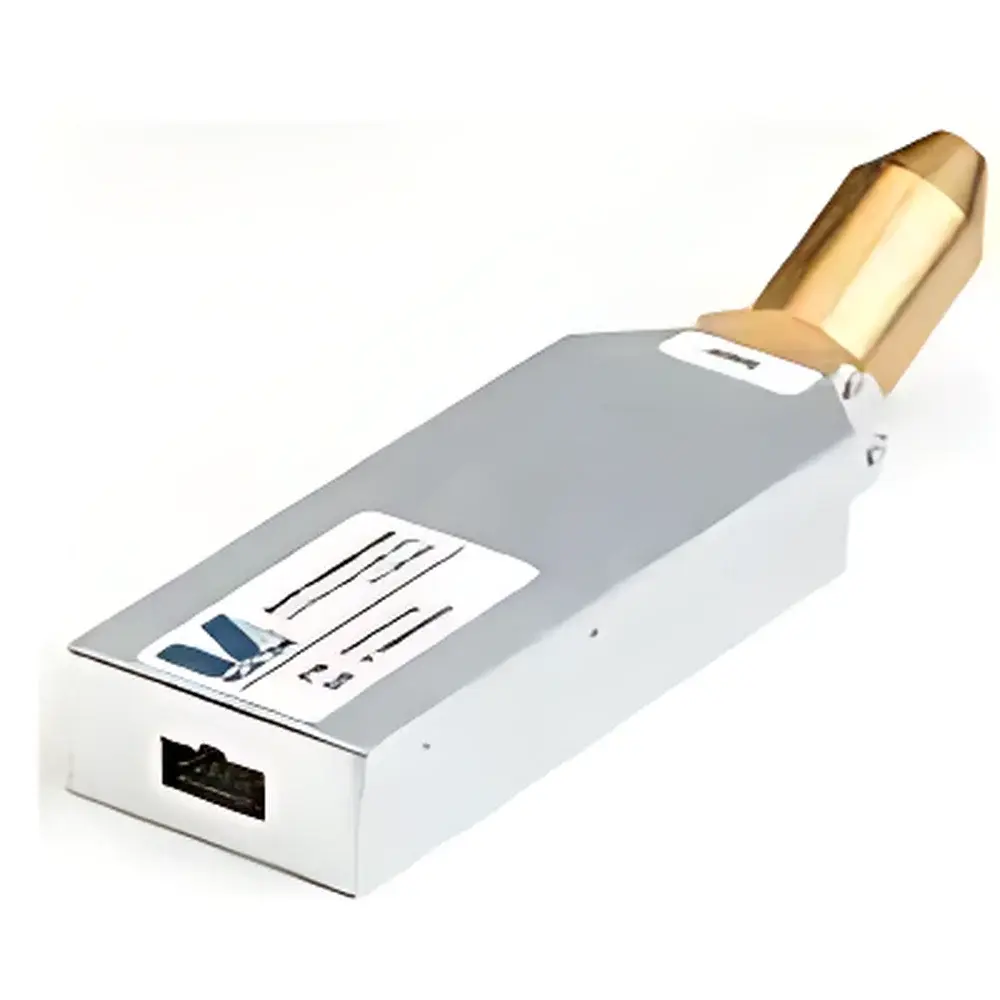
Moxtek Monoblock Miniature X-ray Tube
| Brand | Moxtek |
|---|---|
| Origin | USA |
| Model | Monoblock |
| Tube Type | Metal-Ceramic |
| Target Materials | Ag, W, Pd, Rh |
| Operating Voltage Range | 10–50 kV |
| Current Range | 0–0.2 mA |
| Max Output Power | 10 W |
| Focal Spot Size | 400 µm |
| Stability | < 1.0% RSD |
| Beryllium Window Thickness | 0.25 mm |
| Max Input Power | 20 W |
| Operating Temperature | −10 °C to +50 °C |
| Storage Temperature | −40 °C to +60 °C |
| Weight | 500 g |
| Compliance | RoHS, CE (per IEC 61010-1), FDA 21 CFR Part 1020.40 (X-ray equipment) |
Overview
The Moxtek Monoblock Miniature X-ray Tube is a compact, high-stability metal-ceramic X-ray source engineered for integration into portable and benchtop analytical instrumentation. Based on thermionic emission and optimized electron-beam focusing, the tube generates characteristic X-ray spectra via bremsstrahlung and line emission when accelerated electrons strike the anode target—enabling precise elemental analysis in energy-dispersive X-ray fluorescence (EDXRF), X-ray diffraction (XRD), and transmission-based imaging systems. Designed specifically for low-power, space-constrained applications—including handheld XRF analyzers, point-of-care medical radiography modules, and field-deployable non-destructive testing (NDT) platforms—the Monoblock integrates the X-ray generating assembly and high-voltage controller within a single hermetically sealed housing. Its monolithic architecture eliminates external HV cabling, reduces electromagnetic interference, and enhances mechanical robustness under vibration and thermal cycling.
Key Features
- Integrated high-voltage controller and X-ray tube in one compact package (dimensions: 68 × 68 × 92 mm), minimizing system footprint and simplifying OEM integration.
- Metal-ceramic construction ensures ultra-high vacuum integrity (>1×10⁻⁸ Torr), long-term operational stability, and resistance to thermal shock and outgassing.
- Customizable anode targets (Ag, W, Pd, Rh) selected to optimize excitation efficiency for specific element groups—e.g., Ag for light-element detection (Na–Cl), Rh for mid-Z elements (Ti–Zn), and W for high-energy applications requiring penetration depth.
- High beam stability (<1.0% RSD over 8 hours) enabled by precision filament current regulation, active temperature compensation, and low-noise HV feedback circuitry—critical for quantitative EDXRF calibration reproducibility.
- Beryllium exit window (0.25 mm thickness) provides optimal transmission for low-energy X-rays (down to ~1 keV) while maintaining structural integrity and vacuum barrier performance.
- Low power consumption (max 20 W input) supports battery-operated and embedded-system deployments without active cooling requirements.
Sample Compatibility & Compliance
The Monoblock tube is compatible with solid, powdered, and thin-film samples across diverse matrices—including alloys, geological specimens, polymers, and biological tissues—when paired with appropriate collimation, filtering, and detector geometry. Its fixed focal spot (400 µm) enables consistent geometric magnification and spatial resolution in micro-XRF or laminography configurations. The device complies with international safety and electromagnetic compatibility standards: IEC 61010-1 (electrical safety for measurement equipment), IEC 61326-1 (EMC for laboratory instruments), and FDA 21 CFR Part 1020.40 (performance standards for diagnostic X-ray systems). All units undergo factory burn-in and radiation leakage testing per ISO 15708-2. RoHS-compliant materials and lead-free soldering support sustainable manufacturing and global regulatory acceptance.
Software & Data Management
While the Monoblock itself is a hardware module, its operation is fully controllable via TTL/RS-232 or analog voltage interfaces—enabling seamless integration with third-party acquisition software (e.g., PyMCA, AXIL, or custom LabVIEW/VB.NET applications). OEMs may implement real-time HV and current monitoring, interlock status reporting, and thermal fault logging to meet GLP/GMP audit requirements. Firmware-upgradable controllers support configurable ramp rates, dwell times, and pulse-width modulation for dose-controlled exposure protocols—essential for compliance with ALARA (As Low As Reasonably Achievable) radiation safety principles. Full traceability of operating parameters (kV, µA, duration, temperature) can be embedded into spectral data headers for ISO/IEC 17025-accredited laboratories.
Applications
- Portable and handheld EDXRF analyzers for alloy verification, mining exploration, and environmental soil screening.
- Benchtop micro-XRF mapping systems used in failure analysis, art conservation, and semiconductor wafer inspection.
- Compact X-ray sources in veterinary and dental digital radiography units requiring low-dose, high-contrast imaging.
- Embedded NDT systems for in-field weld inspection, corrosion mapping, and aerospace composite evaluation.
- Research-grade X-ray excitation modules in synchrotron beamline pre-characterization setups and educational physics labs.
FAQ
What is the typical lifetime of the Monoblock X-ray tube under continuous operation?
Rated minimum operational life is 5,000 hours at nominal 50 kV / 0.2 mA, assuming adherence to recommended thermal derating curves and stable ambient conditions (≤35 °C). Lifetime extends significantly under pulsed or intermittent duty cycles.
Can the tube be operated in vacuum or inert gas environments?
No—the Monoblock is a self-contained, sealed vacuum device and must operate at atmospheric pressure. External vacuum chambers or purged enclosures are not required or recommended.
Is radiation shielding integrated into the housing?
The housing provides primary containment but does not replace system-level shielding. OEM integrators must design external lead or tungsten shielding per local regulations (e.g., NRC 10 CFR 35, EU Directive 2013/59/Euratom) based on intended use case and exposure limits.
Does Moxtek provide application-specific target selection guidance?
Yes—application engineers support target material selection (Ag vs. Rh vs. W) based on sample matrix, required detection limits, and spectral overlap considerations, including recommendations for secondary filtration and detector matching.
Are firmware updates and technical documentation available to end users?
Full datasheets, interface protocol manuals, safety compliance reports, and firmware update utilities are provided under NDA to qualified OEM partners and authorized distributors upon project registration.




