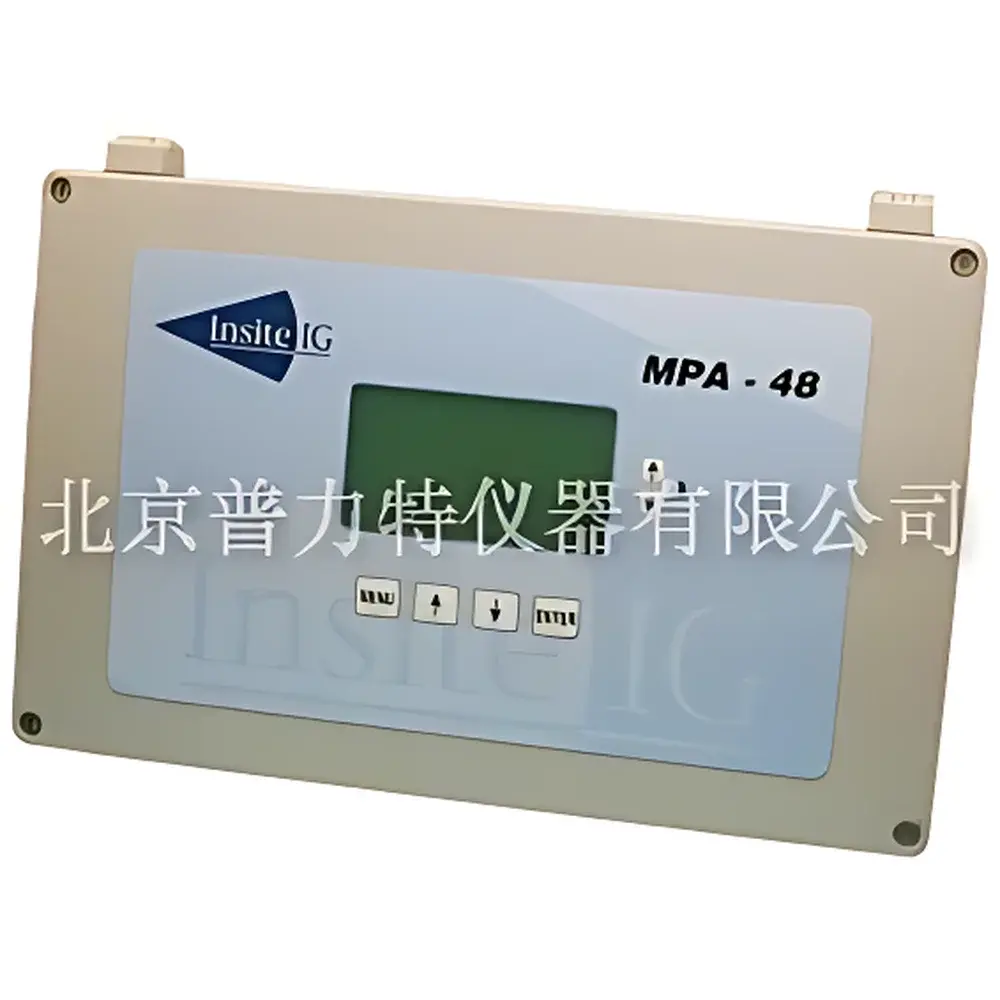
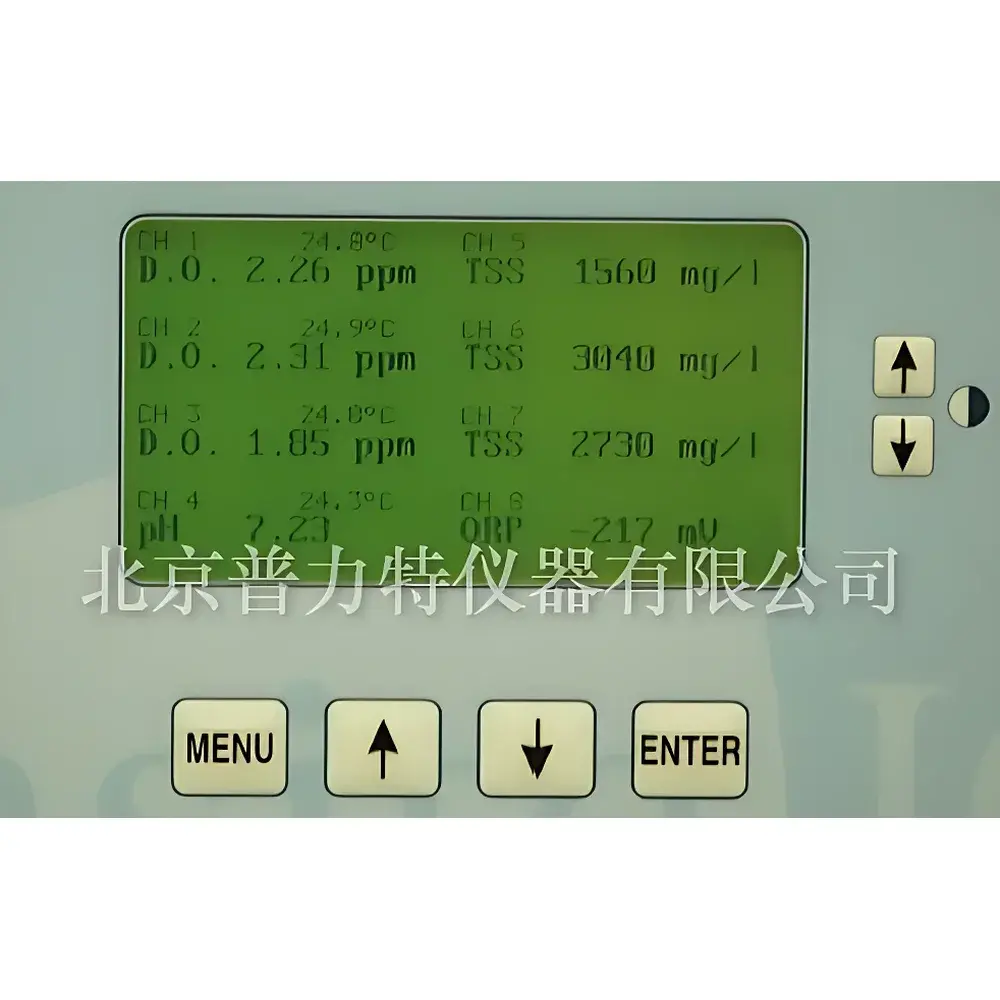
MPA48 Multi-Channel Online Process Analyzer for DO, SS, pH, and ORP
| Origin | USA |
|---|---|
| Manufacturer Type | Authorized Distributor |
| Origin Category | Imported |
| Model | MPA48 |
| Price Range | USD 4,200 – 7,000 |
| Resolution | 0.01 ppm (DO) |
| Measurement Range | DO: 0–25 ppm |
| SS | 0–30,000 mg/L |
| pH | 2–12 |
| ORP | ±2000 mV |
| Repeatability | ±1% (SS), 0.01 ppm (DO) |
| Stability | <1% per year (DO & SS) |
| Temperature Compensation | 0–60 °C (DO/SS), 10–100 °C (pH/ORP) |
| Communication Interfaces | 4–20 mA (up to 8 channels), RS232/RS485, relay outputs (8 dry-contact, 1 alarm, 1 clean signal) |
| Dimensions | 30 cm × 20 cm × 10 cm |
| Operating Ambient Temperature | −20 to +70 °C |
| Enclosure Rating | NEMA 4X |
| Max Pressure Rating | 100 psi |
| Sensor Cable Standard Length | 10 m (optional up to 610 m) |
Overview
The MPA48 Multi-Channel Online Process Analyzer is an engineered platform for continuous, simultaneous monitoring of critical water quality and process parameters in industrial and municipal applications. Designed for robust operation in demanding environments—including wastewater treatment plants, bioreactors, cooling towers, and food & beverage processing lines—the MPA48 integrates four core measurement modalities: dissolved oxygen (DO), suspended solids (SS), pH, and oxidation-reduction potential (ORP). Its architecture follows a modular sensor interface principle: each channel supports automatic plug-and-play recognition of calibrated, field-replaceable sensors without manual configuration. The DO module employs optical fluorescence quenching—eliminating membrane degradation, electrolyte refills, and polarization delays associated with traditional Clark-type electrodes. SS quantification relies on near-infrared (NIR) absorption at 850 nm, minimizing interference from colored organics or turbidity-induced spectral drift. pH and ORP measurements utilize flat-surface glass electrodes with dual-reference junctions and integrated Pt1000 temperature sensors, enabling real-time thermal compensation across the full operational range.
Key Features
- True multi-parameter integration: Simultaneous acquisition and independent scaling of DO, SS, pH, ORP, and temperature (T) within a single DIN-rail mountable enclosure.
- Optical DO sensing: Fluorescence lifetime-based detection with no consumables, zero oxygen consumption, and immunity to flow rate fluctuations.
- NIR SS measurement: Dual-wavelength compensation eliminates color bias and provides stable calibration over extended intervals—even in highly variable influent streams.
- Modular electrode design: Flat-glass pH/ORP sensors feature quick-disconnect terminals and replaceable reference chip cartridges—reducing maintenance downtime and recalibration frequency.
- Industrial-grade I/O: Eight isolated 4–20 mA analog outputs (HART-compatible), eight programmable relay outputs (10 A resistive), plus RS232/RS485 Modbus RTU support for SCADA integration.
- Self-diagnostics & sensor health monitoring: Real-time impedance checks, coating detection algorithms, and drift trend logging compliant with ISO 5667-22 and ASTM D888 verification protocols.
- NEMA 4X-rated enclosure: Epoxy-polyurethane hybrid housing with UV-stabilized LCD display, IP66 sealing, and pressure-rated sensor ports (100 psi max).
Sample Compatibility & Compliance
The MPA48 is validated for use in aqueous matrices ranging from raw sewage (high-fat, high-fiber content) to ultrapure process water (pharmaceutical grade). Sensor materials—including borosilicate glass, PTFE, and FDA-compliant PVC—meet USP Class VI and EC 1935/2004 requirements for indirect food contact. DO and SS modules comply with ISO 5814:2012 (optical DO) and ISO 11923:1997 (infrared turbidity). pH/ORP performance adheres to ISO 7888:2019 and ASTM D1293-22. Data integrity features—including timestamped audit trails, user-access levels, and non-volatile memory backup—support compliance with FDA 21 CFR Part 11 when deployed with validated software configurations. All firmware updates undergo IEC 62443-3-3 security validation prior to release.
Software & Data Management
The MPA48 operates natively with embedded firmware supporting local configuration via front-panel keypad and backlit LCD. For centralized supervision, it integrates seamlessly into existing DCS/PLC infrastructures via Modbus RTU or analog current loops. Optional PC-based configuration utility (MPA-Config v3.2) enables advanced setup—including custom calibration curves, hysteresis settings for relays, and dynamic range switching based on process alarms. Data logging is stored internally (16 MB flash memory) with configurable intervals (1 sec–24 hr) and exportable via USB or serial dump. All logged parameters include metadata: sensor ID, calibration date, operator tag, and diagnostic flags—ensuring traceability under GLP and GMP audit requirements.
Applications
- Wastewater treatment: Aeration basin DO control, secondary clarifier SS monitoring, anaerobic digester ORP profiling.
- Pharmaceutical water systems: PW/WFI loop DO surveillance per USP <1231>, bioburden risk mitigation via ORP trending.
- Food & beverage: CIP rinse water pH/ORP validation, fermentation broth DO optimization, post-filtration SS verification.
- Power generation: Condensate polishing system DO monitoring to prevent corrosion in steam cycles.
- Municipal drinking water: Chlorination residual tracking via ORP, turbidity (SS) compliance reporting per EPA Method 180.1.
FAQ
Does the MPA48 support automatic temperature compensation for all measured parameters?
Yes—DO and SS channels compensate automatically from 0–60 °C using integrated Pt1000 sensors; pH and ORP channels operate from 10–100 °C with separate thermal elements.
Can the MPA48 be used in pressurized pipelines?
Yes—sensor housings are rated to 100 psi (6.9 bar) and compatible with standard ¾” NPT or ISO 228 threaded fittings.
What is the maximum allowable cable length between the analyzer and remote sensors?
Standard delivery includes 10 m shielded, twisted-pair cables; optional extended versions support up to 610 m with signal repeaters and noise-suppression ferrites.
Is calibration data stored onboard the instrument?
Each sensor retains its unique calibration coefficients and date-stamped history in non-volatile memory; the host unit logs all calibration events with operator ID and method reference.
How does the MPA48 handle sensor fouling in high-solids environments?
SS sensors incorporate self-cleaning NIR optics; DO probes feature hydrophobic lens coatings; pH/ORP electrodes support automated air-blast cleaning cycles when interfaced with external solenoid valves.