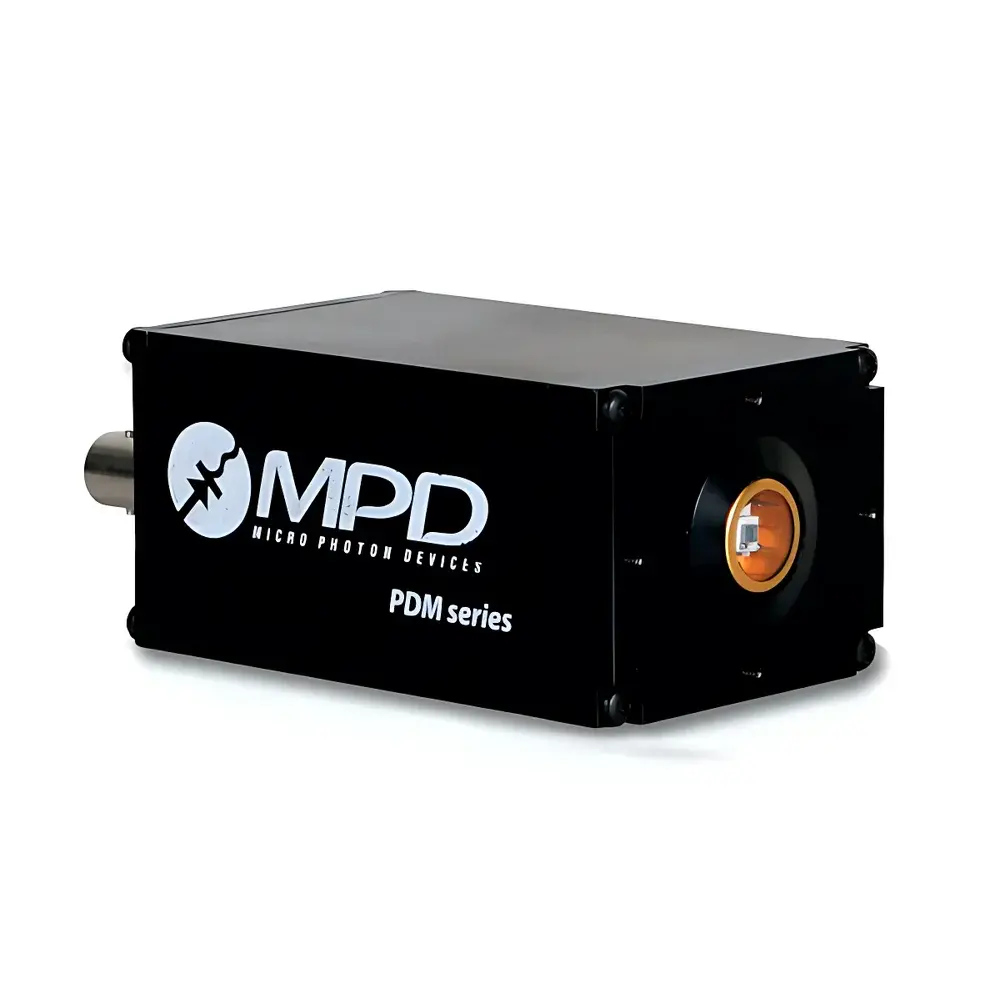
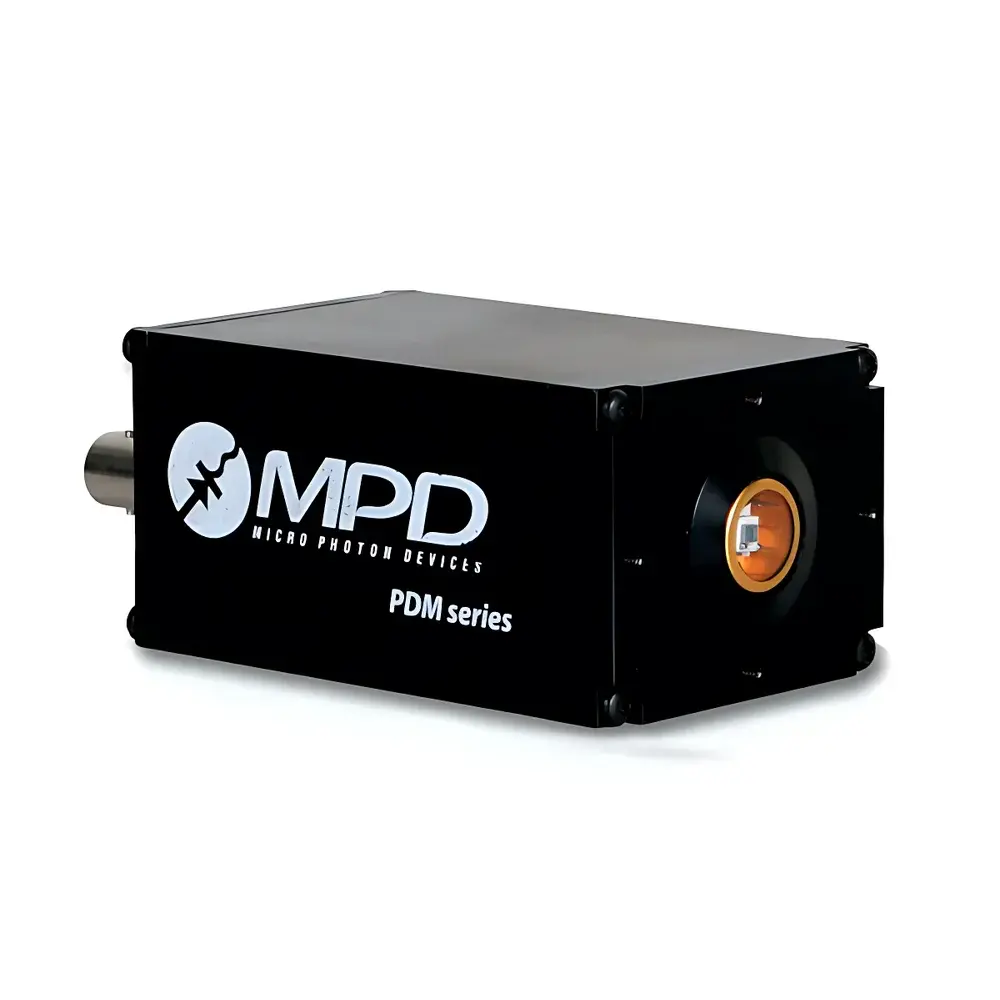
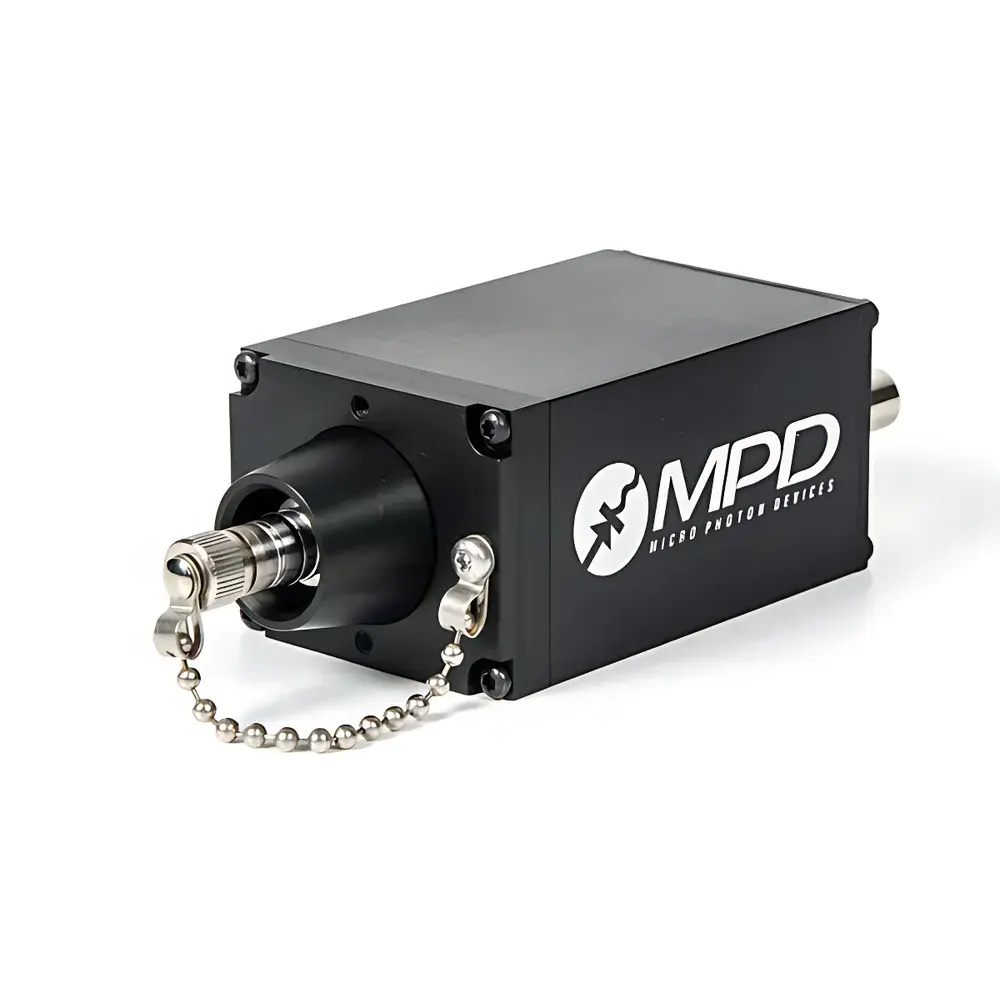
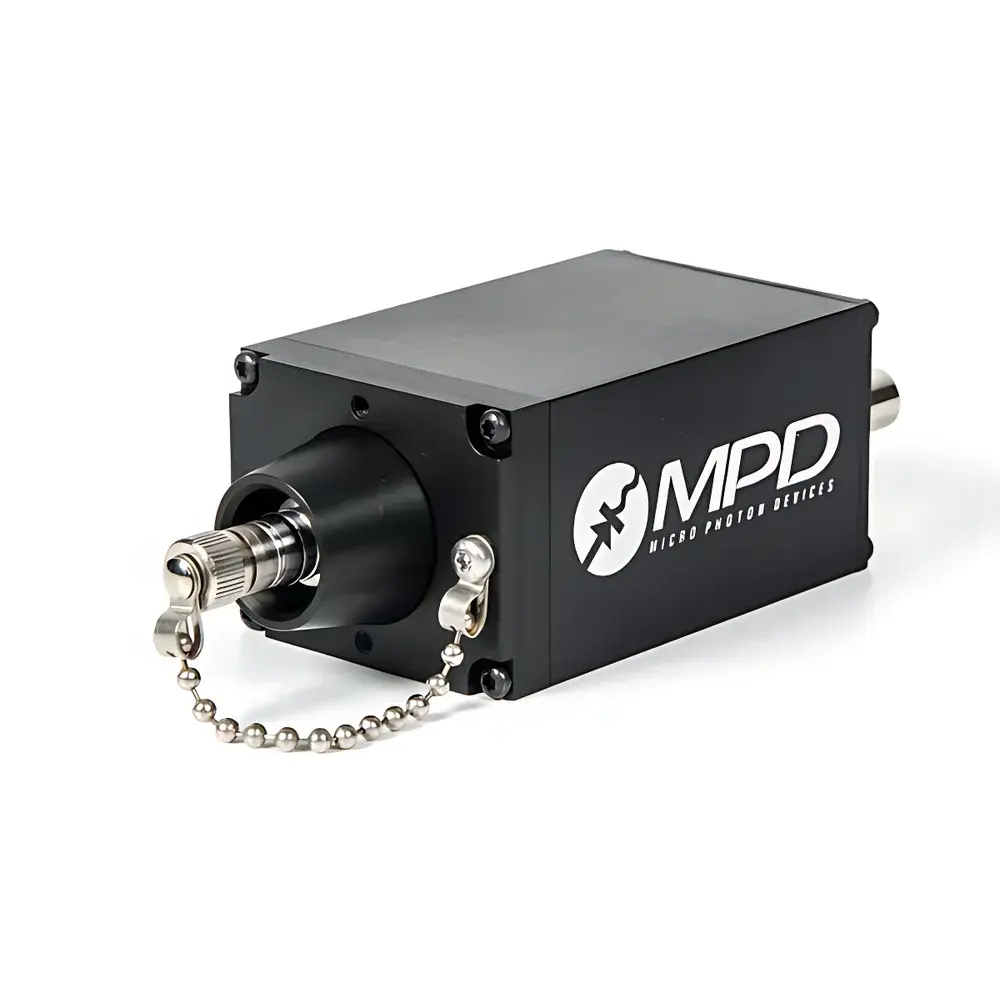
MPD PDM Series Single-Photon Avalanche Diode (SPAD) Detector Module
| Brand | MPD / Micro Photon Devices |
|---|---|
| Origin | Italy |
| Model | PDM Series |
| Wavelength Range | 400–1000 nm |
| Active Area Diameters | 20 µm, 50 µm, 100 µm |
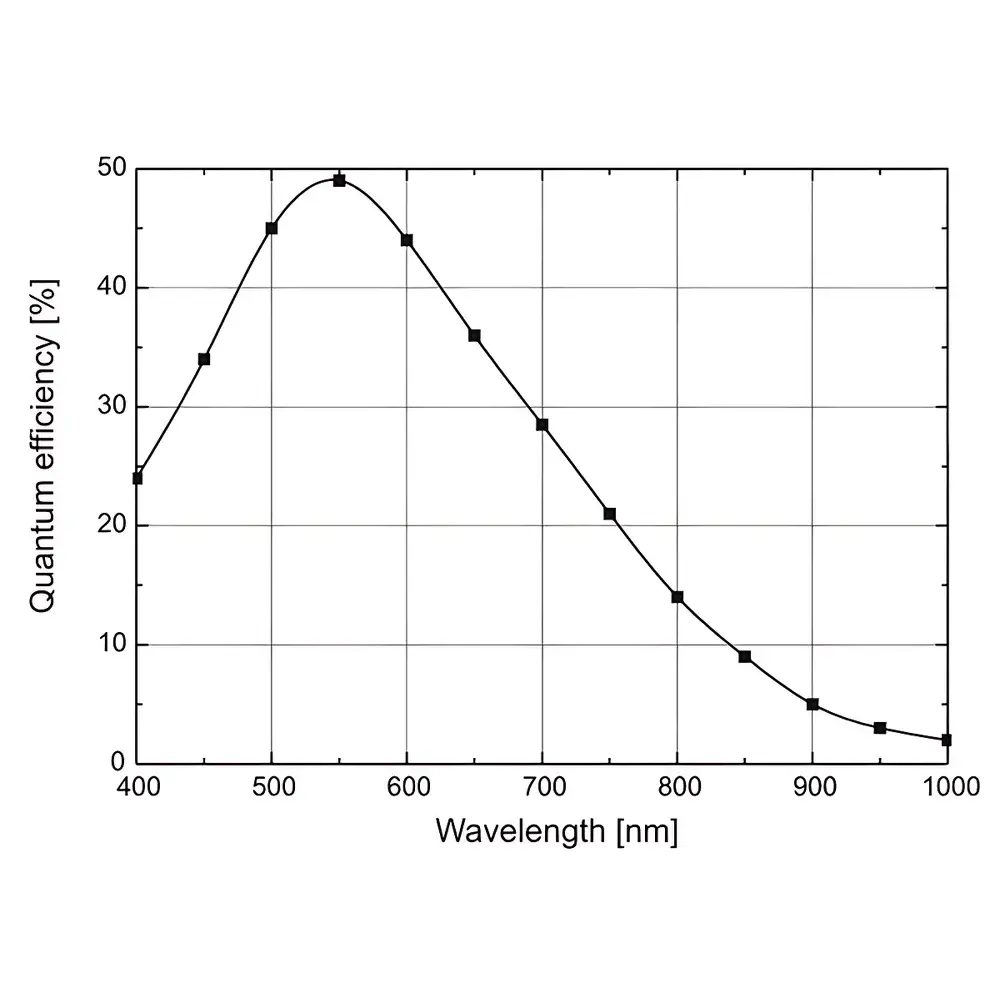
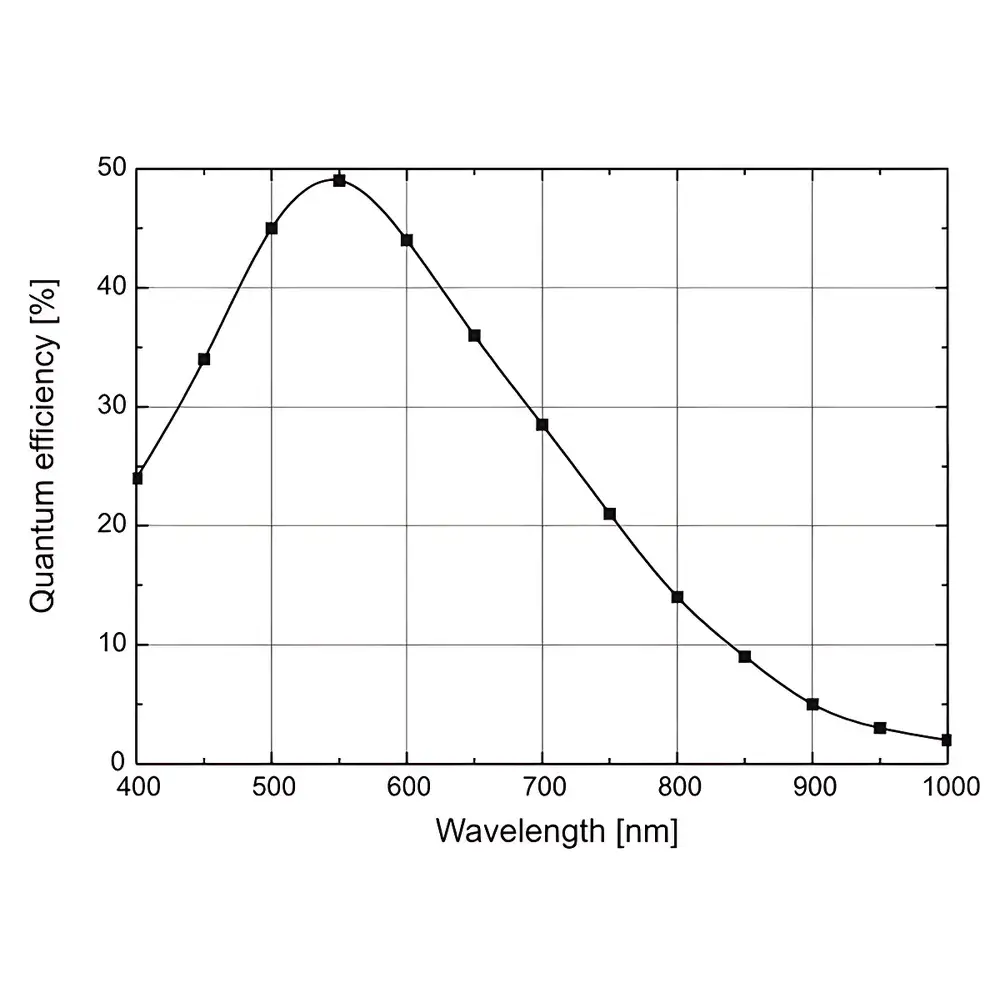
| Peak Detection Efficiency | 49% @ 550 nm |
| Dark Count Rate | <25 cps (20 µm), <50 cps (50 µm), <250 cps (100 µm) |
| Timing Resolution (FWHM) | <35 ps (typ.), <50 ps (max.) |
| Dead Time | <77 ns |
| Afterpulsing Probability | 0.1–3% |
| Cooling | Thermoelectric (Peltier) |
| Fiber Coupling Option | Yes, coupling efficiency >80% |
| Solar Radiation Tolerance | Designed for continuous ambient daylight exposure |
Overview
The MPD PDM Series is a family of high-performance Single-Photon Avalanche Diode (SPAD) detector modules engineered for time-resolved photonic measurements requiring picosecond-scale temporal fidelity and high quantum efficiency in the visible to near-infrared spectrum. Based on MPD’s proprietary iAQC (integrated Active Quenching Circuit) technology developed in Italy, these detectors operate in Geiger mode and deliver exceptional photon timing precision without compromising long-term stability or radiation hardness. Unlike traditional photomultiplier tubes (PMTs), the PDM modules integrate monolithic quenching circuitry directly with the SPAD die, enabling deterministic reset behavior, minimal afterpulsing, and sub-77 ns dead time—critical for high-count-rate fluorescence lifetime imaging (FLIM), time-correlated single-photon counting (TCSPC), and quantum optics experiments. The devices are passively or actively Peltier-cooled to suppress thermal noise, achieving dark count rates as low as 25 counts per second (cps) for the smallest 20 µm active area variant. Their robust packaging and optimized anti-reflection coatings ensure stable operation even under prolonged ambient daylight exposure—a key differentiator for field-deployable LIDAR and remote sensing applications.
Key Features
- Picosecond-level timing resolution: <35 ps FWHM (typical), <50 ps (guaranteed maximum), enabling ultrafast decay kinetics analysis
- High peak detection efficiency: 49% at 550 nm, with spectral response spanning 400–1000 nm
- Three standardized active area options: 20 µm, 50 µm, and 100 µm diameter, each optimized for trade-offs between timing jitter, dark count rate, and photon collection solid angle
- Integrated thermoelectric (Peltier) cooling for stable operation at –20 °C to –30 °C, minimizing thermal generation of carriers
- Fiber-coupled variants available with >80% coupling efficiency using FC/PC or SMA-905 interfaces, compatible with standard SMF-28 or multimode fibers
- Low afterpulsing probability (0.1–3%) and short dead time (<77 ns) support sustained count rates exceeding 10⁶ cps without significant pile-up distortion
- Monolithic iAQC architecture ensures deterministic quenching and recharging, eliminating external bias tuning and improving inter-unit reproducibility
Sample Compatibility & Compliance
The PDM Series is designed for integration into vacuum-compatible, optically isolated, and electromagnetically shielded measurement environments typical of quantum optics laboratories and regulated pharmaceutical analytics workflows. While not intrinsically certified for specific regulatory frameworks, its electrical and optical performance characteristics align with requirements for GLP-compliant TCSPC setups used in fluorescence-based assay development (e.g., USP <1043>, ISO 17025-accredited labs). The module’s low intrinsic noise floor, traceable calibration protocols (available upon request), and stable gain over temperature meet foundational criteria for ASTM E2861-19 (Standard Practice for Fluorescence Lifetime Measurements) and IEC 61228 (UV/Vis/NIR spectrophotometer verification). No hazardous substances are employed in construction; RoHS 3 and REACH compliance is documented per MPD’s EU Declaration of Conformity.
Software & Data Management
The PDM modules interface seamlessly with industry-standard TCSPC hardware platforms—including Becker & Hickl SPC-150NX, PicoQuant HydraHarp 400, and ID Quantique ID120—via TTL-compatible output signals (NIM/LVDS optional). Raw timestamps are acquired without onboard histogramming, preserving full temporal information for post-processing. MPD provides open API libraries (C/C++, Python) supporting cross-platform integration with LabVIEW, MATLAB, and custom acquisition software. All firmware supports firmware-upgradable timing calibration tables and configurable output polarity/delay settings. Audit-trail-capable data logging (timestamped, with detector temperature and bias voltage metadata) satisfies basic 21 CFR Part 11 readiness when deployed with validated host software and secure network architecture.
Applications
- Time-resolved fluorescence spectroscopy and FLIM for biological tissue characterization and protein conformation studies
- Single-molecule FRET and super-resolution microscopy (STED, PALM/STORM) requiring sub-50 ps event localization
- Fluorescence upconversion and time-gated Raman detection in turbid media
- LIDAR and atmospheric remote sensing with photon-starved return signals
- Quantum key distribution (QKD) systems operating at 850 nm and 1064 nm wavelengths
- Bell-state measurement and entanglement verification in photonic quantum computing testbeds
- Ultrafast laser pulse characterization via autocorrelation and streak-camera-free methods
FAQ
What cooling method does the PDM Series use, and what base temperature can it achieve?
The module employs integrated thermoelectric (Peltier) cooling, capable of stabilizing the SPAD junction at –20 °C to –30 °C under standard lab conditions (25 °C ambient), depending on heat-sink thermal resistance and drive current.
Is fiber coupling included by default, or is it an optional configuration?
Fiber coupling is an optional configuration; free-space and fiber-pigtailed versions are both available. FC/PC and SMA-905 connectors support coupling efficiencies >80% with appropriate mode matching.
How is timing resolution measured, and is it specified per unit or batch-averaged?
Timing resolution (FWHM) is measured using pulsed laser excitation (e.g., 405 nm, <5 ps pulse width) and deconvolved from instrument response; values are guaranteed per unit and verified during final QA testing.
Can the PDM Series be operated continuously under direct sunlight?
Yes—the device housing and optical window are engineered to withstand extended ambient daylight exposure without degradation, though optimal performance is achieved with controlled illumination and spectral filtering in high-flux environments.
Does MPD provide NIST-traceable calibration certificates for detection efficiency or timing response?
Traceable calibration reports (including spectral responsivity and timing jitter characterization) are available as optional add-ons, aligned with ISO/IEC 17025-accredited third-party metrology services upon request.