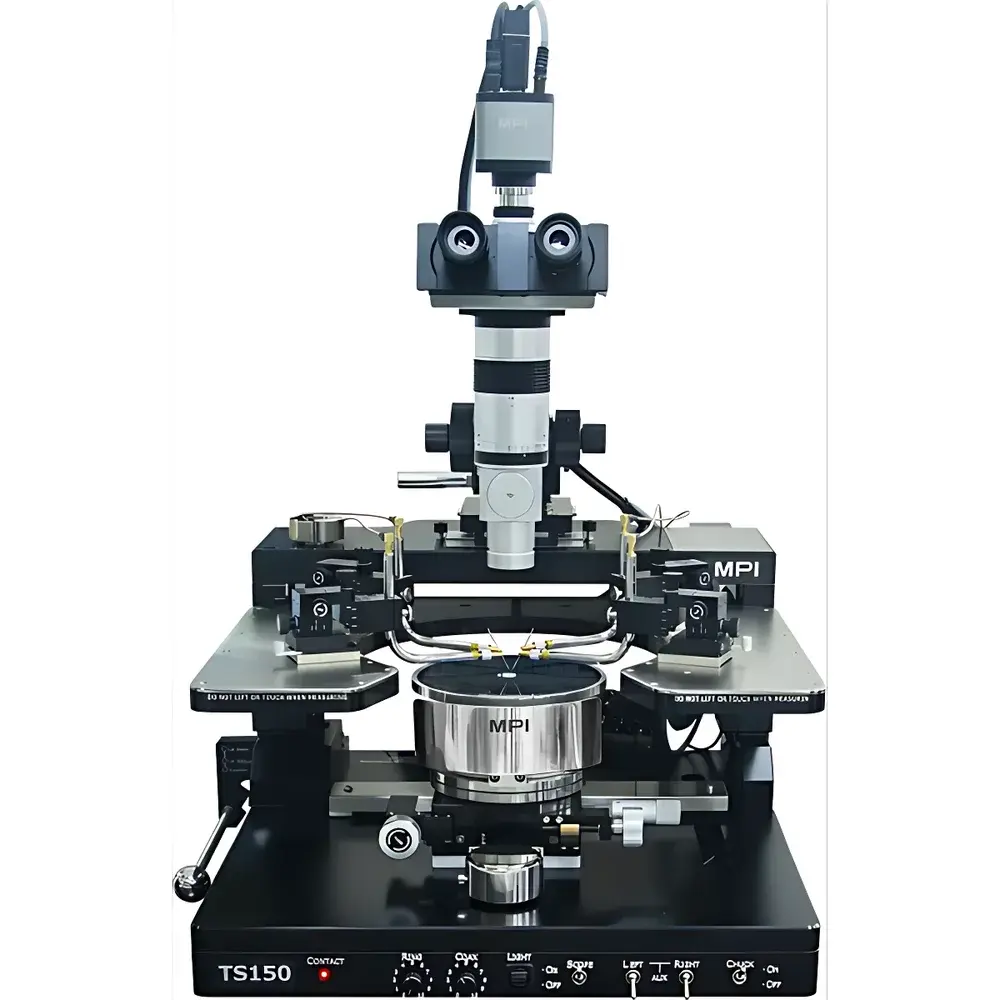
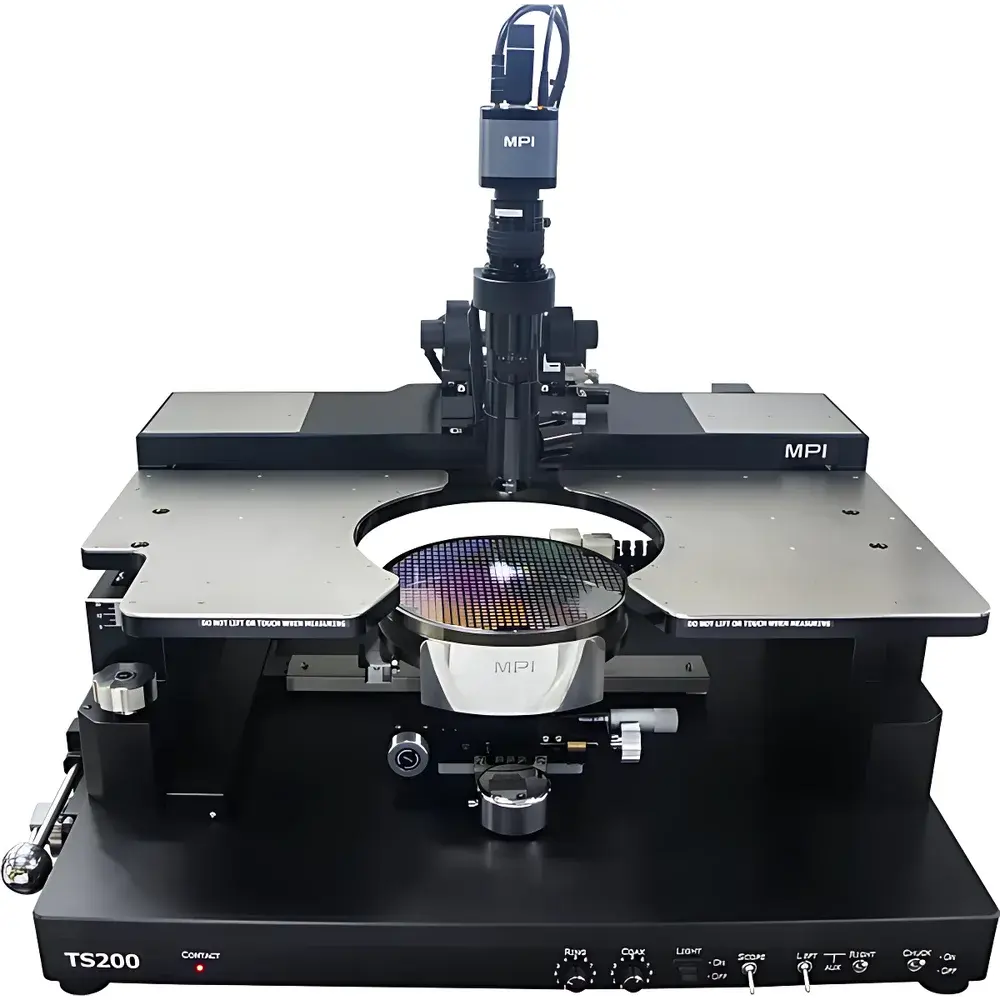
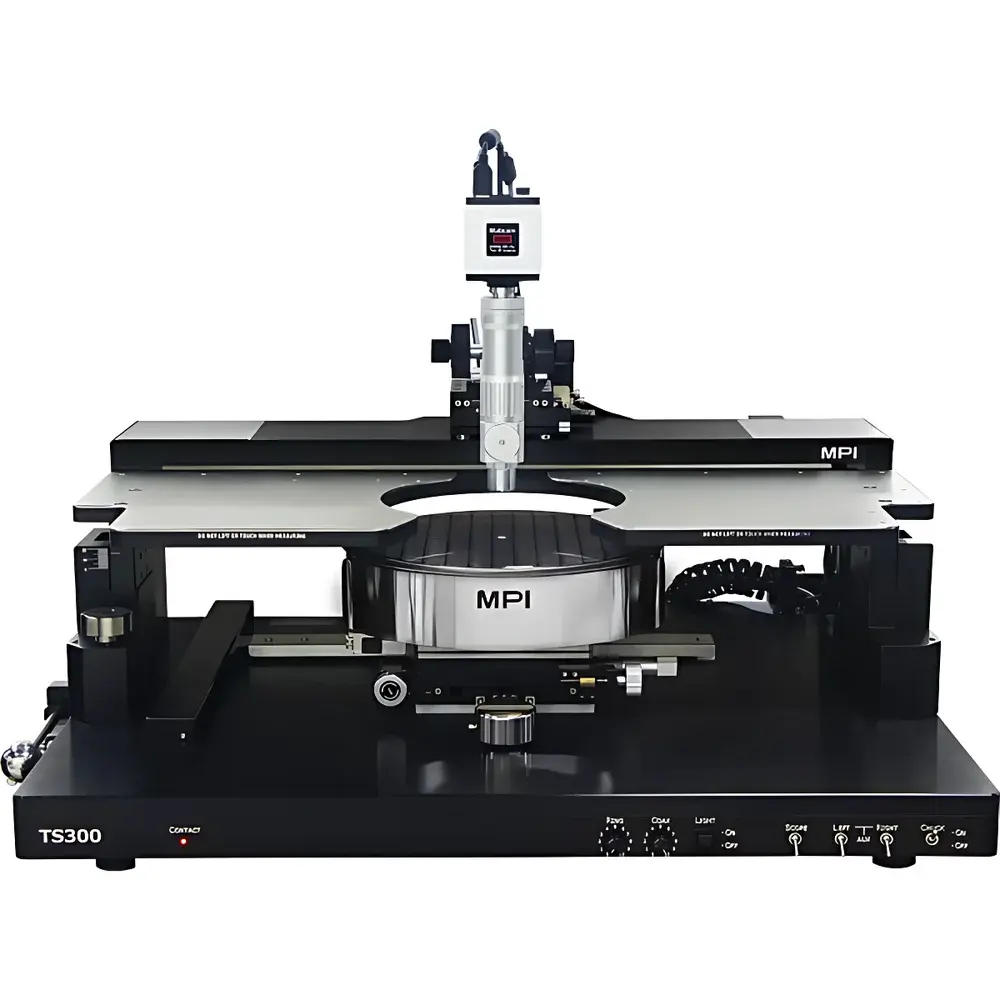
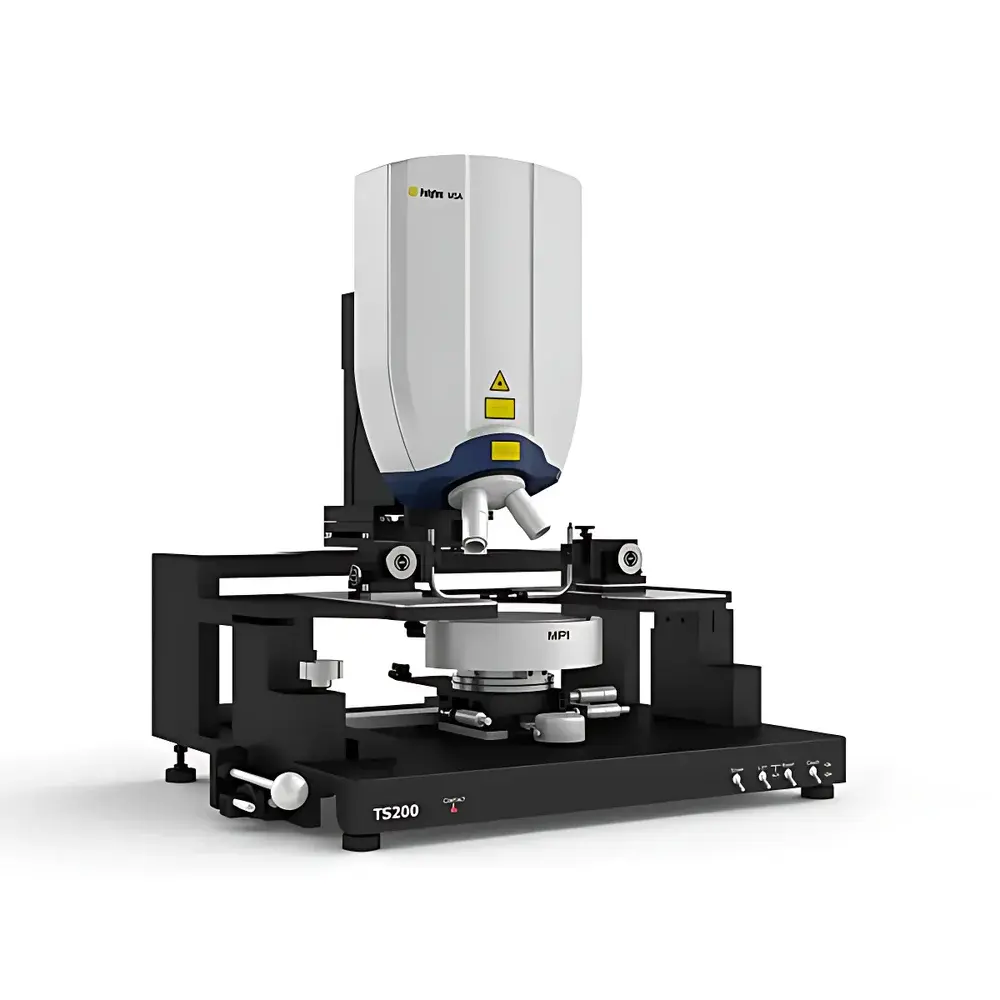
MPI TS150 / TS200 / TS300 Manual RF Probe Station
| Brand | MPI |
|---|---|
| Origin | Taiwan |
| Model | TS150 & TS200 & TS300 |
| Probe Station Type | Manual RF Probe Station |
| Wafer Compatibility | 150 mm (6″), 200 mm (8″), 300 mm (12″) |
| Platen Lift Range | 0–300 µm / 3 mm (3-stage) |
| Positioning Repeatability | ±1 µm |
| XY-θ Motion Stage | 25 × 25 mm with micrometer adjustment |
| Z-Axis Fine Adjustment | 25 mm travel with 1 mm engraved scale |
| RF MicroPositioner Capacity | up to 4 four-port RF probes or 10 DC probes |
| Thermal Chuck Compatibility | ERS-series temperature-controlled chucks (–60 °C to +300 °C) |
| Optical Options | MPI SZ10 stereo zoom, MZ12 monocular zoom, 90° tilt standard |
| Vibration Isolation | Integrated damping base |
| EMI Shielding | Optional light-tight, EMI-shielded enclosure |
Overview
The MPI TS150, TS200, and TS300 are precision-engineered manual RF probe stations designed for wafer-level electrical characterization of semiconductor devices under ambient, thermal, and low-noise conditions. Built upon MPI’s proprietary Platen Lift technology—featuring a three-stage (0–300 µm–3 mm), mechanically interlocked vertical motion system—the platform delivers sub-micron repeatability (±1 µm) and controlled, jerk-free probe touchdown. This architecture eliminates mechanical shock during contact, significantly reducing probe tip damage and die cracking risk while enhancing measurement stability across repeated cycles. The stations serve as foundational platforms for DC, CV, RF, and high-power device testing, supporting full integration with ERS thermal chucks, modular optical systems, and industry-standard RF calibration fixtures. All models comply with ISO 9001 manufacturing protocols and are engineered to support GLP-compliant test workflows in R&D, process development, and failure analysis laboratories.
Key Features
- Three-Stage Platen Lift System: Precision-machined lift mechanism with discrete contact, separation, and load positions; integrated safety lock prevents unintended descent during probe alignment.
- Air-Bearing XY Stage: Single-hand puck-controlled air-float motion enables rapid wafer navigation (25 × 25 mm range) without compromising micron-level positioning accuracy via calibrated micrometer dials.
- Modular Thermal Integration: Native compatibility with ERS-series temperature-controlled chucks (–60 °C to +300 °C), including vacuum-sealed, gas-cooled variants; thermal controller interface supports PID tuning and ramp/soak profiling.
- RF-Optimized MicroPositioner Mounting: Rigid Platen platform accommodates up to four 4-port RF micropositioners with rectangular alignment capability—ensuring precise probe-to-probe spacing and parallelism per IEEE 1382 RF probe calibration standards.
- Dual AUX RF Calibration Chucks: Two ceramic auxiliary chucks included for on-site S-parameter de-embedding and TRL calibration; compatible with Keysight, Anritsu, and Rohde & Schwarz VNAs.
- Optical Flexibility: Interchangeable optical paths: MPI SZ10 stereo zoom (for DC/CV alignment) or MZ12 monocular zoom (optimized for RF pitch < 100 µm); 90° tilt standard; motorized linear Z-lift for rapid probe head exchange.
Sample Compatibility & Compliance
The TS series supports full-wafer probing of 150 mm (6″), 200 mm (8″), and 300 mm (12″) substrates—including silicon, SiC, GaN, SOI, and compound semiconductor wafers—with flatness tolerances up to 50 µm TTV. Chuck options include coaxial, triaxial, and high-current configurations, all meeting SEMI E10–E12 mechanical interface specifications. RF modules conform to IEC 61000-4-3 (radiated immunity) and FCC Part 15B emission limits when used with optional EMI-shielded enclosures. The system is fully compatible with ASTM F2748 (wafer-level RF parameter measurement) and supports audit-ready documentation for ISO/IEC 17025-accredited labs.
Software & Data Management
While the TS series operates manually, it is fully interoperable with third-party automation and data acquisition ecosystems—including Keysight PathWave, FormFactor WinCal XE, and LabVIEW-based custom test sequencers—via standard GPIB, USB-TMC, and Ethernet (VXI-11) interfaces. Thermal controllers log timestamped temperature profiles with traceable calibration metadata. All mechanical adjustments (Z-height, XY position, theta rotation) are engraved or digitally readable, enabling manual test record linkage per FDA 21 CFR Part 11 Annex 11 requirements for non-automated instrumentation in regulated environments.
Applications
These probe stations are deployed in advanced semiconductor development for: wafer-level reliability (WLR) stress testing (HTOL, TDDB, NBTI); RF/mmWave transistor characterization (S-parameters, noise figure, power sweep); MEMS actuator and sensor electro-mechanical validation; high-power GaN HEMT parametric analysis; IC failure analysis (FA) using nanoprobing and laser-assisted defect localization; and compact model extraction for BSIM, PSP, and HiSIM compact models. They are routinely used in foundry PDK validation, university device physics research, and automotive-grade AEC-Q200 qualification labs.
FAQ
What wafer sizes does the TS series support?
The TS150 supports 150 mm wafers; TS200 supports 200 mm; TS300 supports 300 mm. Each model uses interchangeable chuck adapters compliant with SEMI MF-1530 mechanical reference planes.
Is thermal chuck integration plug-and-play?
Yes—ERS chucks mount directly to the Platen interface using standardized vacuum and coolant port layouts; thermal controller communication is auto-detected via RS-485 or Ethernet.
Can the system be upgraded to semi-automated operation?
All TS models feature motorized Z-axis and optional motorized XY stages; retrofit kits for closed-loop motion control and script-driven probe landing are available through MPI Field Service.
Does the system meet electromagnetic compatibility requirements for RF labs?
When equipped with the optional EMI-shielded enclosure (model ENC-TS-RF), the system meets CISPR 22 Class B radiated emission limits and provides >60 dB attenuation from 10 kHz to 18 GHz.
What optical magnification ranges are supported?
The SZ10 stereo zoom offers 6.7×–45× continuous magnification; the MZ12 monocular zoom provides 10×–120× with optimized working distance for RF probe tips down to 25 µm pitch.