
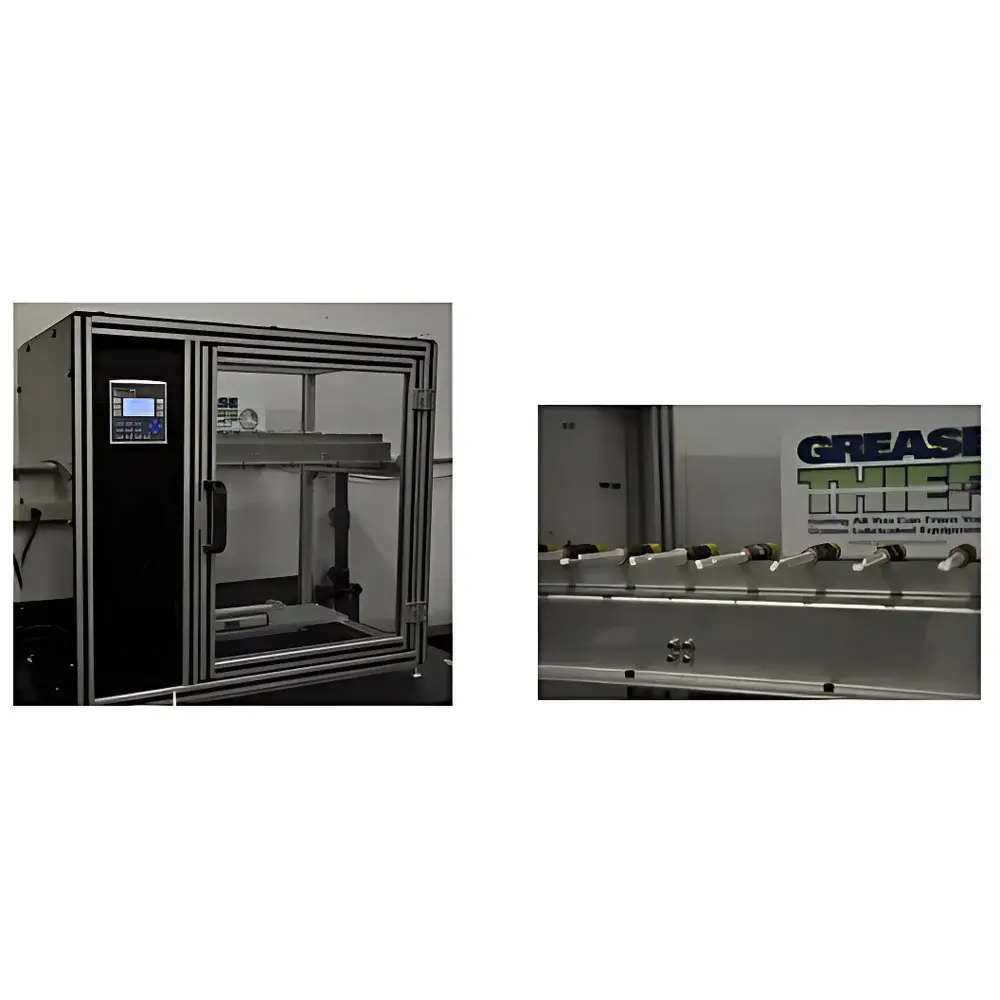
MRG GREASE THIEF© Analytical Chamber
| Brand | MRG |
|---|---|
| Origin | USA |
| Manufacturer Type | Authorized Distributor |
| Import Status | Imported |
| Model | GREASE THIEF© |
| Pricing | Upon Request |
| Dimensions | 82 × 49 × 74 cm |
| Weight | 57 kg |
| Power Supply | 240 VAC, 50 Hz, 2.7 A |
| Operating Temperature Range | 15–27 °C |
| Measured Parameter | Grease Extrusion Index (% New Grease) |
| Sample Mass | 0.25 g |
| Sampling Standard | ASTM D7718 |
| Environmental Control | Microprocessor-based PID controller with thermocouple temperature sensor |
| Consumables | 12 pre-loaded disposable kits included |
| Data Storage | 512 MB SD card |
| Data Interface | RS-232 serial output |
| Display | 2.4-inch LCD with 20-key membrane keypad |
Overview
The MRG GREASE THIEF© Analytical Chamber is a purpose-built, benchtop instrument engineered for rapid, quantitative assessment of grease consistency and compositional stability under controlled thermal conditions. It operates on the principle of controlled extrusion—applying standardized axial force to a fixed mass (0.25 g) of grease contained within a single-use, precision-machined cartridge—while maintaining strict thermal regulation via a microprocessor-driven PID loop and calibrated thermocouple feedback. The resulting extrusion index, expressed as “% New Grease”, provides a reproducible metric correlated with grease thickener degradation, base oil bleed, and additive depletion. Unlike conventional cone penetration or worked penetration methods, the GREASE THIEF© eliminates operator-dependent mechanical variables and eliminates inter-sample carryover by design—each test employs a sterile, factory-calibrated disposable kit. This architecture aligns with ISO 2137 and ASTM D217/D1403 foundational principles while introducing process standardization critical for QC laboratories operating under GLP or ISO/IEC 17025 frameworks.
Key Features
- Disposable cartridge-based workflow: Eliminates cleaning cycles, reduces labor time by >90% per test, and removes risk of cross-contamination between samples.
- Integrated thermal management system: PID-controlled heating block with Class I thermocouple sensing ensures ±0.3 °C stability across the 15–27 °C operating range—critical for evaluating temperature-sensitive greases such as lithium-complex or polyurea formulations.
- ASTM D7718-compliant operation: Fully implements the standard’s procedural requirements for extrusion rate, dwell time, and force application profile without manual intervention.
- Built-in data integrity infrastructure: All measurements are timestamped, annotated with ambient temperature and cartridge lot ID, and stored locally on a tamper-resistant 512 MB SD card compliant with FAT32 formatting for long-term archival.
- RS-232 serial interface enables direct integration with LIMS or enterprise QA databases; supports ASCII-formatted output with configurable delimiter and carriage-return settings.
- Intuitive human-machine interface: 2.4-inch high-contrast LCD display with backlight and tactile 20-key membrane keypad allows full operation without external PC—ideal for production-floor deployment.
Sample Compatibility & Compliance
The GREASE THIEF© accommodates NLGI grades 000 through 3, including mineral-oil, synthetic hydrocarbon, PAO, and ester-based greases containing lithium, calcium sulfonate, aluminum complex, or clay thickeners. Each disposable kit is pre-validated for dimensional repeatability (±2 µm tolerance on die orifice diameter) and surface finish (Ra < 0.4 µm), ensuring consistent shear history during extrusion. The instrument meets electromagnetic compatibility requirements per EN 61326-1:2013 and safety standards IEC 61010-1:2010. Its operational methodology supports compliance with FDA 21 CFR Part 11 when paired with validated software for electronic signature capture and audit trail generation—though native firmware does not include e-signature functionality, the RS-232 log export satisfies raw data retention mandates under USP and ISO/IEC 17025:2017 Clause 7.5.2.
Software & Data Management
No proprietary PC software is required for basic operation; however, MRG provides optional Windows-compatible configuration utility (v3.2+) for advanced calibration offset adjustment, batch report generation (CSV/PDF), and SD card forensic analysis. All stored datasets include embedded metadata: test ID, date/time stamp, operator code (user-input), ambient temperature, cartridge serial number, and raw extrusion displacement waveform (sampled at 100 Hz). Audit trails are retained in non-volatile memory for ≥10,000 test records and support third-party validation protocols for GMP environments. Data export conforms to ASTM E1482-20 Annex A1 for analytical instrument data interchange.
Applications
- Quality control release testing of incoming grease batches against supplier specifications.
- Stability monitoring of in-service greases recovered from bearings or gearboxes—used alongside FTIR and RULER® to triage oxidation state.
- R&D screening of new thickener systems or base oil blends where rapid comparative extrusion profiling accelerates formulation iteration.
- Field-deployable assessment in maintenance depots where lab-grade penetrometers are impractical due to size, calibration burden, or contamination sensitivity.
- Regulatory documentation support for automotive OEMs requiring traceable, repeatable grease performance metrics aligned with SAE J300 or DIN 51825.
FAQ
Is the GREASE THIEF© suitable for testing biodegradable or vegetable-oil-based greases?
Yes—its thermal control range (15–27 °C) avoids thermal degradation of sensitive ester bases, and the disposable cartridge prevents residue buildup that could alter rheology in subsequent tests.
Can the instrument be recalibrated in-house?
Field recalibration is restricted to zero-force verification using certified deadweight standards; full metrological calibration requires return to MRG-certified service centers per ISO/IEC 17025-accredited procedures.
What is the expected lifetime of the heating block assembly?
Rated for ≥50,000 thermal cycles under continuous use at 25 °C; mean time between failures exceeds 8 years at typical QC lab throughput (≤20 tests/day).
Does the SD card require periodic formatting?
No—firmware implements wear-leveling and automatic file rotation; manual formatting voids calibration traceability and is not supported.
Is ASTM D7718 the only applicable standard?
While D7718 is the primary reference, the extrusion index correlates empirically with ASTM D1092 (grease dropping point) and ISO 6743-9 (lubricant classification), enabling cross-standard trending when validated per laboratory SOP.





