
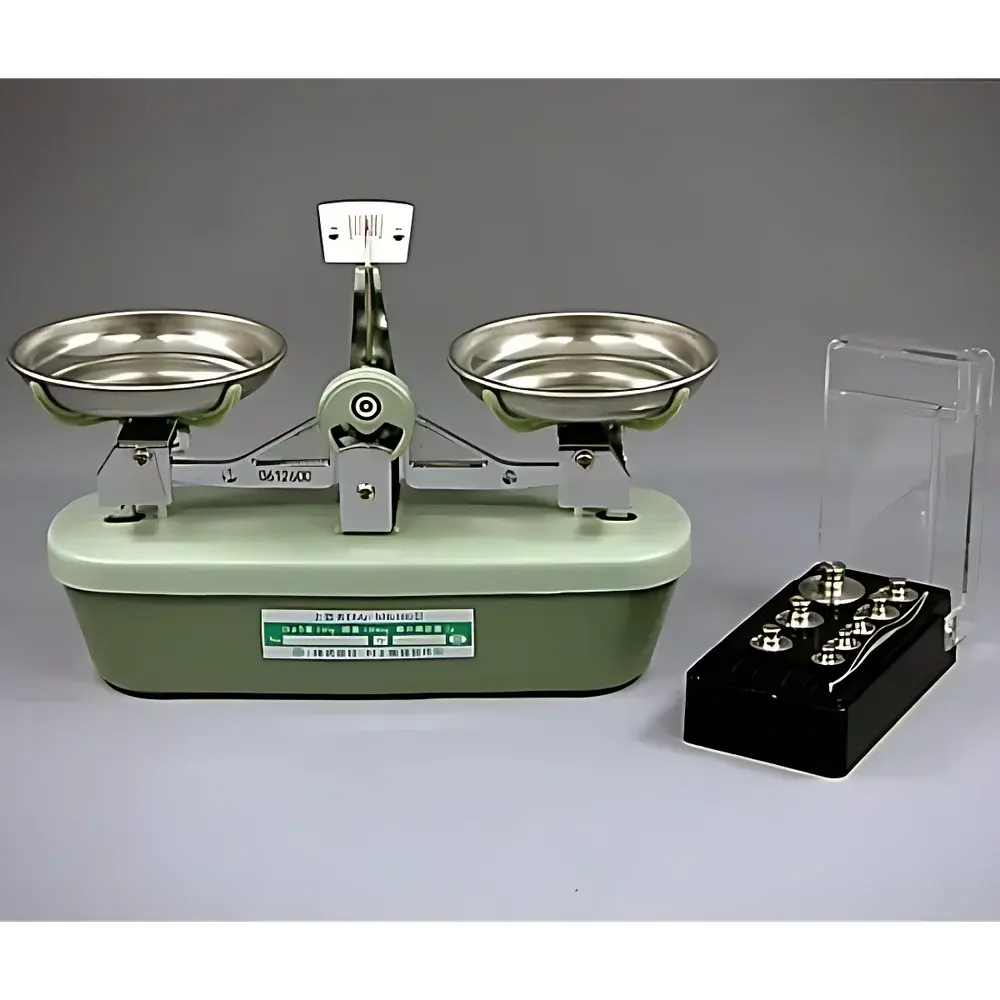
AND MS-50 Standard Precision Balance (Resin Housing)
| Brand | AND/A&D |
|---|---|
| Origin | Japan |
| Model | MS-50 |
| Capacity | 50 g |
| Readability | 50 mg |
| Net Weight | 295 g |
| Dimensions (W×D×H) | 195 × 80 × 135 mm |
| Housing Material | Impact-Resistant Engineering Resin |
| Packaging Dimensions | 400 × 300 × 270 mm |
| Certification | JIS Class III Compliant (Certified by Japanese National Metrology Institute, stamped official certificate provided) |
Overview
The AND MS-50 Standard Precision Balance is a compact, high-reliability analytical instrument engineered for routine mass measurement tasks in educational laboratories, quality control environments, and field-based technical applications. Designed and manufactured in Japan under strict adherence to JIS B 7721 (Japanese Industrial Standard for non-automatic weighing instruments), this balance operates on electromagnetic force restoration (EMFR) principle—ensuring stable, drift-free readings without mechanical levers or knife-edge pivots. Its 50 g maximum capacity and 50 mg readability deliver consistent repeatability under ambient laboratory conditions (20 ± 5 °C, RH ≤ 80 %, non-condensing). The unit is calibrated at the factory using traceable NMIJ (National Metrology Institute of Japan)-certified weights and ships with a stamped JIS Class III conformity certificate—validating compliance with statutory metrological requirements for trade-related and instructional use in Japan and other jurisdictions recognizing JIS equivalency.
Key Features
- Impact-resistant engineering resin housing—lightweight (295 g net), corrosion-resistant, and optimized for portability without compromising structural rigidity or vibration damping.
- Stainless steel weighing pan (integrated, non-removable) providing chemical resistance and ease of cleaning—compatible with common solvents and mild disinfectants.
- EMFR sensor architecture delivering intrinsic linearity, low temperature coefficient (< 2 ppm/°C), and minimal warm-up time (< 60 seconds to operational stability).
- Zero-tracking function with automatic drift compensation during idle periods—maintaining baseline integrity without manual re-zeroing.
- Simple two-button interface (TARE and UNIT) enabling intuitive operation without menu navigation—reducing training overhead in teaching labs or production floor settings.
- JIS Class III certification documented via physically stamped national metrology certificate—supporting audit readiness for GLP-aligned workflows and internal calibration records.
Sample Compatibility & Compliance
The MS-50 accommodates solid, granular, and low-viscosity powdered samples within its 50 g limit. Its open-top resin enclosure allows unobstructed access for spatula-based loading and visual verification—ideal for classroom demonstrations, raw material checks, and formulation pre-weighing. The stainless steel pan resists oxidation from salts, organic acids, and aqueous solutions; however, prolonged exposure to halogenated solvents or strong alkalis is not recommended. The device meets JIS B 7721-1:2018 for accuracy class III and conforms to OIML R 76-1 (International Organization of Legal Metrology) reference requirements for non-automatic instruments used in legally regulated applications. While not FDA 21 CFR Part 11–enabled (lacking electronic audit trail functionality), its physical certificate and deterministic output support paper-based QC documentation per ISO 9001:2015 clause 7.1.5.2.
Software & Data Management
The MS-50 operates as a standalone instrument with no embedded software, USB interface, or data logging capability. All measurements are displayed locally on a 5-digit LCD with 12 mm high numerals—optimized for viewing at 0.5 m distance under standard illumination (≥ 300 lux). Output is strictly analog-to-digital converted and presented in grams only; no unit conversion (e.g., oz, carat) or statistical functions (e.g., averaging, deviation) are implemented. For integration into digital lab notebooks or LIMS, external serial-to-USB adapters (RS-232 compatible, TTL-level) may be used with third-party terminal emulation software—though AND does not supply or validate such configurations. Calibration history must be manually recorded per internal SOPs, aligned with ISO/IEC 17025:2017 clause 6.4.10.
Applications
- Student laboratory exercises in chemistry and physics—measuring reagent masses, reaction stoichiometry verification, and density determination protocols.
- In-process checks of tablet or capsule weight variation in pharmaceutical manufacturing (pre-compression stage, non-GMP environment).
- Calibration verification of pipettes and volumetric glassware using water displacement method (ASTM E542-22 Annex A1).
- Inventory management of small components (e.g., PCB parts, fasteners, seeds) where ±50 mg tolerance is acceptable.
- Field-deployed environmental sampling—soil aliquot preparation, filter paper pre/post-weighing for particulate matter analysis (EPA Method 201A).
FAQ
Is the MS-50 suitable for GMP-regulated weighing tasks?
No. It lacks documented calibration traceability to SI units via accredited providers, electronic audit trail, and password-protected configuration—key requirements under EU Annex 11 and FDA 21 CFR Part 11.
Can the balance be recalibrated in-house?
Yes—using a certified 50 g Class M2 weight (or lower uncertainty standard); however, internal calibration procedure requires AND’s proprietary adjustment tool and is not user-accessible without service authorization.
Does the resin housing meet IP rating standards?
No IP rating is assigned. The enclosure provides splash resistance but is not sealed against dust ingress or immersion—intended for dry, controlled indoor environments only.
Is temperature compensation automatic?
Yes—the EMFR sensor includes built-in thermal drift correction across 15–25 °C; performance outside this range is not specified in the JIS Class III declaration.
What is the recommended recalibration interval?
AND recommends verification before each use in critical applications; formal recalibration every 6 months when used daily in stable ambient conditions per JIS Z 8401.



