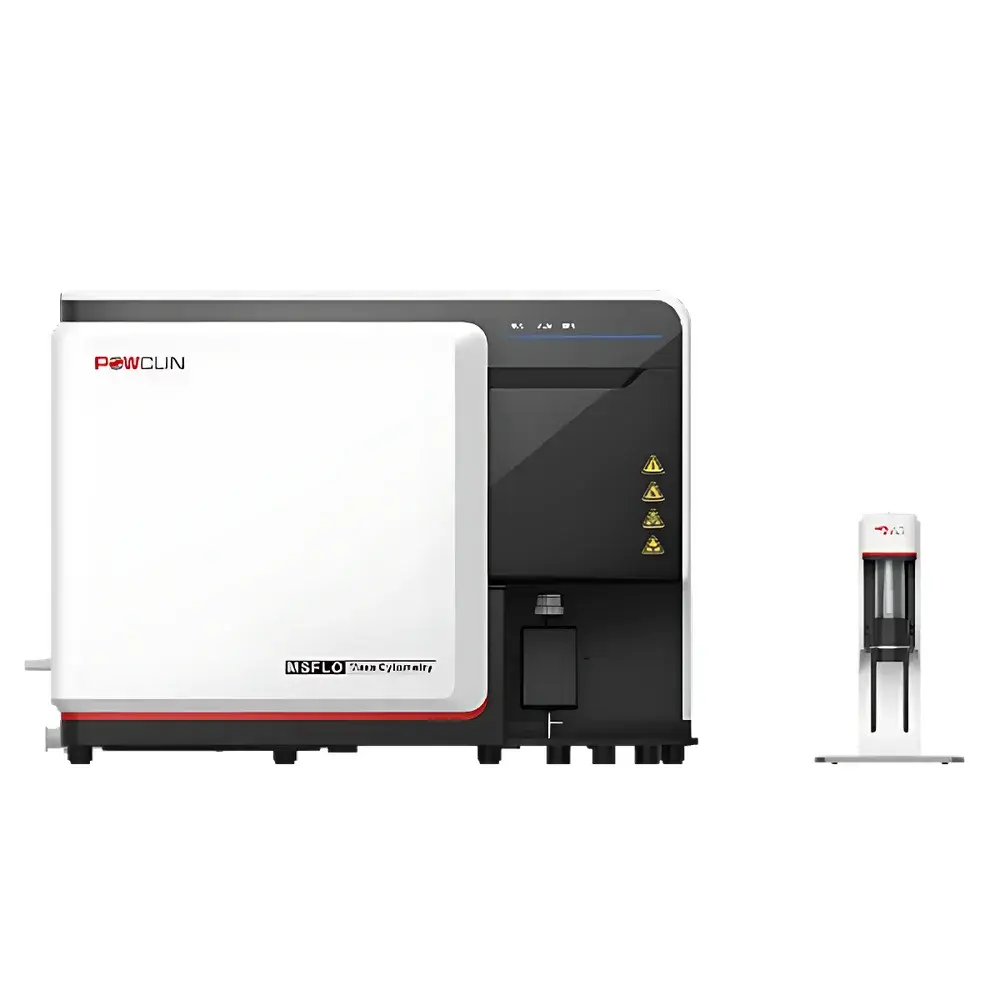
MSFLO Desktop Mass Cytometry System
| Brand | POWCLIN |
|---|---|
| Origin | Zhejiang, China |
| Manufacturer Type | Authorized Distributor |
| Product Category | Domestic |
| Model | MSFLO |
| Pricing | Upon Request |
| Technology Platform | Mass Cytometry (ICP-TOF) |
| Instrument Type | Flow Cytometer for Single-Cell Metal Isotope Detection |
| Primary Use Case | Academic & Translational Research |
Overview
The MSFLO Desktop Mass Cytometry System is a compact, high-performance benchtop instrument engineered for single-cell proteomic and signaling analysis using inductively coupled plasma time-of-flight mass spectrometry (ICP-TOF MS). Unlike conventional fluorescence-based flow cytometers, the MSFLO leverages metal-conjugated antibodies tagged with stable isotopes (e.g., lanthanides), enabling simultaneous detection of >40 parameters per cell with minimal spectral overlap. Its core architecture integrates a vertically oriented plasma torch—designed to enhance plasma stability, improve signal reproducibility (RSD < 3% over 4-hour runs), and reduce argon consumption by up to 25% compared to horizontal configurations. Ion transmission efficiency is optimized via a 90° off-axis ion optics path, which physically separates neutral species from charged analyte ions prior to mass analysis, thereby eliminating background noise without requiring periodic lens cleaning or realignment.
Key Features
- Vertical ICP Torch Configuration: Ensures consistent plasma ignition, thermal equilibrium, and reduced matrix-induced signal drift during extended acquisition.
- Reflectron-Based Time-of-Flight Mass Analyzer: Delivers sub-microsecond transient response, enabling high-speed data acquisition (>1,000 events/sec at full mass range) with mass resolution (m/Δm) > 300 at m/z 159 (¹⁵⁹Tb).
- Water-Cooled Collision/Reaction Cell with Orthogonal Gas Inlet: Employs distributed gas diffusion geometry and orthogonal introduction of helium/hydrogen reaction gases—enabling both polyatomic interference removal (e.g., ⁴⁰Ar¹⁶O⁺ on ⁵⁶Fe⁺) and controlled ion-molecule reaction studies.
- Off-Axis Ion Transmission Pathway: Incorporates dedicated neutral particle collection trap, eliminating the need for routine ion lens maintenance while maintaining >75% ion transmission efficiency across the 75–210 Da mass window.
- Multi-Mode Quadrupole Pre-Filter: Supports bandpass (full-spectrum acquisition), notch-filter (interference rejection), and single-ion monitoring (SIM) modes—enhancing flexibility for targeted panel validation, discovery workflows, or isobaric correction strategies.
Sample Compatibility & Compliance
The MSFLO accepts standard 5-mL polystyrene FACS tubes and is compatible with commercially available metal-tagged antibody panels (Fluidigm/MAXPAR®-certified reagents) as well as custom-labeled probes validated per ISO 13485–aligned conjugation protocols. Sample introduction utilizes standard quartz nebulizers and cyclonic spray chambers. The system meets electromagnetic compatibility requirements per IEC 61326-1:2020 and operates within Class II laser safety standards (IEC 60825-1:2014) for internal alignment diagnostics. While not FDA-cleared for clinical diagnostics, its data output structure supports GLP-compliant audit trails when integrated with validated LIMS environments adhering to 21 CFR Part 11 principles.
Software & Data Management
Acquisition and preliminary processing are managed through CytoBank-compatible desktop software (v3.2+), supporting real-time event visualization, live compensation matrix generation, and automated bead-based normalization. Raw .fcs and vendor-specific .cyt binary files are generated with embedded metadata (including acquisition date, operator ID, calibration status, and instrument configuration logs). Export modules support HDF5 and MEX formats for downstream analysis in R/Bioconductor (Cytofkit, CATALYST), Python (FlowKit, scCODA), or MATLAB-based clustering pipelines. All software modules undergo annual penetration testing and maintain SHA-256 cryptographic integrity verification for executable binaries.
Applications
The MSFLO serves as a critical platform for deep immunophenotyping, particularly in translational oncology and systems immunology. It enables quantitative profiling of surface and intracellular phospho-protein markers across heterogeneous tumor infiltrating lymphocyte (TIL) subsets, facilitating spatially resolved immune microenvironment mapping when combined with imaging mass cytometry preprocessing workflows. In drug discovery, it supports mechanism-of-action studies via longitudinal signaling cascade interrogation (e.g., p-STAT, p-ERK, p-S6 kinetics post-stimulation). Additional use cases include hematopoietic lineage tracing, autoantibody-mediated immune dysregulation profiling in SLE/RA cohorts, and host-pathogen interaction analysis in biosafety level-2 (BSL-2) compliant laboratories.
FAQ
Is the MSFLO compatible with existing metal isotope antibody panels?
Yes—it supports all commercially available MAXPAR®-validated reagents and third-party conjugated antibodies meeting ISO/IEC 17025 traceability requirements for elemental labeling efficiency.
What maintenance intervals are recommended for the plasma torch and ion optics?
The vertical torch requires no scheduled replacement under normal operation; routine inspection every 200 hours is advised. The off-axis ion path eliminates lens fouling—no quarterly cleaning is necessary.
Can the system be integrated into an automated sample preparation workflow?
It interfaces with standard autosamplers (e.g., Hamilton STAR, PerkinElmer Janus) via RS-232 and Ethernet APIs, supporting unattended 96-well plate acquisition with barcode-triggered method recall.
Does the MSFLO meet regulatory requirements for GMP-aligned research?
While not a GMP-certified device, its software architecture includes electronic signature support, configurable audit trail logging, and version-controlled method storage—fully aligned with ALCOA+ data integrity principles for preclinical development studies.