
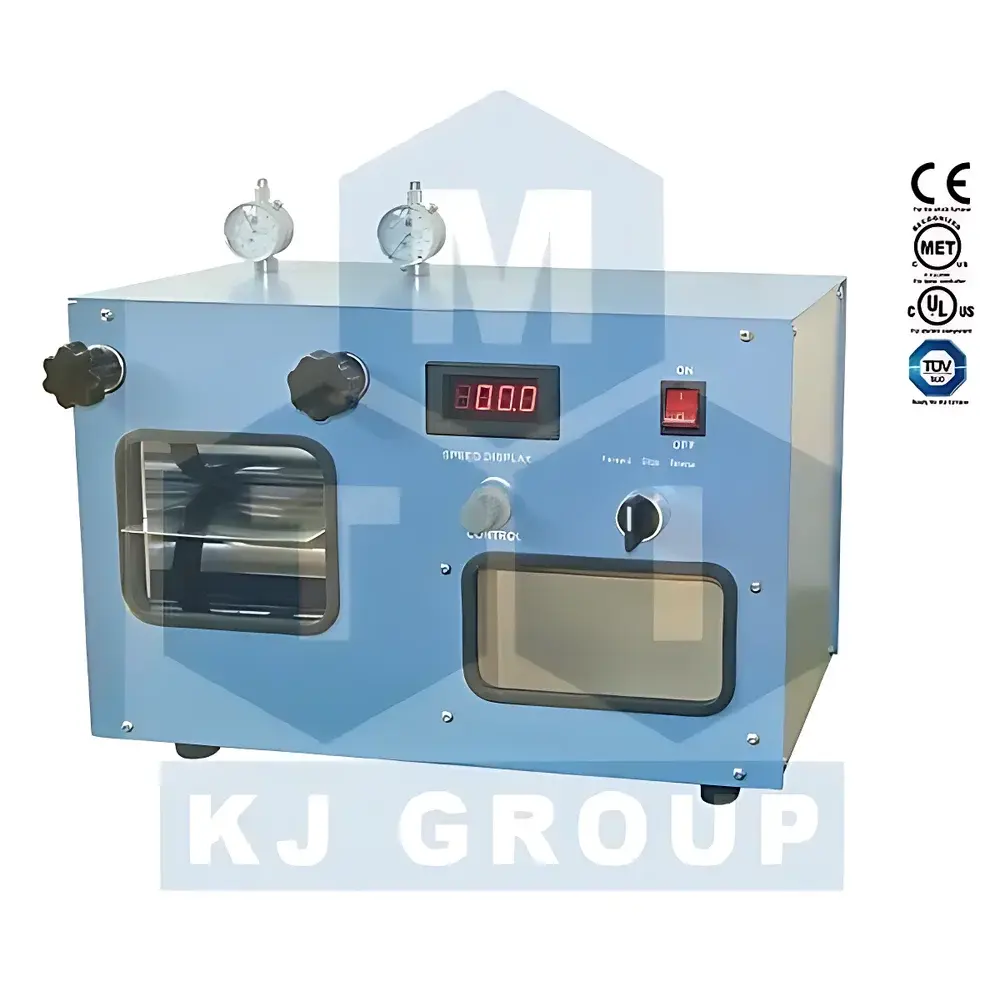
MTI MSK-MR100DC Adjustable-Speed Electric Calendering Roll Press
| Brand | MTI Corporation (formerly Hefei Kejing) |
|---|---|
| Model | MSK-MR100DC |
| Roller Diameter × Length | Φ100 mm × 100 mm |
| Roller Surface Hardness | RC > 62 (Chromium-plated carbon steel) |
| Gap Adjustment Range | 0–1.8 mm (micrometer-verified) |
| Linear Speed | 5–40 mm/s (continuously adjustable via potentiometer) |
| Drive Motor | 24 V DC, high-torque, max. current 1.8 A, rated power 40 W |
| Input Power | 110–220 V AC, 50/60 Hz |
| Dimensions (L×W×H) | 430 × 175 × 290 mm |
| Weight | Approx. 18 kg |
| Compliance | CE, UL/CSA-certified external power supply |
| Max. Sample Hardness | ≤50 HRC |
| Min. Final Thickness (typical) | 0.04 mm (graphite-coated Cu foil), 0.09 mm (LiFePO₄-coated Al foil) |
Overview
The MTI MSK-MR100DC is a compact, benchtop electric calendering roll press engineered for precise thickness reduction and density enhancement of electrode coatings in battery R&D laboratories. It operates on the principle of cold, two-roll calendering—where a coated substrate (e.g., metal foil with active material slurry) passes through a precisely controlled nip between two counter-rotating rollers under defined linear velocity and compressive gap. The system utilizes a 24 V DC brushless motor with high torque output and low electromagnetic interference, enabling safe operation inside inert-atmosphere gloveboxes (e.g., Ar or N₂ environments). Its modular architecture, chromium-plated hardened steel rollers (RC > 62), and micrometer-based gap adjustment ensure repeatable mechanical deformation without thermal degradation—critical for preserving binder integrity and particle morphology in Li-ion and Na-ion electrode fabrication.
Key Features
- Adjustable linear speed from 5 to 40 mm/s via front-panel potentiometer—enabling controlled strain rate application across diverse coating viscoelasticities.
- 0–1.8 mm precision gap setting, verified with calibrated dial indicator; ensures sub-10 µm repeatability in final thickness control.
- Inert-compatible design: All electronics (except external AC/DC converter) operate at ≤24 V DC; no spark hazards or outgassing concerns in sealed glovebox integration.
- Roller construction: AISI 1045 carbon steel core with electroplated Cr layer (≥30 µm thickness), delivering wear resistance, chemical inertness toward common battery solvents (NMP, water), and easy cleaning.
- Bi-directional operation (forward/reverse/stop) supports iterative thinning protocols—essential for avoiding delamination or cracking during multi-pass calendering.
- CE-marked and supplied with UL/CSA-listed external power adapter; optional per-unit TÜV or CSA certification support available for regulated QA/QC environments.
Sample Compatibility & Compliance
The MSK-MR100DC accommodates flexible and rigid substrates up to 100 mm wide, including copper and aluminum current collectors coated with graphite, LFP, NMC, LMO, or hard carbon slurries. Maximum sample hardness must not exceed 50 HRC to prevent premature roller wear. Users are advised to perform incremental reductions—typically 10–20% thickness reduction per pass—to maintain coating adhesion and minimize microcracking. The system complies with IEC 61000-6-3 (EMC emission limits) and IEC 61000-6-2 (immunity), and its electrical isolation meets UL 508A Class 1, Division 2 requirements when deployed with certified power supplies. For GLP/GMP-aligned labs, full audit trails—including operator ID, date/time stamps, gap setting, speed, and pass count—can be manually logged per ASTM D6988-22 (Standard Practice for Calendering Electrode Coatings).
Software & Data Management
The MSK-MR100DC is a manually operated, hardware-controlled instrument with no embedded firmware or digital interface. All operational parameters—including speed setpoint, direction, and stop command—are executed via analog controls. This design eliminates software validation overhead and aligns with FDA 21 CFR Part 11 “non-electronic record” classification. For laboratories requiring traceability, MTI provides a standardized Calendering Log Sheet (PDF/Excel format) compliant with ISO/IEC 17025 documentation practices. Optional integration with third-party data acquisition systems (e.g., LabVIEW or Python-based DAQ via analog voltage output modules) is feasible using the motor driver’s 0–10 V speed reference input.
Applications
- Electrode densification for lab-scale Li-ion, Na-ion, solid-state, and Li-S battery development.
- Controlled porosity tuning in cathode/anode layers to optimize ionic conductivity and mechanical stability.
- Process validation studies correlating calendering pressure (indirectly via gap + speed), coating rheology, and electrochemical performance (e.g., rate capability, cycle life).
- Preparation of uniform thin films for XRD, SEM cross-section analysis, or four-point probe resistivity measurement.
- Small-batch production of test cells where reproducible thickness (±2 µm) and surface roughness (Ra < 0.8 µm) are prerequisites.
FAQ
Can the MSK-MR100DC be used inside an argon-filled glovebox?
Yes—the 24 V DC motor drive and absence of high-voltage internal components make it fully compatible with inert-atmosphere enclosures. Only the external AC/DC power adapter remains outside the glovebox.
What maintenance is required to ensure long-term roller accuracy?
After each use, clean rollers with anhydrous ethanol and lint-free wipes. For storage >72 hours, apply a thin film of rust-inhibiting oil (provided) and wrap the unit in polyethylene film to prevent oxidation.
Is single-pass calendering recommended for achieving target thickness?
No—multi-pass processing with incremental gap reduction is mandatory to avoid coating fracture, edge curling, or current collector buckling. Empirical data shows optimal results with ≤15% thickness reduction per pass.
Does MTI provide calibration certificates for the gap adjustment mechanism?
The micrometer-adjustable stand is factory-verified to ±5 µm linearity across 0–1.8 mm using NIST-traceable dial indicators. Certificate of Conformance (CoC) is included with shipment.
What is the maximum continuous duty cycle for the motor?
Rated for intermittent operation: ≤15 minutes ON followed by ≥10 minutes OFF at 40 mm/s. Continuous operation at speeds ≤25 mm/s is permissible with ambient temperature <30 °C and adequate ventilation.



