
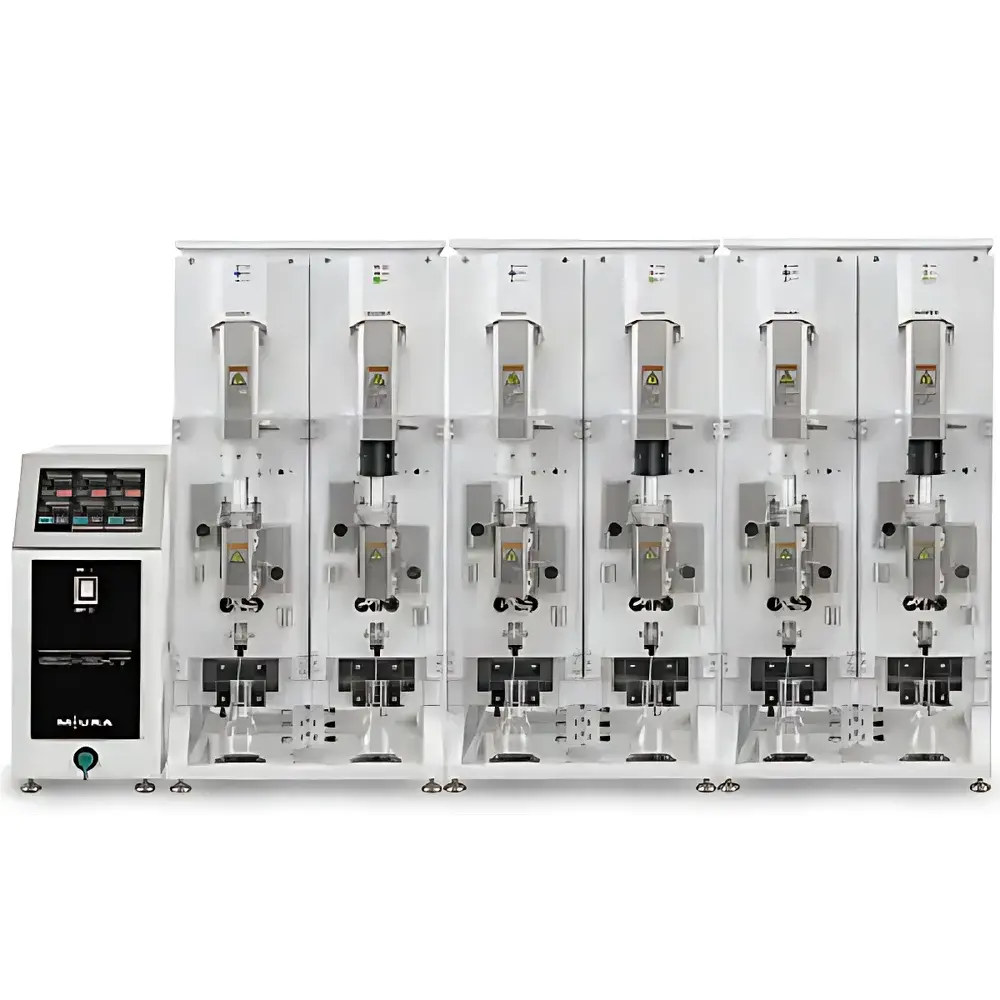
Muira GO-6EHT Six-Channel Fully Automated Dioxin/PCBs Sample Cleanup and Preparation System
| Brand | Muira/MIURA |
|---|---|
| Origin | Japan |
| Manufacturer Type | Authorized Distributor |
| Origin Category | Imported |
| Model | GO-6EHT |
| Pricing | Upon Request |
Overview
The Muira GO-6EHT is a six-channel, fully automated sample cleanup and preparation system engineered specifically for the quantitative analysis of persistent organic pollutants (POPs), with primary application in dioxins (PCDD/Fs) and polychlorinated biphenyls (PCBs). It operates on the principle of selective solid-phase extraction (SPE) using chemically modified silica-based adsorbents—optimized for high-affinity binding of planar aromatic compounds while rejecting structurally dissimilar interferences. Unlike conventional manual or semi-automated cleanup methods, the GO-6EHT integrates thermally assisted elution, valve-free fluidic architecture, and precisely controlled solvent gradients to deliver reproducible, matrix-resistant fractionation. Its design aligns with internationally recognized analytical workflows described in EPA Method 1613B, EN 1948, ISO 18073, and JIS K 0311, ensuring compatibility with high-resolution gas chromatography coupled with high-resolution mass spectrometry (HRGC-HRMS) platforms.
Key Features
- Six independent parallel channels enable simultaneous processing of up to six samples—maximizing throughput without compromising method integrity.
- Thermally regulated column oven (ambient to 80 °C) enhances chemical interaction between target analytes and surface-modified silica, improving selectivity for dioxins and PCBs while suppressing co-elution of sterols, fatty acids, and other lipophilic interferents.
- Valve-free fluidic path eliminates mechanical carryover; all columns, tubing, and collection vials are single-use consumables, ensuring zero cross-contamination between runs.
- Low-solvent operation: each sample requires only 90 mL n-hexane and 5 mL toluene—no dichloromethane required—reducing hazardous waste generation and operational costs.
- Automated fraction collection delivers final eluate volumes of 1–2 mL per sample, eliminating post-cleanup concentration steps and enabling direct injection into GC systems after volumetric adjustment.
- Flexible method configuration: supports interchangeable column formats (e.g., acid-treated silica, carbon molecular sieve, alumina) and customizable gradient profiles via intuitive touchscreen interface.
- Full method programmability allows users to develop, save, and validate custom cleanup protocols beyond preloaded standard methods (e.g., WHO-TEQ, I-TEQ, or congener-specific schemes).
Sample Compatibility & Compliance
The GO-6EHT accommodates diverse environmental and biological matrices—including soil, sediment, fly ash, fish tissue, human serum, and milk—following established extraction procedures (e.g., Soxhlet, ASE, or pressurized liquid extraction). All purification steps comply with Good Laboratory Practice (GLP) requirements for trace-level POPs analysis. The system meets electromagnetic compatibility (EMC) and electrical safety standards including EN 61010-1, UL 61010-1:2012, CAN/CSA C22.2 No. 61010-1-12:2012, EN 55011, EN 61000-6-2, FCC Part 15 Subpart B, and RoHS Directive 2011/65/EU (as implemented in BS EN IEC 63000:2018). Hardware and firmware support audit-trail generation for regulatory submissions under FDA 21 CFR Part 11 when integrated with compliant LIMS environments.
Software & Data Management
The embedded control software provides real-time monitoring of pressure, temperature, flow rate, and fraction collection status across all six channels. Each run generates a timestamped log file containing method parameters, column lot numbers, solvent batch IDs, operator ID, and calibration verification records. Data export is supported in CSV and XML formats for integration with laboratory information management systems (LIMS) or electronic lab notebooks (ELN). Software updates are delivered via secure HTTPS channel and include version-controlled release notes aligned with ISO/IEC 17025:2017 clause 7.7.2 on method validation documentation.
Applications
- Regulatory monitoring of dioxin-like compounds in foodstuffs and feedstuffs per EU Commission Regulation (EU) 2023/915 and EC No. 1881/2006.
- Compliance testing for industrial emissions under the Stockholm Convention reporting framework.
- Human biomonitoring studies requiring ultra-trace quantification of PCDD/Fs and dioxin-like PCBs in adipose tissue or blood serum.
- Method development and validation for accredited laboratories seeking ISO/IEC 17025 accreditation in POPs analysis.
- Research applications involving congener-specific profiling, toxic equivalency factor (TEF) calculations, and source apportionment modeling.
FAQ
What types of sample extracts can be processed on the GO-6EHT?
It accepts non-aqueous extracts prepared by standard techniques (e.g., acid digestion followed by liquid–liquid partitioning or accelerated solvent extraction), provided they are dissolved in n-hexane or toluene-compatible solvents.
Is method validation support available from Muira?
Yes—Muira provides application notes, interlaboratory study data, and SOP templates aligned with ISO/IEC 17025 requirements for method verification and uncertainty estimation.
Can the system be integrated with robotic autosamplers or HRGC-HRMS instruments?
The GO-6EHT outputs standardized 2-mL amber vials compatible with most commercial autosamplers; optional RS-232 or Ethernet interfaces enable synchronization with external GC triggers.
How is performance consistency ensured across batches of purification columns?
Each column lot undergoes QC testing using certified reference materials (CRM 178, CRM 179, and NIST SRM 1946); full test reports are accessible via Muira’s secure customer portal using batch-specific QR codes.
Does the system support remote diagnostics or preventive maintenance alerts?
Yes—the onboard diagnostics module monitors pump wear, heater stability, and pressure drift, and transmits maintenance flags via email or SNMP trap to facility service management platforms.



