
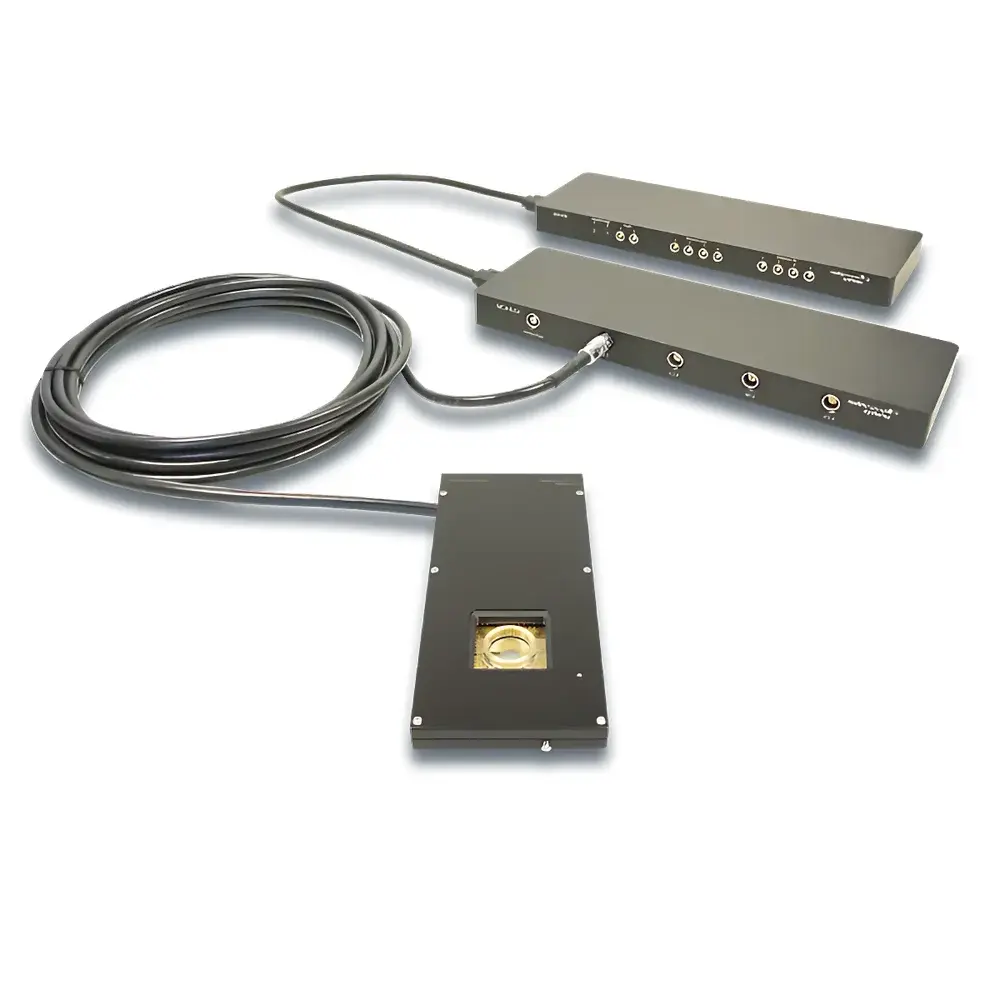
Multi Channel Systems MEA2100-mini In Vitro Microelectrode Array System
| Brand | Multi Channel Systems |
|---|---|
| Origin | Germany |
| Manufacturer Type | Original Equipment Manufacturer (OEM) |
| Product Category | Imported Instrument |
| Model | MEA2100-mini |
| Instrument Type | Single-Well Format |
| Application Scope | In Vitro Electrophysiological Recording & Stimulation |
| Electrode Pitch | 200 µm |
| Electrode Diameter | 30 µm |
| Electrode Layout | 8×8 (60 active + 4 ground/ reference electrodes, or 120-channel variant) |
| Physical Dimensions | 186 × 80 × 12 mm |
| Amplifier Resolution | 24-bit |
| Max Sampling Rate per Channel | 50 kHz |
| Stimulator Modes | Current Source (±1 mA), Voltage Source (±10 V) |
| Signal Acquisition Units per MCS-IFB Interface Board | Up to 2 |
| Probes per Acquisition Unit | Up to 4 |
| Integrated On-Probe Electronics | Amplification, Stimulation, and ADC |
| Operating Environment | Standard CO₂ incubators (37 °C, 5% CO₂, humidified) |
Overview
The Multi Channel Systems MEA2100-mini is a compact, high-fidelity in vitro microelectrode array (MEA) system engineered for long-term, low-noise electrophysiological recording and closed-loop stimulation of cultured neuronal networks, cardiac monolayers, or other excitable cell preparations. Based on the well-established MEA2100 platform, the mini variant retains full signal integrity and functional capability while optimizing footprint, thermal dissipation, and incubator compatibility. Its core architecture implements distributed signal conditioning—amplification, stimulation generation, and analog-to-digital conversion—all integrated directly onto each probe—to minimize cable-induced noise, capacitive coupling, and signal degradation. The system operates on the principle of extracellular field potential detection via planar TiN or Pt black microelectrodes embedded in biocompatible glass or PDMS substrates, enabling non-invasive, multi-site temporal resolution of action potential propagation, network bursting, synaptic efficacy, and pharmacological response kinetics.
Key Features
- Compact single-well MEA platform with dimensions of 186 × 80 × 12 mm—designed for seamless integration into standard CO₂ incubators and microscope stages without obstructing optical access or environmental control.
- Dual configuration options: 60-channel (8×8 layout with 4 ground/reference electrodes) or 120-channel (interleaved electrode design) probes, both featuring 30 µm electrode diameter and 200 µm inter-electrode spacing for optimal spatial resolution and cellular coverage.
- On-probe 24-bit analog-to-digital conversion and programmable gain amplifiers ensure high dynamic range (>120 dB SNR) and minimal baseline drift during extended recordings (≥72 h).
- Integrated dual-mode stimulators per probe: precision current-source output (±1 mA, <10 nA resolution) and voltage-source mode (±10 V, <100 µV resolution), supporting biphasic, monophasic, and custom waveform delivery synchronized to acquisition.
- Modular signal acquisition architecture: one MCS-IFB interface board supports up to two MEA2100-mini acquisition units; each unit controls up to four independent probes—enabling parallel experiments or multi-condition screening within a single setup.
- eSATA-based real-time data streaming to host PC ensures deterministic latency (<100 µs jitter) and sustained throughput for continuous 50 kHz/channel acquisition across all active channels.
Sample Compatibility & Compliance
The MEA2100-mini is validated for use with primary rodent cortical/hippocampal cultures, human iPSC-derived neurons, stem-cell-derived cardiomyocytes, and organotypic brain slices (200–400 µm thickness). Probe substrates comply with ISO 10993-5 (cytotoxicity) and USP Class VI biocompatibility standards. All electronics meet IEC 61000-4 electromagnetic immunity requirements for laboratory environments. Data acquisition workflows support audit-trail-enabled operation per FDA 21 CFR Part 11 when used with MCS’s certified Acquis1 software suite—ensuring traceability, electronic signatures, and version-controlled protocol storage required for GLP and preclinical safety pharmacology studies.
Software & Data Management
Acquis1 software provides native driver support for real-time visualization, spike sorting (template matching & PCA-based clustering), burst detection (based on minimum inter-spike interval and duration thresholds), and network-level metrics (mean firing rate, synchrony index, functional connectivity graphs). Raw binary data is stored in HDF5 format with embedded metadata (electrode map, sampling parameters, stimulation timestamps, environmental logs). Batch processing pipelines integrate with Python (via MCS-Python API) and MATLAB for custom analysis—including cross-correlation, Granger causality, and graph-theoretical network modeling. Export modules generate standardized .mat, .csv, and NWB 2.0 files compatible with Neurodata Without Borders ecosystem tools.
Applications
- Longitudinal monitoring of network maturation in human neuronal cultures over weeks in vitro (DIV 7–42).
- High-content screening of neuroactive compounds (e.g., sodium channel blockers, GABAergic modulators) using multi-parameter readouts: spike rate, burst frequency, network oscillation power (theta/gamma bands), and conduction velocity mapping.
- Cardiac electrophysiology assays: detection of arrhythmic events (early/delayed afterdepolarizations), field potential duration (FPD) correction (QT interval analog), and proarrhythmic risk assessment per CiPA guidelines.
- Optogenetic interfacing: synchronized light stimulation (via optional MCS-LSI LED modules) and simultaneous multi-electrode recording for causal circuit mapping.
- Neurotoxicity evaluation under physiologically relevant conditions—incubator-based operation maintains pH, temperature, and O₂/CO₂ homeostasis throughout exposure protocols.
FAQ
Can the MEA2100-mini be operated inside a standard humidified CO₂ incubator?
Yes—the entire acquisition unit and probe holder are rated for continuous operation at 37 °C and 5% CO₂. No external cooling fans or heat sinks are required due to ultra-low power consumption (<2 W per probe).
What electrode materials are available for the MEA2100-mini probes?
Standard probes use sputter-deposited titanium nitride (TiN); custom variants with platinum black (Pt-black) or iridium oxide (IrOx) coatings are available for enhanced charge injection capacity and chronic stability.
Is synchronization between multiple probes possible?
Yes—hardware-level trigger distribution via the MCS-IFB board enables sub-microsecond inter-probe timing alignment for cross-chamber or multi-tissue comparative studies.
Does the system support closed-loop stimulation based on real-time detection?
Yes—Acquis1 supports configurable event-triggered stimulation with user-defined latency windows (100 µs–10 s), enabling conditional paradigms such as spike-triggered stimulation or burst-terminated inhibition.
Are calibration certificates and IQ/OQ documentation provided?
Multi Channel Systems supplies factory calibration reports traceable to PTB (Physikalisch-Technische Bundesanstalt) standards, along with customizable Installation Qualification (IQ) and Operational Qualification (OQ) templates compliant with ISO/IEC 17025 and GxP requirements.





