
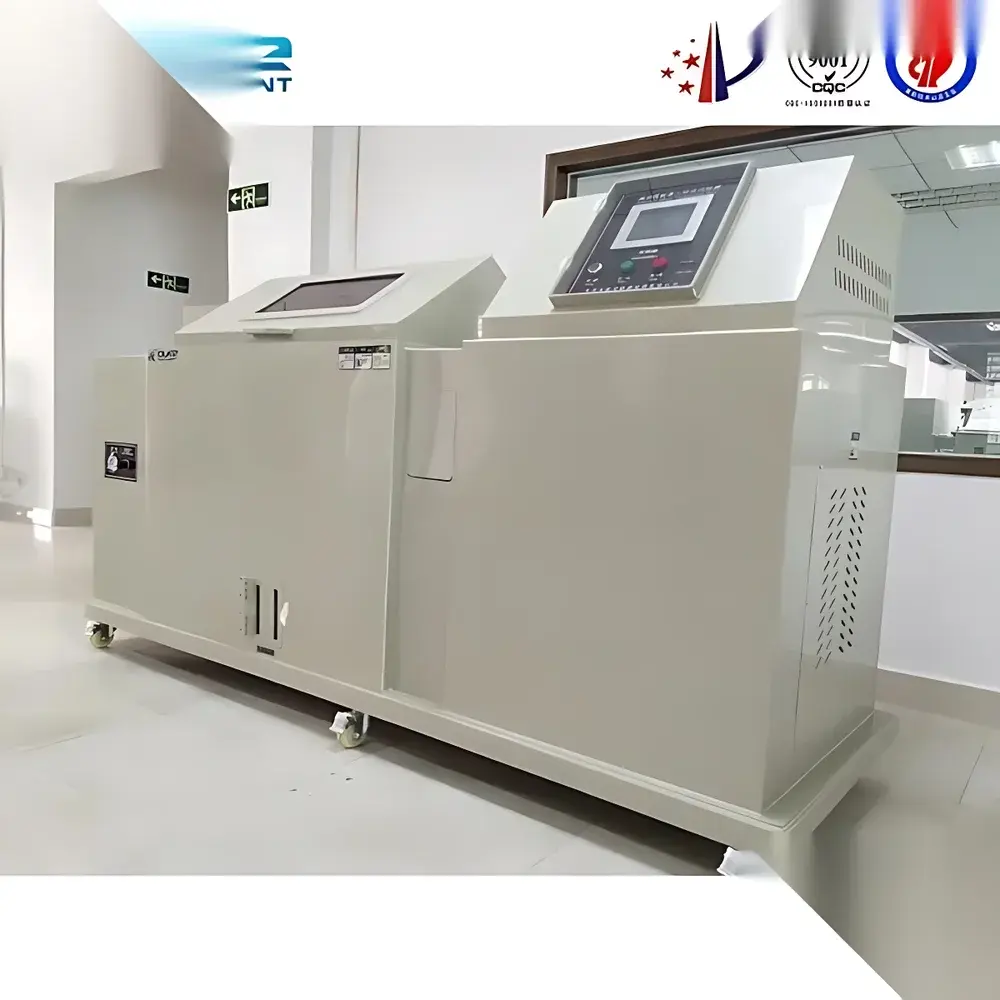
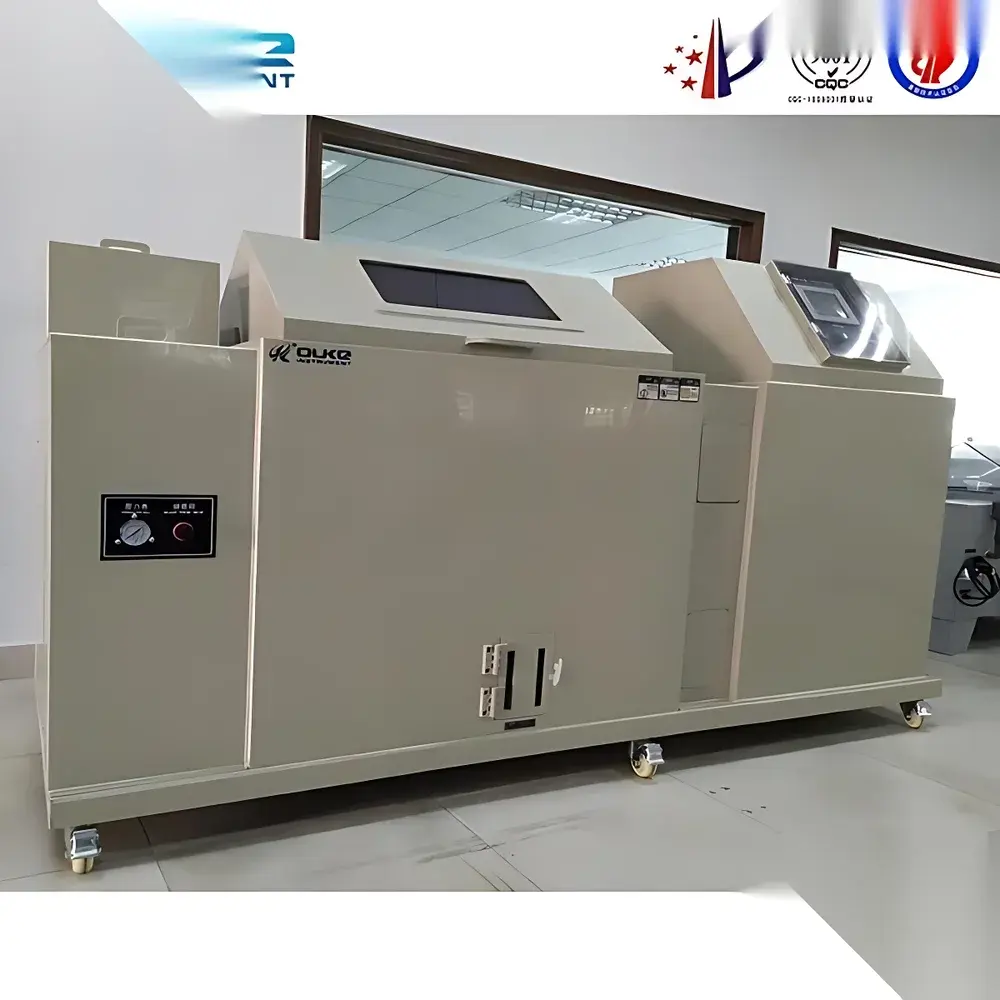
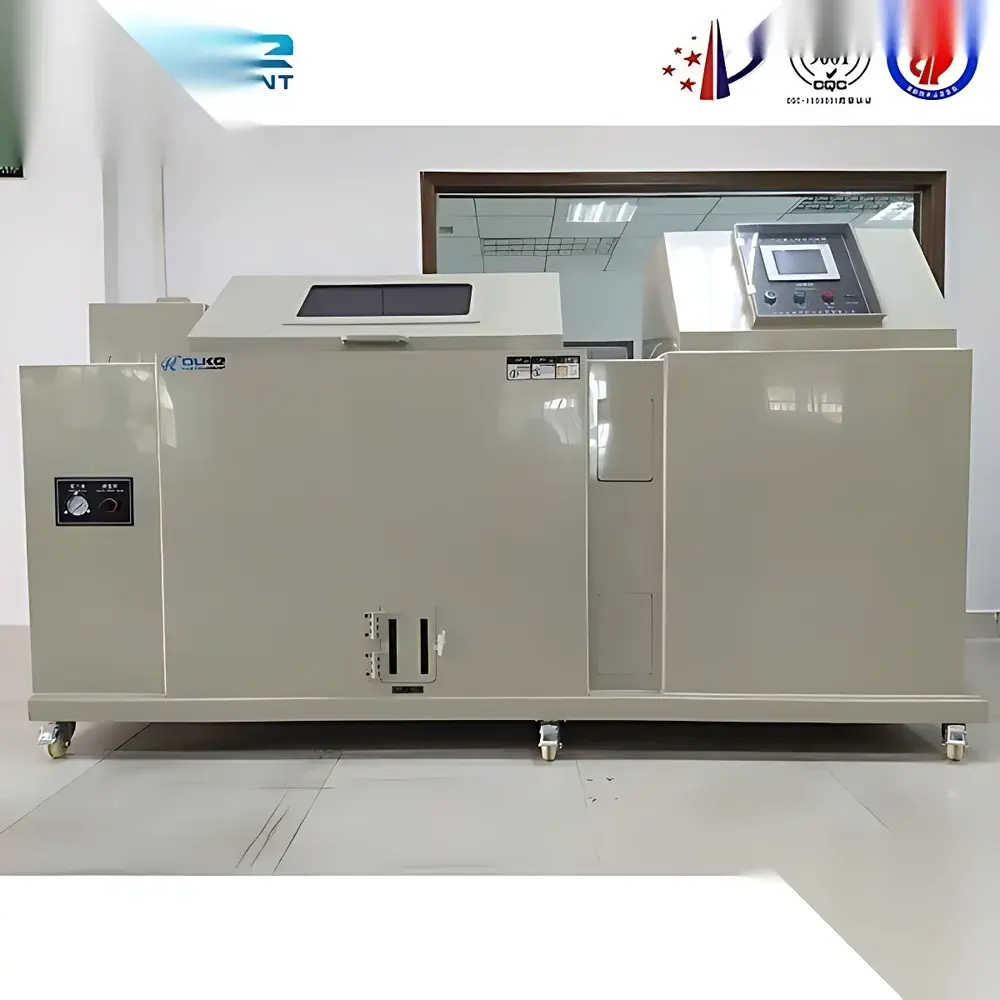
Multi-Climate Salt Spray Corrosion Test Chamber with Dry-Wet-Cyclic Functionality
| Brand | OEM / Custom-Built |
|---|---|
| Origin | Imported |
| Supplier Type | Authorized Distributor |
| Price | USD 21,500 (FOB) |
| Program Groups | 120 |
| Total Program Segments | 1,200 |
| Max Repetitions per Command | 999 |
| Segment Duration Range | 0–99 h 59 min |
| Power-Failure Recovery | Yes, auto-resume with state retention |
| Real-Time Graphical Curve Display | Yes |
| PID Parameter Sets | 9 independent groups |
| Saturation Chamber | Heated, oil-filtered, humidity-conditioned air supply |
| Spray Mode | Pneumatic atomization (continuous or intermittent) |
| Compressed Air Control | Regulated via precision pressure-reducing valve + solenoid shut-off valve |
Overview
The Multi-Climate Salt Spray Corrosion Test Chamber with Dry-Wet-Cyclic Functionality is an engineered environmental simulation system designed to replicate accelerated corrosion conditions encountered in real-world service environments—particularly for automotive components, marine hardware, coated metals, and aerospace fasteners. Unlike conventional single-mode salt spray chambers (e.g., ASTM B117-compliant units), this chamber integrates three distinct climatic phases—salt fog deposition, high-humidity dwell, and dry thermal exposure—within a single, programmable cycle. The system operates on the principle of controlled electrochemical degradation acceleration: chloride ion penetration under cyclic hygrothermal stress induces pitting, crevice corrosion, and intergranular attack at rates significantly exceeding natural exposure. Its architecture conforms to the structural and operational logic defined in ISO 9227, ASTM G85 Annex A5 (Prohesion™), and JIS Z 2371, while supporting custom test protocols aligned with OEM-specific durability specifications (e.g., GMW 14872, Ford CETP 00.00-L-467). The chamber features a double-wall insulated stainless-steel interior, corrosion-resistant PTFE-coated internal plumbing, and a fully sealed observation window with anti-fog heating.
Key Features
- Triple-phase environmental sequencing: programmable salt fog → humid soak → dry bake cycles within one unified test program
- 120 user-defined program groups, each supporting up to 1,200 individual segments; repeat commands up to 999 times per segment
- Touchscreen HMI with bilingual (English/Chinese) interface; real-time graphical overlay of setpoint (SV) vs. actual (PV) temperature and relative humidity
- Embedded power-loss recovery: retains full program state—including active segment, elapsed time, and loop counter—and resumes execution upon power restoration
- Dual PID control loops with 9 independently tunable parameter sets; automatic PID self-tuning and dry/wet bulb auto-calibration
- Pneumatic spray system with precision-regulated compressed air (0.1–1.0 bar adjustable); integrated saturated air generator featuring heated filtration, oil removal, and RH conditioning
- Comprehensive safety logic: over-temperature cutoff, low-level salt solution alarm, door interlock, and audible/visual fault indication
Sample Compatibility & Compliance
This chamber accommodates flat panels (up to 600 × 450 mm), cylindrical specimens (max Ø300 mm), and assembled subassemblies (height ≤ 500 mm) mounted on non-corroding PVC or PP racks. It supports standardized specimen orientation per ISO 9227 (15°–30° from vertical) and includes provision for electrical feedthroughs (optional) to monitor galvanic current during testing. All materials in contact with salt solution—nozzles, reservoirs, piping—are fabricated from acid-resistant PVDF or titanium-grade SS316L. The system meets CE marking requirements (2014/30/EU EMC Directive, 2014/35/EU LVD), complies with RoHS 2011/65/EU, and is designed to support GLP-compliant validation documentation (IQ/OQ/PQ templates available upon request). Optional calibration certificates traceable to NIST standards are provided for temperature (±0.3°C), RH (±2% RH), and pH (±0.1 unit) sensors.
Software & Data Management
The embedded controller logs timestamped temperature, RH, and chamber status data at user-selectable intervals (1 s to 60 min). Export formats include CSV and Excel-compatible .xlsx; data can be retrieved via USB port or optional Ethernet interface (Modbus TCP). Audit trail functionality records all operator actions—including parameter changes, program starts/stops, and alarm acknowledgments—with user ID and timestamp. For regulated environments, optional software modules provide 21 CFR Part 11 compliance: electronic signatures, role-based access control, and immutable data archiving. Historical run data is indexed by test ID, operator, date, and program name—enabling cross-batch trend analysis and failure root-cause correlation.
Applications
- Accelerated corrosion screening of electrogalvanized steel, aluminum alloys (e.g., 5052, 6061), and zinc-nickel coatings
- Validation of automotive under-hood component durability per SAE J2334 and VW TL 226
- Qualification of printed circuit board conformal coatings (IPC-CC-830B) and connector plating systems
- Corrosion resistance benchmarking of marine-grade stainless steels (e.g., UNS S32205) under tidal zone simulation
- Development testing of water-based anti-corrosion primers and self-healing polymer coatings
FAQ
What standards does this chamber support out-of-the-box?
Pre-loaded test profiles include ASTM B117 (neutral salt spray), ASTM G85 Annex A5 (Prohesion™), ISO 9227, and JIS Z 2371. Custom profiles can be created to match proprietary OEM test methods.
Can the chamber operate unattended for extended durations?
Yes—the system supports continuous operation for up to 30 days with scheduled maintenance intervals; built-in salt solution level monitoring and auto-refill capability (optional) extend uptime.
Is remote monitoring possible?
With the optional Ethernet module, users can view live chamber status, download logs, and trigger manual overrides via secure HTTPS web interface or Modbus SCADA integration.
How is salt solution concentration verified and maintained?
Integrated conductivity sensor continuously monitors NaCl concentration; deviation beyond ±0.5% triggers visual alert and optional automated dilution correction via dual-solution reservoir.
What maintenance is required for the saturation system?
Quarterly replacement of coalescing filter elements and annual recalibration of the heated saturation chamber’s temperature and humidity sensors are recommended per preventive maintenance schedule.



