
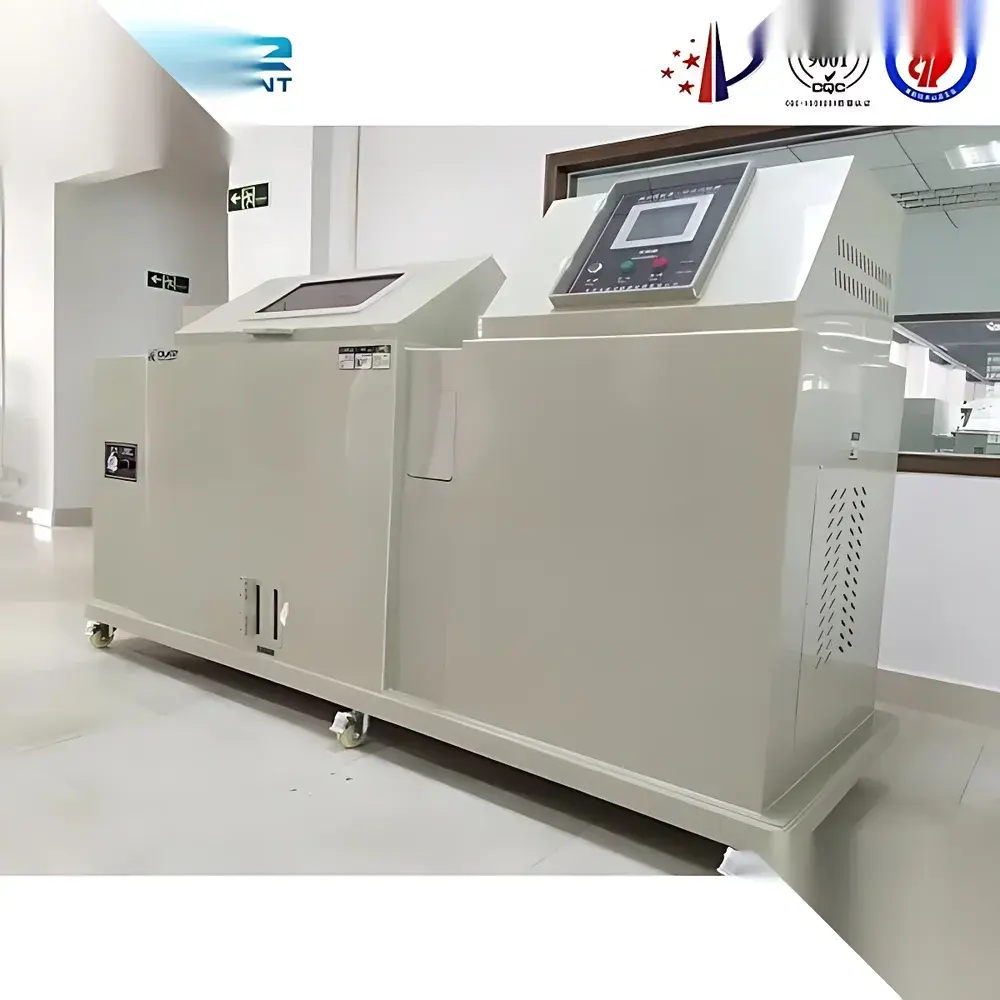
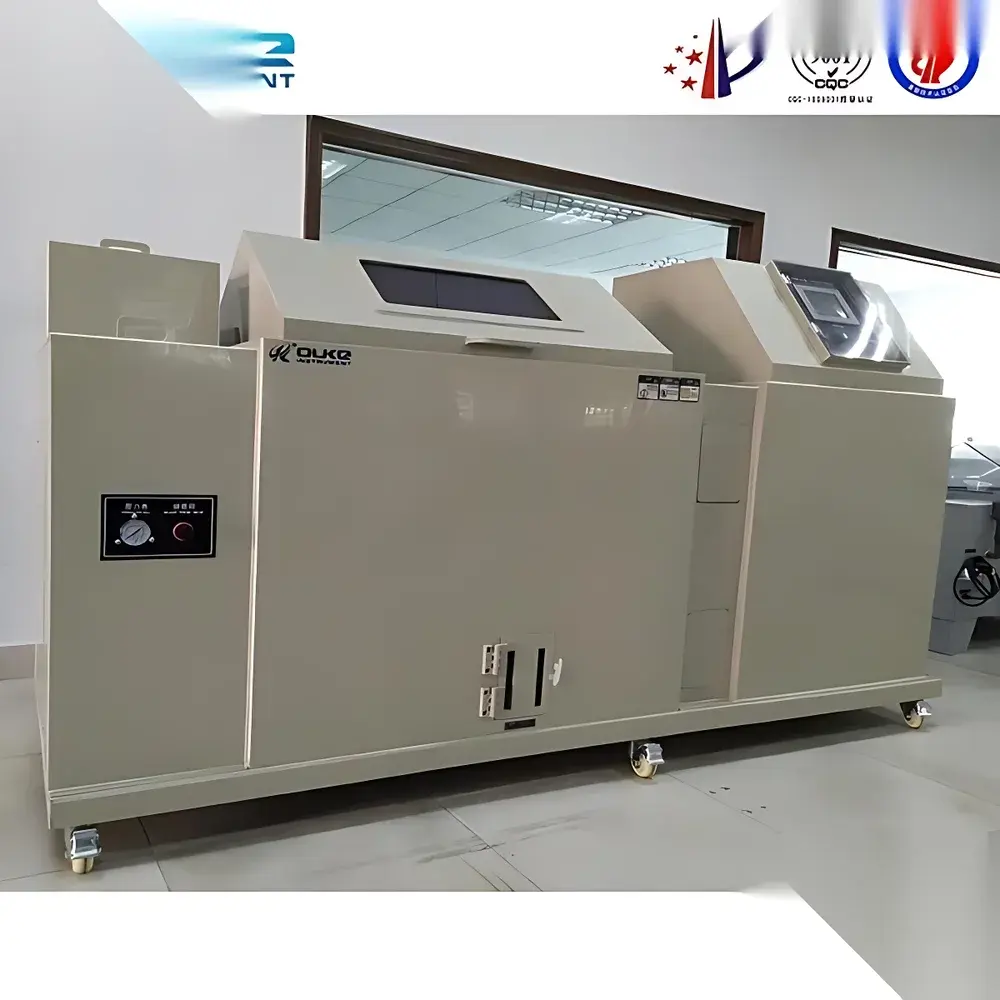
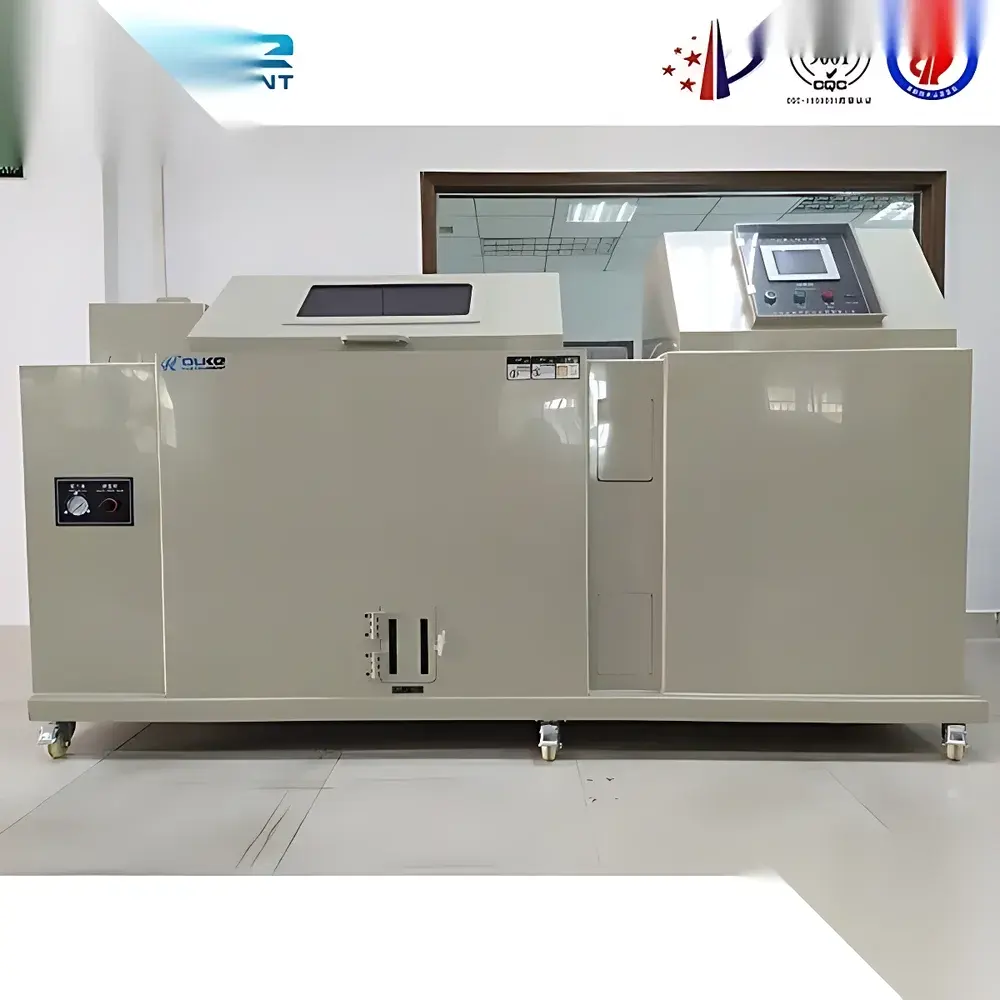
Multi-Condition Salt Spray Corrosion Test Chamber with Dry-Wet Cycling Capability
| Brand | OEM / Custom Brand |
|---|---|
| Origin | Imported |
| Manufacturer Type | Authorized Distributor |
| Pricing | USD 21,500 (FOB) |
| Internal Chamber Dimensions | 600 × 450 × 400 mm / 900 × 600 × 500 mm / 1200 × 840 × 500 mm (W×D×H) |
| Chamber Material | 5 mm PVC board (heat-resistant up to 85°C) |
| Lid Material | 5 mm impact-resistant acrylic |
| Test Standards Compliant | ASTM B117, ISO 9227, JIS Z2371, CNS 12207, GB/T 10587 |
| Salt Spray Modes | Neutral Salt Spray (NSS), Acetic Acid Salt Spray (AASS), Copper-Accelerated Acetic Acid Salt Spray (CASS) |
| Test Chamber Temp Control | 35°C ±1°C (NSS/AASS), 50°C ±1°C (CASS) |
| Saturated Air Chamber Temp Control | 47°C ±1°C (NSS/AASS), 63°C ±1°C (CASS) |
| Timer Range | 0–999.9 h (Italian-made digital timer) |
| Water Supply System | Dual-mode (automatic + manual) for chamber and saturator |
| Temperature Controller Resolution | ±0.3°C (LCD digital PID controller) |
| Pressure Regulator | Precision air filter + pressure gauge (0–2.5 kg/cm², accuracy ±0.01 kg/cm²) |
| Safety Protections | Low-water cutoff, overtemperature shutdown, salt-solution level alarm, visual warning indicators |
Overview
The Multi-Condition Salt Spray Corrosion Test Chamber with Dry-Wet Cycling Capability is an engineered environmental test system designed to evaluate the corrosion resistance of metallic materials, coated surfaces, and electroplated components under accelerated, multi-phase exposure conditions. Unlike conventional single-mode salt spray chambers, this instrument integrates sequential or simultaneous control of salt fog, high-humidity dwell, and dry-air cycling—enabling simulation of real-world atmospheric degradation mechanisms such as chloride-induced pitting, crevice corrosion, and hygroscopic salt deliquescence followed by oxidative drying. Its operational principle relies on precise regulation of saturated air temperature, nozzle pressure, solution concentration, and chamber thermal stability—ensuring strict adherence to internationally recognized corrosion testing protocols including ASTM B117 (Neutral Salt Spray), ISO 9227 (NSS, AASS, CASS), and JIS Z2371. The chamber’s structural integrity is maintained via 5 mm industrial-grade PVC construction rated for continuous operation at 85°C, while the transparent acrylic lid permits unobstructed visual monitoring without compromising seal integrity or operator safety.
Key Features
- Triple-mode corrosion testing capability: NSS (neutral), AASS (acetic acid), and CASS (copper-accelerated) per ASTM, ISO, and JIS specifications
- Independent dual-zone temperature control: test chamber (±1°C stability) and saturated air chamber (±1°C stability), each equipped with PID-regulated LCD digital controllers (0.3°C resolution)
- Integrated dry-wet cycling function enabling programmable transitions between salt fog, high-humidity soak (≥95% RH), and forced-air drying phases
- Dual water supply architecture: automatic replenishment for both test chamber and saturator, supplemented by manual override to prevent dry-run failure
- Redundant safety interlocks: low-water-level cutoff, overtemperature cutout (dual independent thermal fuses), and salt-solution reservoir monitoring with illuminated fault indicators
- Precision pneumatic subsystem: calibrated pressure regulator with integrated air filtration, stainless steel mist nozzles, and a 0.01 kg/cm²-resolution pressure gauge
- Digital timing and accumulation: 0–999.9 h programmable cycle timer and 0–9999.9 h cumulative runtime meter for GLP-compliant test recordkeeping
Sample Compatibility & Compliance
This chamber accommodates standard test specimens up to 1200 × 840 × 500 mm (W×D×H), supporting flat panels, fasteners, automotive trim parts, printed circuit boards with conformal coatings, and aerospace alloy coupons. It meets mechanical and procedural requirements for ISO/IEC 17025-accredited laboratories and supports audit-ready documentation when paired with optional data logging. All operational parameters align with regulatory expectations for corrosion validation in industries subject to IATF 16949, MIL-STD-810, and FDA 21 CFR Part 11–compliant quality systems. The chamber’s design facilitates traceable calibration using NIST-traceable thermistors and pressure transducers, and its sealed PVC construction ensures chemical inertness against 5% NaCl, acetic acid, and CuCl₂ solutions.
Software & Data Management
While the base configuration features embedded digital controllers, optional RS-485/Modbus RTU interface enables integration with LabVIEW, MATLAB, or custom LIMS platforms for remote parameter setting, real-time data streaming, and automated report generation. Time-stamped temperature, pressure, and cycle phase logs can be exported in CSV format for long-term archival and statistical process analysis (e.g., Weibull modeling of coating failure onset). Audit trails—including operator ID, parameter changes, and alarm events—are retained internally for ≥30 days, satisfying GLP/GMP traceability mandates without third-party software dependency.
Applications
- Automotive OEMs validating zinc-nickel plating durability on brake calipers and chassis components
- Aerospace suppliers qualifying aluminum-lithium alloy anodized finishes per AMS 2469
- Medical device manufacturers assessing stainless-steel surgical instrument passivation per ASTM F86 and ISO 10993-15
- Electronics manufacturers evaluating conformal coating performance on PCBAs exposed to coastal environments
- Coating formulators conducting comparative studies of epoxy, polyurethane, and ceramic-based barrier systems
- Government metrology labs performing interlaboratory round-robin corrosion testing per ISO/IEC 17043 guidelines
FAQ
What standards does this chamber fully support?
It is configured and validated for ASTM B117, ISO 9227 (NSS/AASS/CASS), JIS Z2371, CNS 12207, and GB/T 10587. Full compliance documentation—including calibration certificates and uncertainty budgets—is provided upon shipment.
Can the dry-wet cycling sequence be programmed independently?
Yes. Using the optional PC-based controller upgrade, users define custom profiles with up to 99 steps, specifying duration, temperature, humidity, and spray activation for each phase.
Is the chamber suitable for testing non-metallic materials such as elastomers or adhesives?
While primarily intended for metallic corrosion assessment, it may be used for preliminary evaluation of polymer degradation under cyclic chloride exposure—provided specimen geometry and mounting do not interfere with雾化 pattern uniformity.
How is temperature uniformity verified across the test volume?
Uniformity is confirmed during factory acceptance testing using 9-point thermocouple mapping per ASTM E2297, with deviation ≤ ±2°C across the working volume at steady-state 35°C and 50°C setpoints.
Does the system include calibration tools or certification?
Each unit ships with a NIST-traceable temperature verification kit (three calibrated PT100 sensors), pressure gauge calibration certificate, and a signed IQ/OQ protocol compliant with ISO 13485 and GAMP5 Annex 11 requirements.



