
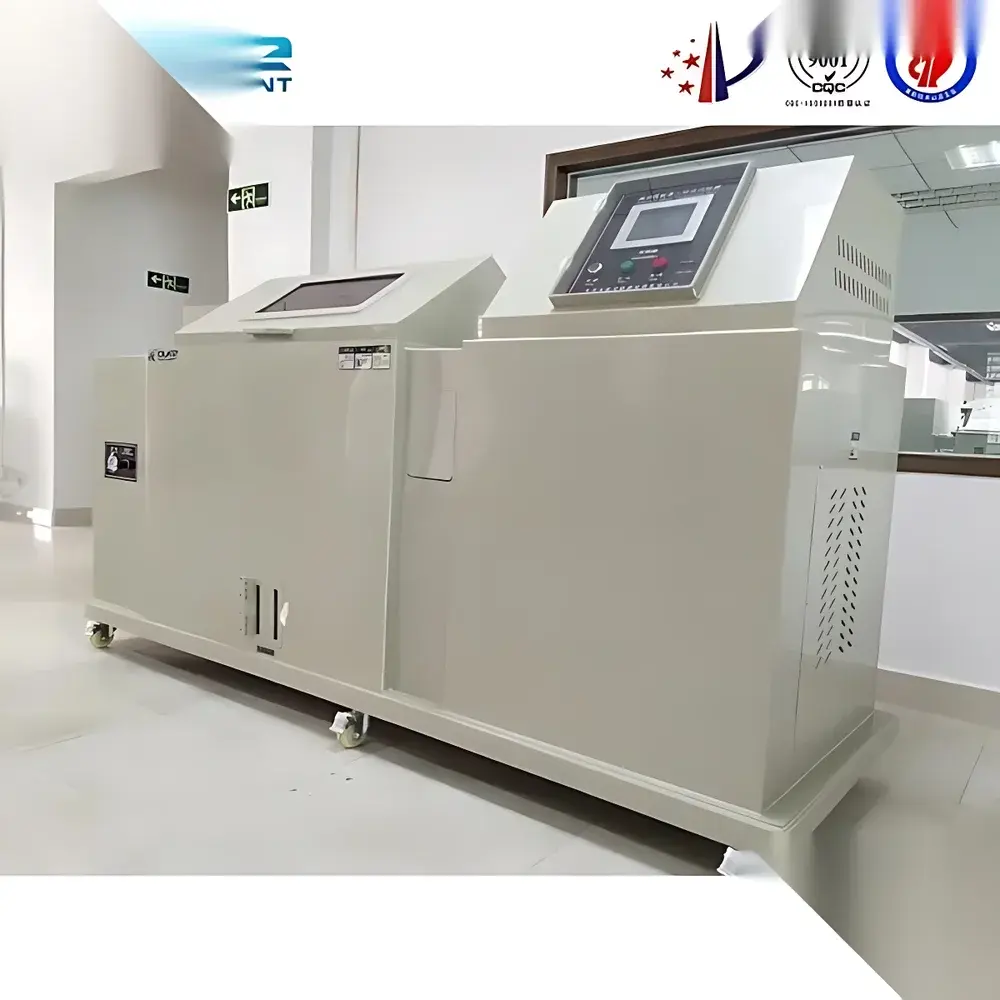
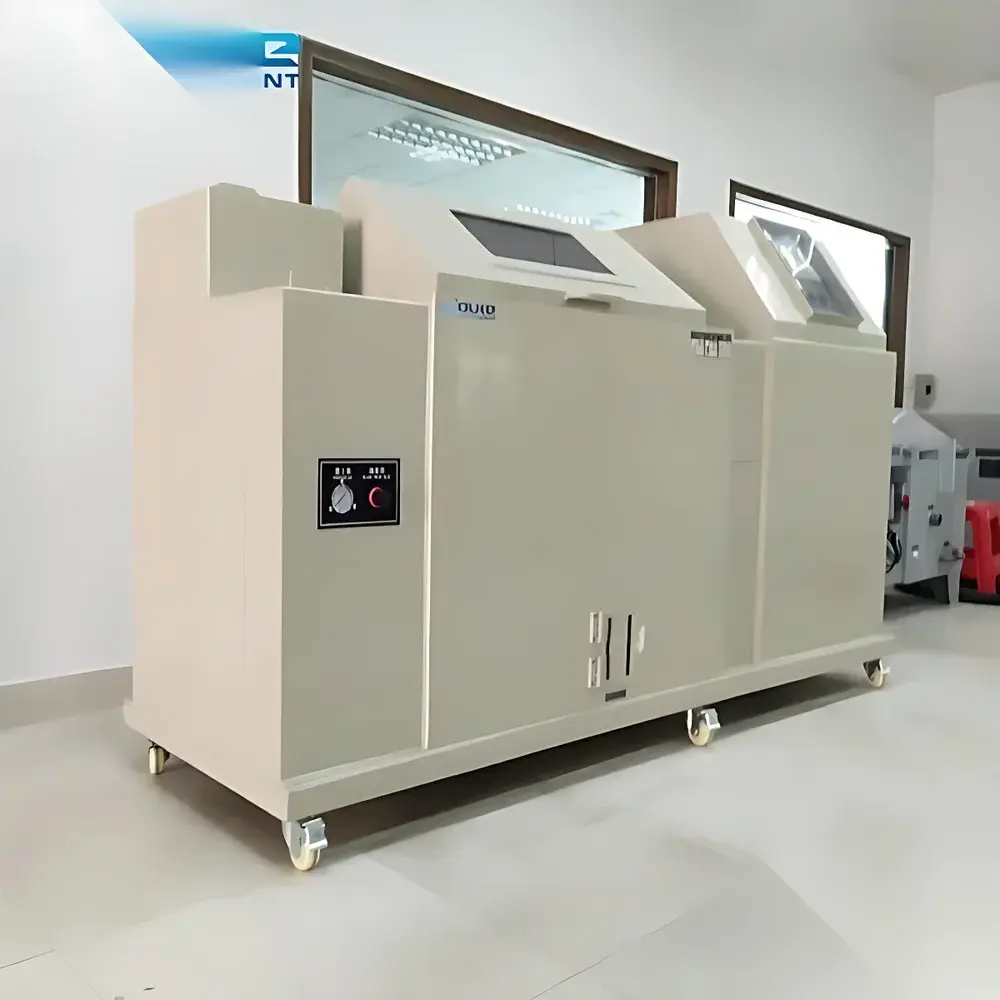
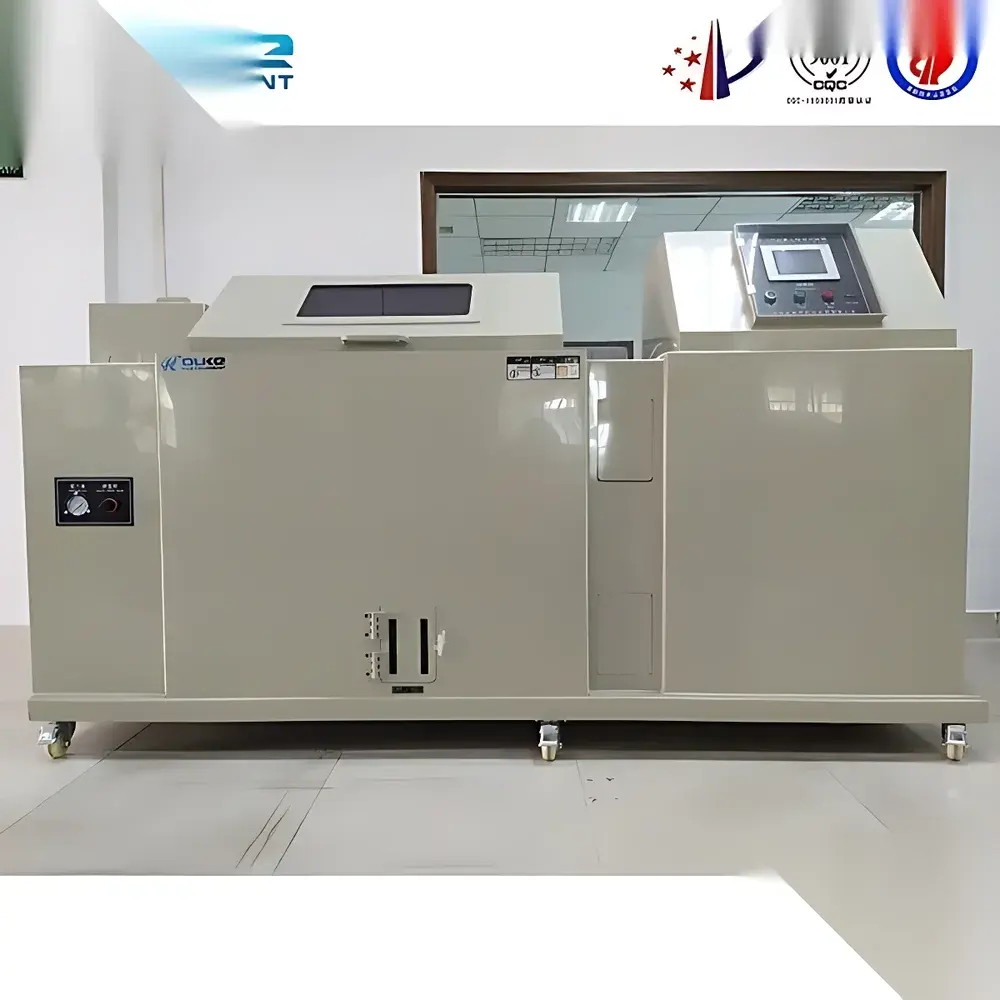
Multi-Environment Corrosion Test Chamber for Combined Salt Spray, Humidity, and Dry Cycling
| Brand | OEM / Custom-Built |
|---|---|
| Origin | Imported |
| Supplier Type | Authorized Distributor |
| Price | USD 21,500 (FOB) |
| Power Supply | AC 220 V ±10% / 50 Hz or AC 380 V ±10% / 50 Hz |
| Operating Ambient | 5–30 °C, ≤85% RH |
| Chamber Construction | Fiberglass-Reinforced Polymer (FRP) Monolithic Body |
| Sealing Method | Water-Seal Lid Design |
| Safety Protections | Overtemperature, Leakage Current, Short-Circuit, Low-Water Level, Overcurrent, End-of-Test Auto-Shutdown |
| Standard Accessories | V-Type Sample Racks (2 pcs), Dual Nozzles, Calibration Funnel & Graduated Cylinder, Water Filter on Brine Suction Line, Preheated Brine Delivery System |
| Compliance Standards | GB/T 2423.17–2022, IEC 60068-2-11, ASTM B117, ISO 9227, MIL-STD-810H (Method 509.6), DIN 50021 |
Overview
The Multi-Environment Corrosion Test Chamber for Combined Salt Spray, Humidity, and Dry Cycling is an engineered environmental simulation system designed to replicate and accelerate real-world corrosion mechanisms under rigorously controlled multi-stress conditions. Unlike single-mode salt fog chambers, this chamber integrates sequential or cyclic exposure to neutral salt spray (NSS), controlled humidity (up to 98% RH), elevated temperature drying phases, ambient temperature storage, and optional low-temperature conditioning — all programmable within a single test sequence. Its measurement principle relies on standardized aerosol generation via tower-type pneumatic atomization, coupled with high-fidelity PID-controlled thermal and hygric regulation. The monolithic fiberglass-reinforced polymer (FRP) chamber body eliminates weld seams and ensures structural integrity against chloride-induced degradation, while the water-seal lid design prevents salt mist leakage — a critical requirement for laboratory safety and regulatory compliance in accredited testing facilities.
Key Features
- Monolithic FRP chamber construction: Seamless, corrosion-resistant enclosure with zero permeability and no seam-related leakage points
- Independent dual heating system: Nickel-chromium alloy heaters with overtemperature cut-off, enabling precise control across 10–70 °C range
- Tower-type spray system with non-crystallizing nozzles: Ensures uniform fog distribution per ASTM B117 collection rate specifications (1.0–2.0 mL/80 cm²/h)
- Brine preheating module: Maintains brine solution temperature within ±2 °C of chamber setpoint to eliminate thermal shock during spray initiation
- Dual-sensor monitoring: PT100 platinum resistance thermometers and capacitive humidity sensors calibrated traceably to NIST standards
- Integrated water filtration: Inline particulate filter on brine suction line prevents nozzle clogging and ensures long-term operational reproducibility
- Comprehensive safety architecture: Six independent protection circuits covering overtemperature, electrical leakage, phase loss, low reservoir level, overcurrent, and automatic shutdown at test completion
Sample Compatibility & Compliance
This chamber accommodates standard test specimens up to 600 mm × 450 mm × 400 mm (W×D×H) on V-type stainless steel sample racks, supporting metallic coatings, automotive components, aerospace fasteners, printed circuit boards, and protective finishes. All internal hardware—including racks, funnels, and collection cylinders—meets ASTM B117 requirements for inert material compatibility. The system is validated for conformance with ISO/IEC 17025-accredited laboratories performing corrosion testing under GB/T 2423.17–2022, IEC 60068-2-11, ISO 9227 (NSS, AASS, CASS variants), and MIL-STD-810H Method 509.6. Optional calibration certificates (traceable to national metrology institutes) and IQ/OQ documentation packages are available for GMP/GLP-regulated environments.
Software & Data Management
The embedded LED-based PID controller supports up to 99 programmable cycles, each with customizable dwell times, ramp rates, and environmental transitions (e.g., 2 h salt spray → 4 h dry at 60 °C → 16 h RH 95% at 40 °C). Real-time data logging records temperature, relative humidity, and spray status at user-defined intervals (1–60 min), exporting CSV files compatible with LIMS integration. Audit trails comply with FDA 21 CFR Part 11 requirements when paired with optional PC-based software featuring electronic signatures, user access levels, and change history tracking. All firmware updates maintain backward compatibility with existing test protocols.
Applications
This chamber serves as a core qualification tool in quality assurance workflows for industries where long-term corrosion resistance is mission-critical: automotive OEMs validating under-hood components; electronics manufacturers assessing conformal coating durability; defense contractors verifying naval equipment survivability; and coating suppliers certifying zinc-nickel, chromate, or epoxy primer performance. It enables comparative lifetime modeling through modified Prohesion™-type cycling (ASTM G85 Annex A5) and supports failure analysis root-cause investigations by isolating synergistic effects between chloride ingress, hygroscopic swelling, and thermal stress.
FAQ
Can this chamber operate in standalone salt spray mode only?
Yes — the control system allows isolation of NSS, humidity, or dry cycles without requiring full sequence programming.
Is the brine delivery system compatible with acidic or copper-accelerated salt solutions?
Yes — the FRP body and stainless-steel fluid path support NSS, AASS (acetic acid), and CASS (copper chloride) per ISO 9227.
What maintenance intervals are recommended for optimal repeatability?
Weekly nozzle inspection and cleaning; monthly calibration verification of PT100 and humidity sensors; quarterly replacement of water filter elements.
Does the chamber meet CE or UKCA marking requirements?
Yes — supplied with EU Declaration of Conformity covering Machinery Directive 2006/42/EC and EMC Directive 2014/30/EU.
Can third-party calibration services be arranged post-installation?
Yes — certified field service engineers provide on-site calibration and IQ/OQ validation aligned with ISO/IEC 17025 procedures.



