
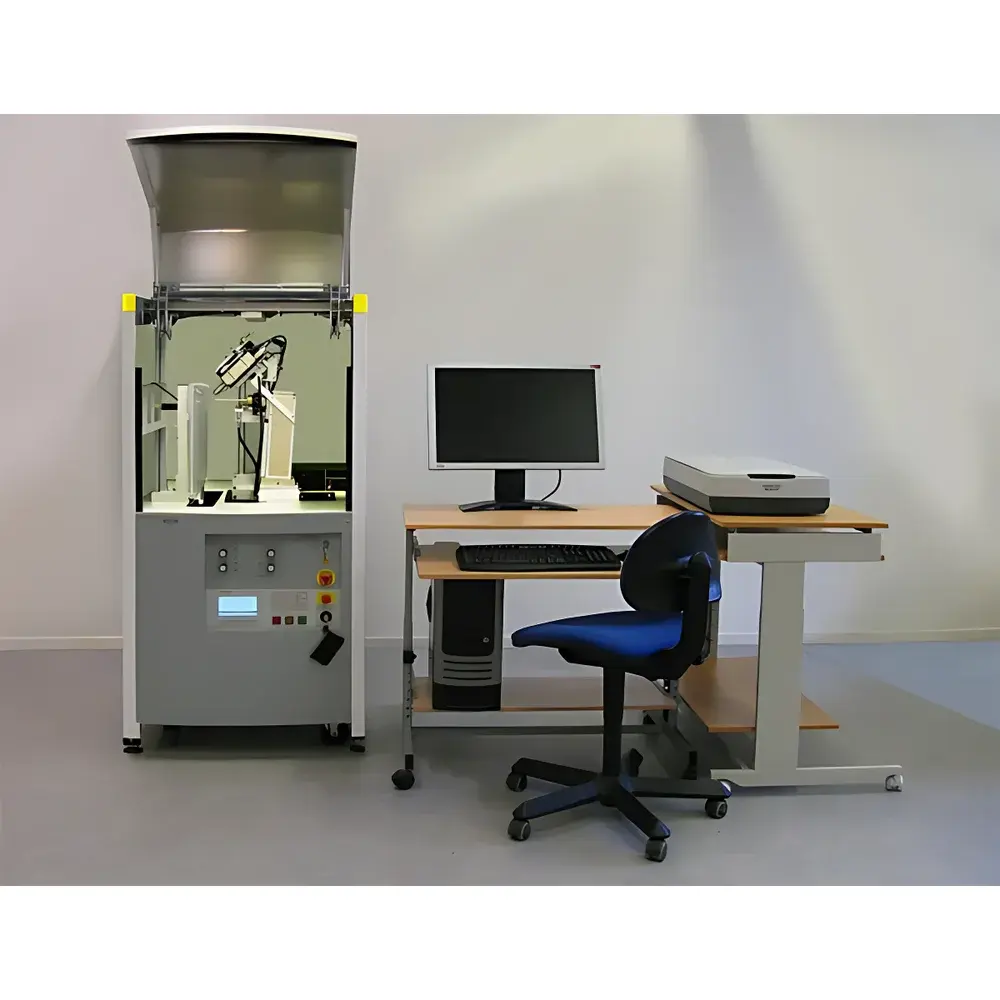
MultiScanner Tree-Ring Density and Elemental Analysis System
| Origin | Sweden |
|---|---|
| Manufacturer Type | Authorized Distributor |
| Origin Category | Imported |
| Model | MultiScanner |
| Pricing | Available Upon Request |
Overview
The MultiScanner Tree-Ring Density and Elemental Analysis System is a high-precision, dual-modality scientific instrument engineered for dendrochronological and paleoenvironmental research. It uniquely integrates digital X-ray imaging (XRI) and energy-dispersive X-ray fluorescence (ED-XRF) in a single platform to simultaneously quantify wood density profiles and spatially resolved elemental distributions across tree-ring sequences. Based on the physical principles of X-ray attenuation (for density mapping) and characteristic X-ray emission (for elemental identification), the system delivers non-destructive, micron-scale structural and geochemical data from solid organic samples—including increment cores, cross-sections, sediment slices, peat monoliths, and lacustrine deposits. Its design adheres to the metrological requirements of long-term climate reconstruction, environmental forensics, and archaeological provenance studies where sub-annual resolution and trace-element sensitivity are critical. The system operates under controlled radiation safety protocols compliant with IEC 61000-4 and EU Directive 2013/59/Euratom, with integrated lead-shielded enclosure and interlocked beam shutdown.
Key Features
- Dual-mode acquisition: Synchronized X-ray imaging (density) and ED-XRF (elemental mapping) in one scan pass
- Polyflat™ collimated X-ray beam: 50 µm × 20 mm focal spot enabling 10 × 20 µm spatial resolution in XRI mode; 50 µm horizontal / 2 mm vertical resolution in XRF mode
- Adjustable beam optics: X-ray beam trimmer supports 10 µm horizontal resolution enhancement for high-fidelity ring boundary delineation
- Modular X-ray source: Standard LFF Cr-anode tube (60 kV, 55 mA, 3.3 kW max); optional Mo-tube configuration available for thicker (>15 mm) or high-Z matrix samples
- High-dynamic-range detection: 16-bit linear CCD array detector optimized for low-noise density calibration and quantitative XRF intensity capture
- Automated multi-sample handling: 9-slot sample tray accommodating 280 mm × 7–12 mm wood strips; removable tray design for rapid specimen exchange
- Integrated density calibration: NIST-traceable plastic wedge positioned above sample plane for pixel-wise mass attenuation coefficient normalization
Sample Compatibility & Compliance
The MultiScanner accepts heterogeneous natural samples without destructive sectioning or metal coating—ideal for fragile archaeological wood, waterlogged timbers, and unconsolidated sediments. Sample thickness range: 1–50 mm (Cr tube: 1–10 mm optimal; Mo tube: up to 50 mm). Geometry flexibility includes cylindrical cores (5–12 mm diameter), planar slabs (up to 280 × 12 mm), and irregular sediment cores. All hardware and firmware comply with ISO/IEC 17025:2017 requirements for testing laboratories, and software architecture supports audit trails aligned with GLP and FDA 21 CFR Part 11 for regulated environmental monitoring programs. Radiation shielding meets EN 61331-1:2014 standards; operational interlocks prevent X-ray emission during cabinet access.
Software & Data Management
The proprietary ScanControl Suite provides full experimental control via touchscreen interface or remote desktop. Key capabilities include region-of-interest (ROI) selection, adaptive scanning speed adjustment, batch queue scheduling, and automated drift correction. Density outputs are delivered as calibrated µg/cm² maps; XRF data are quantified using fundamental parameter (FP) algorithms with matrix-matched standards (e.g., NIST SRM 1515, 1577c). Export formats include TIFF (16-bit), CSV (ring-by-ring elemental concentrations), and HDF5 (multi-dimensional metadata-rich containers). Time-stamped acquisition logs, user authentication records, and version-controlled processing scripts ensure full data provenance—essential for peer-reviewed publication and regulatory submission.
Applications
- Paleoclimatology: Reconstruction of summer temperature, drought severity, and volcanic forcing via maximum latewood density (MXD) and sulfur/chlorine anomalies
- Environmental Forensics: Temporal tracking of anthropogenic pollutants (Pb, Zn, As, Hg) in tree rings as historical deposition archives
- Forest Ecology: Quantifying silvicultural impacts on wood anatomy and nutrient allocation across decades
- Archaeology & Art History: Provenancing timber in historic structures using elemental fingerprinting and growth-ring synchronization
- Geochemistry: Correlating tree-ring chemistry with lake sediment cores and ice-core records for multi-proxy climate modeling
FAQ
What elements can be detected and at what detection limits?
Al, Si, S, Cl, K, Ca, Cr, Mn, Fe, Cu, Zn, As, Hg, Pb are routinely quantified; detection limits range from 1–50 ppm depending on element atomic number, sample matrix, and acquisition time (typical scan: 30–120 min per core).
Is sample preparation required before scanning?
No chemical treatment or metallization is needed. Cores must be air-dried and mounted flat; surface planing is recommended for optimal X-ray transmission uniformity.
Can the system analyze non-wood materials such as peat or sediment cores?
Yes—provided sample thickness and density fall within the operational envelope (≤50 mm with Mo tube); custom sample holders are available for cylindrical cores.
Does the software support statistical comparison across multiple samples?
Yes—built-in ring-width alignment (COFECHA-compatible), cross-dating tools, and PCA-based elemental correlation modules enable multi-series chronology development.
What safety certifications does the system hold?
CE-marked per 2014/30/EU (EMC) and 2014/35/EU (LVD); radiation safety certified by Swedish Radiation Safety Authority (SSM) under SSMFS 2008:8.
Related Products






