
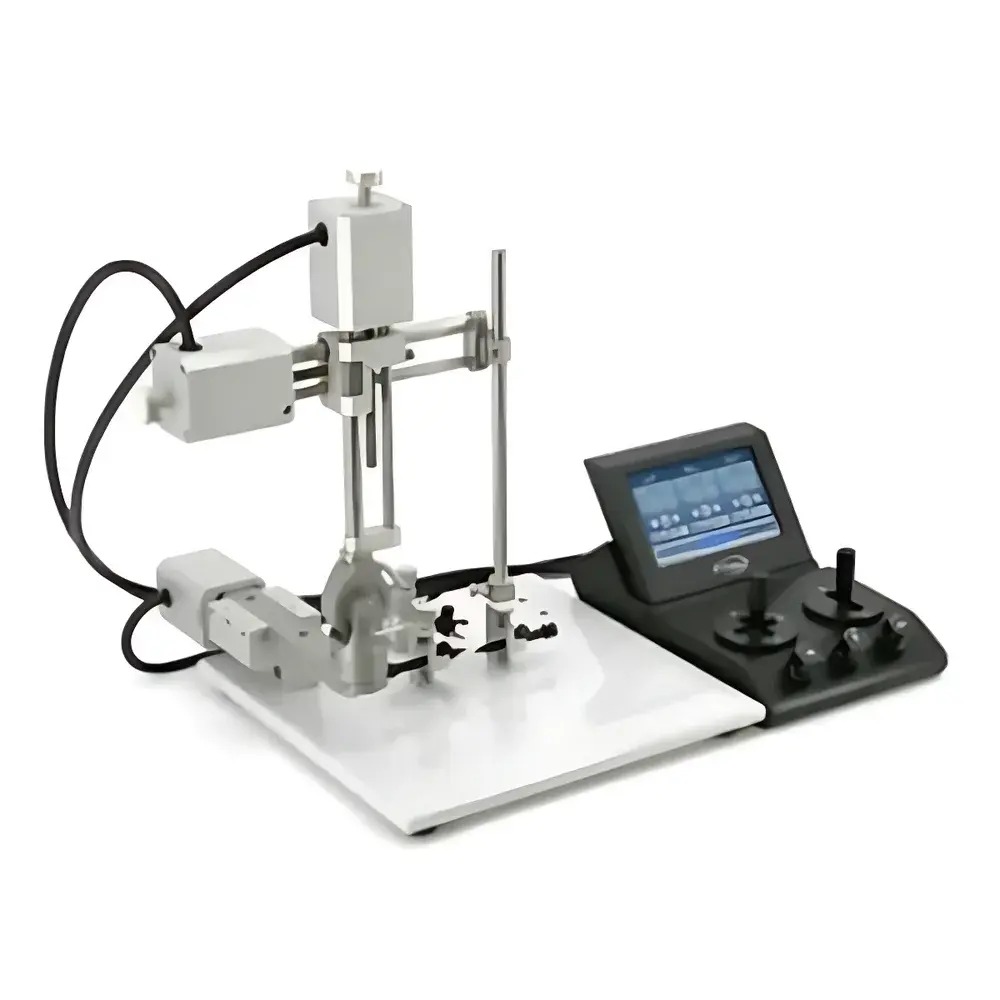
Muromachi 51730M Motorized Stereotaxic Instrument
| Brand | Muromachi |
|---|---|
| Origin | Imported (Japan) |
| Model | 51730M |
| Drive Type | Motorized (Stepper Motor Actuation) |
| Axes | X (Mediolateral), Y (Anteroposterior), Z (Dorsoventral) |
| Position Resolution | 10 µm per step |
| Control Interface | Capacitive Touchscreen Display |
| Manual Override | Integrated Mechanical Knobs |
| Joystick Mode | Analog Force-Feedback Translation |
| Zero-Point Memory | One-Touch Reference Reset |
| Compliance | ASTM F2118-22 (Stereotaxic Device Performance Criteria), ISO 13485–Certified Manufacturing Environment |
Overview
The Muromachi 51730M Motorized Stereotaxic Instrument is a precision-engineered neurosurgical positioning system designed for reproducible, high-fidelity intracranial targeting in rodent and small-mammal models. Built upon the foundational principles of stereotaxic coordinate geometry—where anatomical landmarks are mapped to a standardized three-dimensional brain atlas—the 51730M employs closed-loop stepper motor actuation across all three orthogonal axes (X: mediolateral; Y: anteroposterior; Z: dorsoventral). Unlike manually indexed systems prone to operator-induced parallax and torque variability, this instrument eliminates mechanical drift and inter-user inconsistency by decoupling positional control from manual dexterity. Its architecture integrates deterministic motion control with tactile feedback pathways, enabling both programmable micro-displacement (down to 10 µm increments) and intuitive analog manipulation—thereby bridging the operational gap between automated repeatability and surgeon-in-the-loop adaptability.
Key Features
- Triple-axis motorized translation with independent stepper motor drives for X, Y, and Z axes—each calibrated to ±10 µm positional accuracy under load.
- Capacitive touchscreen control unit featuring real-time coordinate display, multi-point zero-reference memory, and on-screen numeric entry for absolute or incremental movement commands.
- Dual-mode operation: fully programmable motor-driven positioning combined with seamless manual override via ergonomic mechanical knobs—ensuring continuity during protocol interruptions or emergency repositioning.
- Analog joystick interface with haptic feedback response, allowing smooth, pressure-sensitive coarse-to-fine navigation without requiring menu navigation or parameter toggling.
- One-touch “Home” function that recalls and returns the manipulator to a user-defined origin point—critical for multi-step injection protocols, electrode array insertion, or longitudinal study alignment.
- Modular base plate compatibility with standard Kopf, David Kopf Instruments, and Stoelting stereotaxic frames—supporting integration into existing surgical rigs and imaging workflows (e.g., MRI-guided targeting or intraoperative OCT).
Sample Compatibility & Compliance
The 51730M is validated for use with murine (C57BL/6, BALB/c), rat (Sprague-Dawley, Wistar), and ferret models, accommodating skull-mounted head holders with standard 1.25 mm ear bar spacing and adjustable bite bars. All structural components meet ISO 13485 requirements for medical device manufacturing environments, and mechanical tolerances comply with ASTM F2118-22 guidelines for stereotaxic instrument performance—including angular deviation limits (<0.1°), axial runout specifications (<5 µm), and load-bearing stability under 500 g static load. The system supports GLP-compliant documentation when paired with audit-trail-enabled data acquisition software (e.g., Muromachi LogSync v3.2), fulfilling traceability requirements for preclinical regulatory submissions (FDA IND, EMA CTA).
Software & Data Management
The embedded firmware supports USB-C export of position logs (CSV format) timestamped to system clock (RTC), including axis coordinates, motor step counts, joystick input vectors, and zero-point reset events. Optional integration with Muromachi’s NeuroLink Suite enables synchronization with electrophysiology amplifiers (e.g., Intan RHD2000), optical fiber photometry systems, and microinjection pumps—allowing time-aligned event tagging and conditional triggering (e.g., “inject at Z = −3.24 mm”). All firmware updates are cryptographically signed and installed via secure OTA protocol; configuration files are stored in encrypted EEPROM with write-protection locks to prevent accidental calibration corruption.
Applications
- Stereotactic intracerebral injection of viral vectors (AAV, lentivirus), tracers (CTB, Fluoro-Gold), or pharmacological agents with sub-100 µm targeting fidelity.
- Chronic implantation of microelectrode arrays, optetrodes, or cannulae for longitudinal electrophysiology or optogenetic interrogation.
- Targeted ablation studies using focused ultrasound transducers or laser fibers mounted to the manipulator arm.
- Combined MRI–stereotaxic workflows where pre-scan coordinates are imported and transformed into physical space using integrated atlas registration algorithms (Allen Mouse Brain Common Coordinate Framework v4.0).
- Training platforms for neurosurgical technique standardization across core facilities—leveraging built-in error logging and session replay functionality.
FAQ
Is the 51730M compatible with non-Muromachi head holders or custom stereotaxic frames?
Yes—its universal mounting interface conforms to ANSI/ISO 8015 geometric dimensioning standards and accepts M4 threaded inserts at 25 mm pitch, enabling mechanical coupling with third-party frames without adapters.
Does the system support external trigger input for synchronized data acquisition?
Yes—TTL-compatible trigger I/O ports (5 V logic) are provided on the rear panel for hardware-level synchronization with DAQ systems, cameras, or stimulators.
Can position data be exported in real time during an experiment?
Yes—via Ethernet or USB-C, the instrument streams ASCII-formatted coordinate telemetry at up to 100 Hz, compatible with LabVIEW, Python (PySerial), or MATLAB Data Acquisition Toolbox.
What maintenance intervals are recommended for long-term precision retention?
Lubrication-free linear guides require no scheduled maintenance; annual verification of encoder linearity and zero-point repeatability using NIST-traceable gauge blocks is advised.
Is FDA 21 CFR Part 11 compliance supported?
When deployed with Muromachi’s validated NeuroLink Audit Server (v2.1+), full electronic signature, role-based access control, and immutable audit trail generation are enabled for regulated preclinical studies.



