
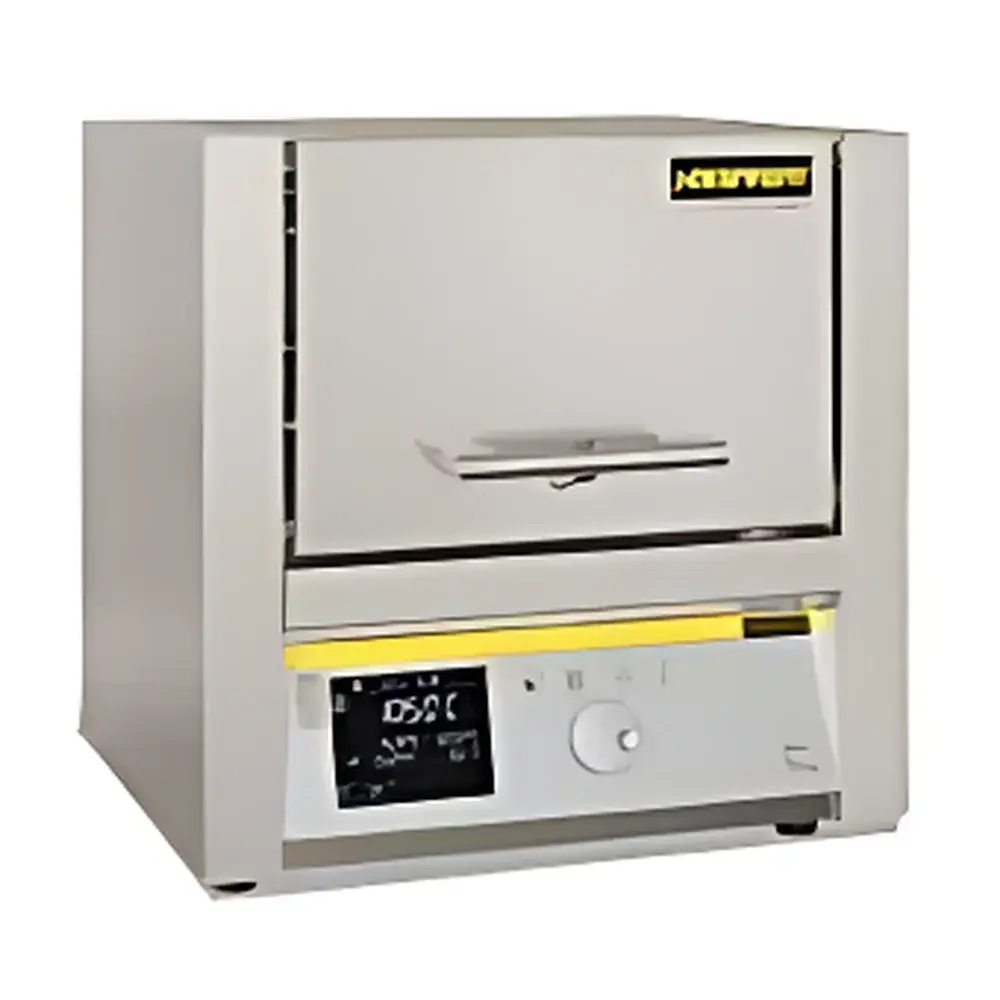
Nabertherm L 1/12 – LT 40/12 Series Muffle Furnaces
| Brand | Nabertherm |
|---|---|
| Origin | Germany |
| Model | L 1/12 – LT 40/12 |
| Heating Temperature Range | 1100 °C or 1200 °C |
| Chamber Volume | 1–40 L |
| Power Supply | 1-phase (230 V) or 3-phase (400 V) |
| Heating Configuration | Dual-sided ceramic heating plates (triple-sided for L 24/11 – LT 40/12) |
| Insulation | High-purity alumina-silica safety fiber |
| Construction | Double-walled stainless steel housing (brushed finish) |
| Door Options | Front-opening (L) or top-opening (LT) |
| Safety Compliance | EN 60519-2, Thermal Protection Class 2 |
| Data Logging | NTLog via USB flash drive |
| Optional Accessories | Gas purge interface, exhaust chimney with fan/catalyst, VCD process control software |
Overview
The Nabertherm L 1/12 – LT 40/12 series comprises precision-engineered laboratory muffle furnaces designed for reproducible high-temperature thermal processing in research, quality control, and industrial R&D environments. These units operate on the principle of radiant heat transfer within a fully insulated, gas-tight chamber, isolating samples from combustion by-products and external contaminants. Constructed to meet stringent European safety and electromagnetic compatibility standards (EN 60519-2), each furnace features a dual-zone ceramic heating system—comprising embedded resistance wires within high-alumina ceramic plates—that ensures uniform temperature distribution across the working chamber. Models with capacities from 1 L to 40 L support maximum operating temperatures of either 1100 °C (L/ LT 3/11 – 40/11) or 1200 °C (L/ LT 1/12 – 40/12), validated per IEC 60584 thermocouple calibration protocols. The double-walled stainless steel housing minimizes surface temperature rise (<55 °C at ambient conditions), while the optional top-opening (LT) configuration enhances operator ergonomics during frequent sample loading under controlled atmosphere conditions.
Key Features
- Dual- or triple-sided ceramic heating elements with integrated resistance wire—chemically inert, resistant to volatiles and splashes, and field-replaceable without disassembly
- High-density alumina-silica safety fiber insulation (≥1260 °C classification), providing low thermal conductivity (<0.09 W/m·K at 1000 °C) and minimal heat loss
- Front-opening (L) and top-opening (LT) door variants—LT models include adjustable air inlet and rear-mounted exhaust port for controlled atmosphere operation
- Thermal protection system compliant with EN 60519-2: independent overtemperature limiter (Class 2), setpoint-adjustable cut-off to safeguard both furnace integrity and sample integrity
- Low-noise solid-state relay (SSR) switching with zero-crossing control—ensuring stable power delivery and extended component lifetime
- Standard NTLog data logger: records time-stamped temperature profiles directly to USB storage, supporting GLP-compliant audit trails
Sample Compatibility & Compliance
These furnaces accommodate a broad range of sample geometries and materials—including crucibles (alumina, quartz, platinum), ceramic sintering trays, ashing boats, and metallurgical specimens—within defined dimensional envelopes (e.g., LT 40/12: internal 320 × 490 × 250 mm). All models comply with ISO/IEC 17025 requirements for equipment qualification when operated within specified environmental limits (ambient 5–40 °C, max. 80% RH non-condensing). Optional gas purge interfaces support inert (N₂, Ar) or reactive (H₂, forming gas) atmospheres per ASTM E1111 and DIN 51742; however, gas purging is incompatible with exhaust chimneys equipped with fans or catalytic converters. Units are CE-marked and manufactured under DIN EN ISO 9001-certified processes.
Software & Data Management
The integrated NTLog function enables autonomous recording of furnace temperature, ramp rate, hold time, and event markers (e.g., door open/close) onto standard USB 2.0 flash drives—no PC required during operation. For advanced process orchestration, the optional VCD (Virtual Control Device) software package provides real-time remote monitoring, multi-step program editing, and export of CSV/Excel-compatible datasets. VCD supports 21 CFR Part 11-compliant user access control, electronic signatures, and full audit trail generation—making it suitable for regulated pharmaceutical, medical device, and contract testing laboratories adhering to GMP/GLP frameworks.
Applications
- Gravimetric analysis: ash content determination (AOAC 923.03, ASTM D3174), loss-on-ignition (LOI) testing in geology and cement chemistry
- Thermal pre-treatment: calcination of catalysts, activation of adsorbents, and binder burnout in ceramic green bodies
- Heat treatment studies: phase transformation kinetics, oxidation behavior of alloys, and sintering optimization under controlled atmospheres
- Calibration reference: serving as stable thermal sources for thermocouple verification per ISO 17025 Clause 6.5.2
- Material stability screening: evaluating thermal degradation thresholds of polymers, composites, and battery electrode materials
FAQ
What is the difference between L and LT model designations?
L denotes front-opening (horizontal hinge) furnaces optimized for easy placement of large or heavy workpieces; LT indicates top-opening (vertical hinge) units designed to minimize operator exposure to radiant heat during routine loading.
Can these furnaces be used under inert gas atmospheres?
Yes—models equipped with the optional gas purge interface support continuous flow of N₂, Ar, or H₂. Note that gas purging must be configured separately from mechanical exhaust systems.
Is third-party validation support available for IQ/OQ/PQ documentation?
Nabertherm provides comprehensive technical documentation packages—including factory calibration certificates, wiring schematics, and material declarations—to facilitate user-led qualification under ISO/IEC 17025 or FDA guidance.
How is temperature uniformity verified across the working chamber?
Uniformity is characterized per DIN EN 15381 using nine-point mapping (center + eight equidistant locations) at 50%, 75%, and 100% of maximum temperature; typical deviation is ±3 °C at 1100 °C and ±5 °C at 1200 °C.
Are replacement heating elements user-serviceable?
Yes—ceramic heating plates are modular and accessible via rear panel removal; no specialized tools or recalibration are required post-replacement.



