
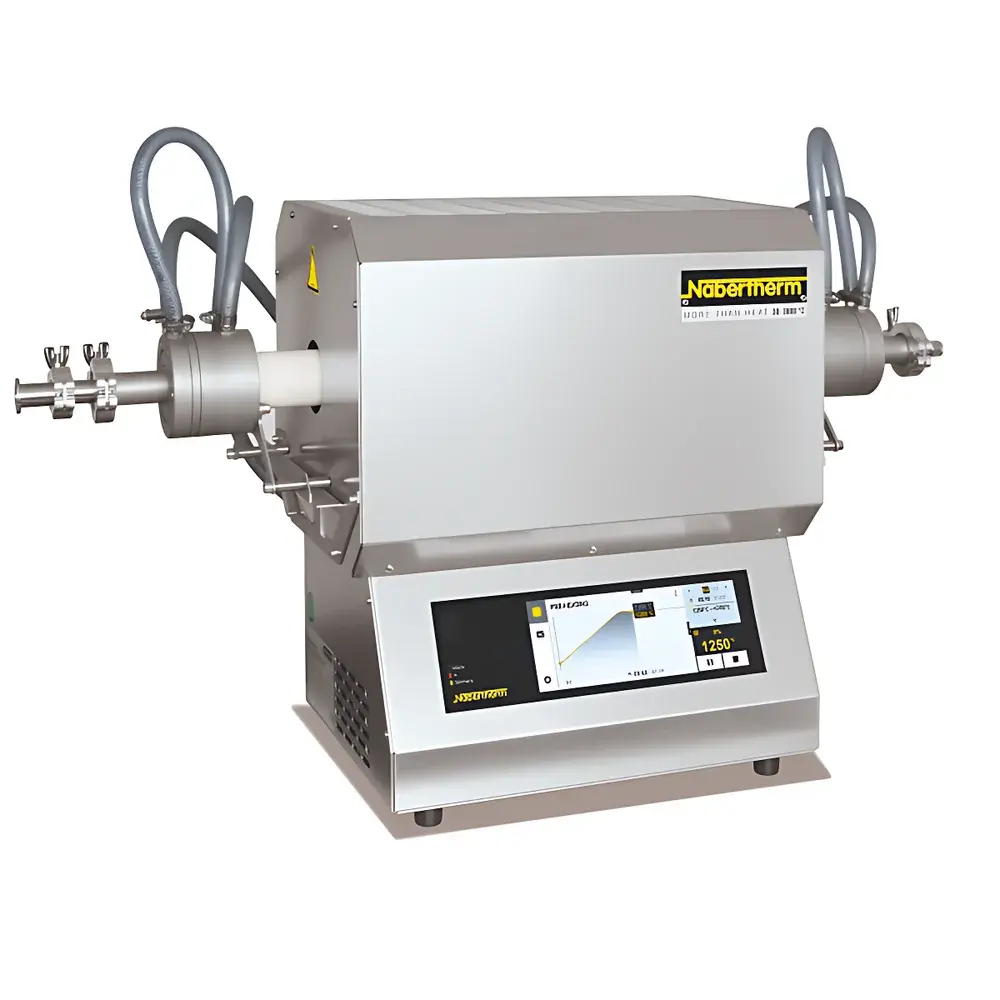
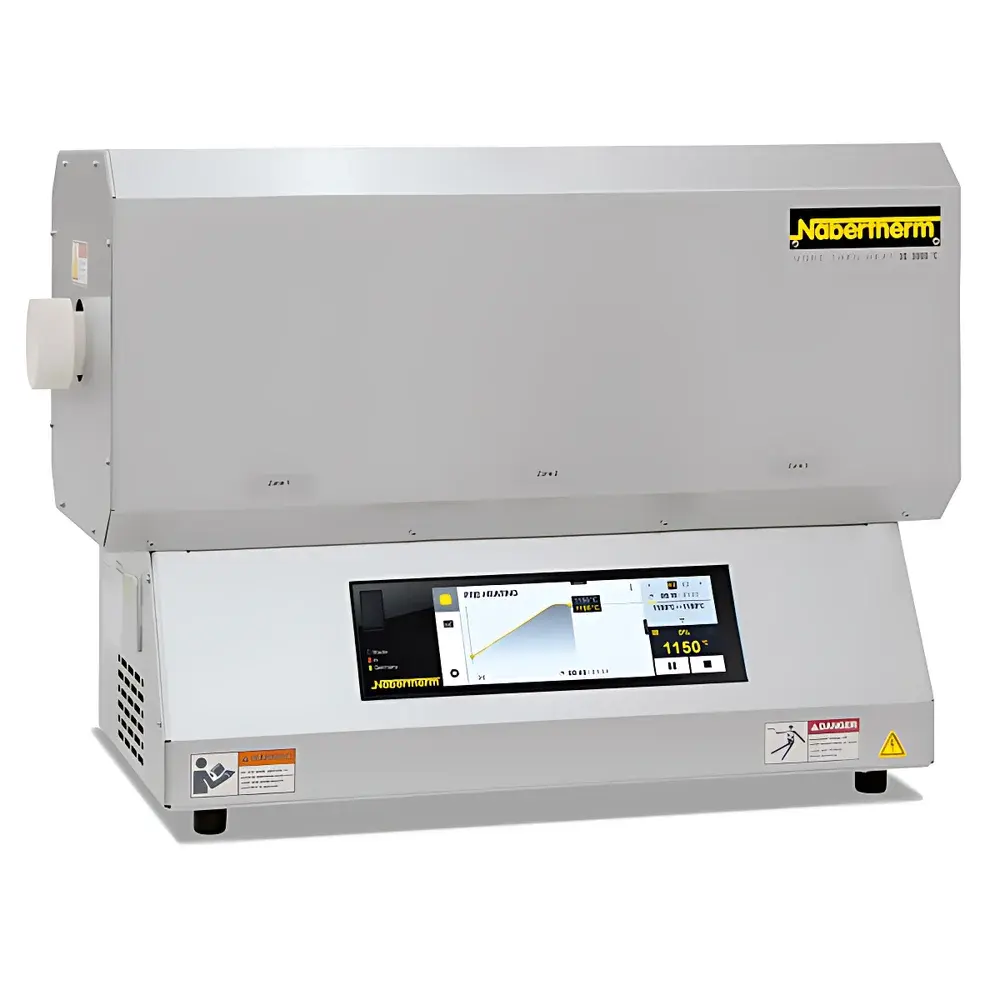
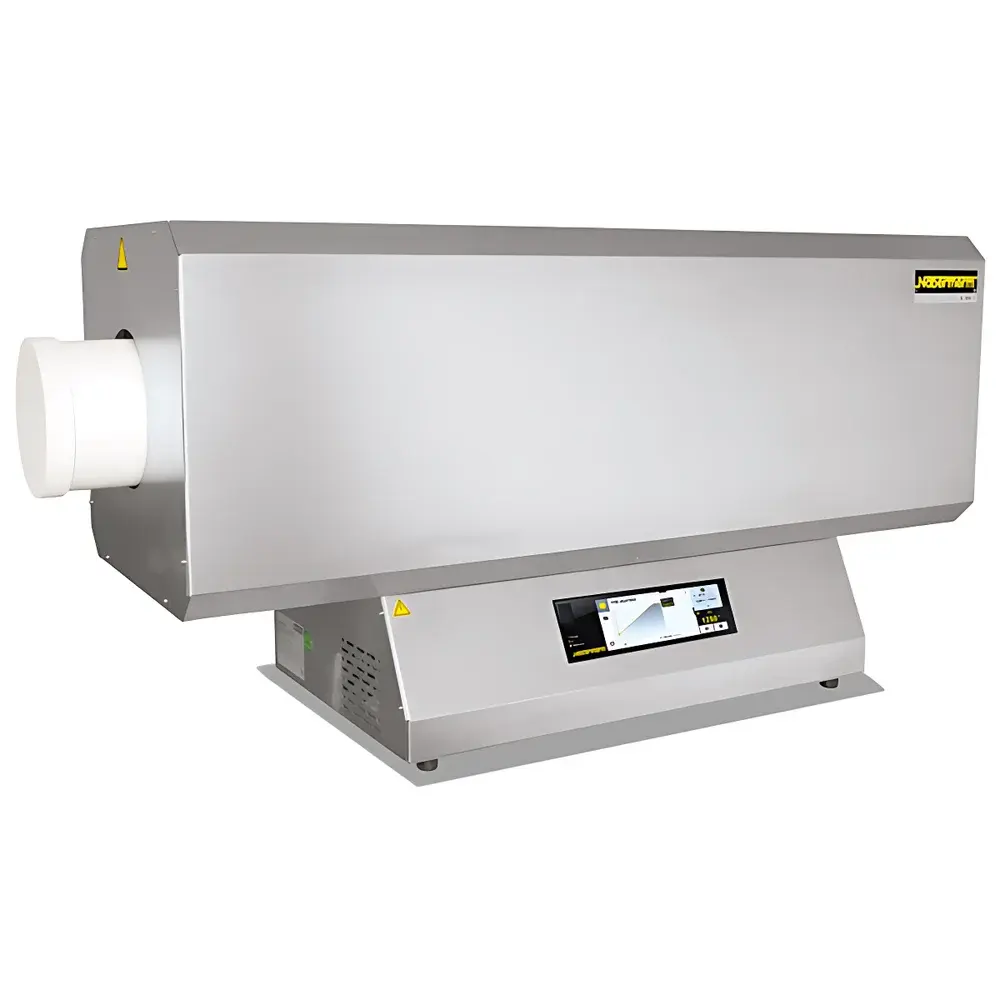
Nabertherm R 50-170/250-1000/12/13 Compact Tube Furnace
| Brand | Nabertherm |
|---|---|
| Origin | Germany |
| Model | R 50-170/250-1000/12/13 |
| Maximum Temperature | 1300 °C |
| Temperature Control Accuracy | ±1 °C |
| Max. Power | 11.5 kW |
| Heating Method | Resistance heating (SiC or MoSi₂ heating elements) |
| Tube Outer Diameter | 50–170 mm |
| Heating Zone Length | 250–1000 mm |
| Thermocouple Type | Type N (1200 °C) or Type S (1300 °C) |
| Controller | B510 (5 programs × 4 segments) |
| Overtemperature Protection | Adjustable cutoff limit |
| Optional Multi-zone Configuration | Three-zone design available for heating zones >500 mm |
| Standard Tube Material | Ceramic C530 (Al₂O₃-based refractory) with two ceramic fiber end plugs |
Overview
The Nabertherm R 50-170/250-1000/12/13 is a compact, single-zone horizontal tube furnace engineered for precision thermal processing in research laboratories and pilot-scale production environments. Designed around a robust ceramic C530 (alumina-rich refractory) working tube and free-radiation heating elements mounted on a supporting quartz or ceramic mandrel, this furnace operates via resistive heating using either silicon carbide (SiC) or molybdenum disilicide (MoSi₂) elements—selected based on maximum temperature requirements and atmospheric compatibility. Its core architecture supports stable operation up to 1300 °C under ambient air conditions, with optional configurations accommodating inert, reducing, or vacuum atmospheres when integrated with compatible gas supply systems (e.g., Nabertherm Gas Supply Units G1, G15, G2, G4). The furnace’s thermal profile is actively managed by a Type S thermocouple (for 1300 °C operation) embedded in the tube wall or inserted into the process zone, enabling direct measurement of internal sample environment temperature—not just furnace chamber setpoint.
Key Features
- Compact footprint optimized for benchtop or modular lab integration, minimizing floor space without compromising thermal performance.
- Single-zone configuration standard; three-zone variant available for heating lengths exceeding 500 mm to improve axial temperature uniformity (±3 °C over 100 mm at 1200 °C).
- High-reproducibility temperature control with ±1 °C accuracy maintained across the full operating range (room temperature to 1300 °C), validated per DIN EN 60584-2 and IEC 60584-1 standards.
- B510 programmable controller with five independent ramp-soak profiles, each supporting up to four segments—including rate-limited heating/cooling, dwell time, and automatic shutdown logic.
- Dual safety architecture: adjustable overtemperature cutoff limiter (independent of main controller) plus integrated thermal fuse protection in heating element circuitry.
- Standard C530 ceramic tube (95% Al₂O₃) rated for continuous service at 1300 °C in oxidizing atmospheres; alternative tubes (quartz, high-purity alumina, or recrystallized SiC) available for specialized chemical or thermal stability requirements.
Sample Compatibility & Compliance
The R-series tube furnace accommodates samples ranging from powder-packed crucibles and catalyst pellets to semiconductor wafers and thin-film substrates, provided dimensional constraints align with selected tube diameter (50–170 mm OD) and heating length (250–1000 mm). End plugs are fabricated from low-conductivity ceramic fiber (density <200 kg/m³) to minimize heat loss while maintaining structural integrity below 1200 °C. All models comply with EU Machinery Directive 2006/42/EC, Low Voltage Directive 2014/35/EU, and EMC Directive 2014/30/EU. Electrical insulation meets IP20 rating per IEC 60529. For regulated environments (e.g., GLP/GMP labs), optional audit-trail-capable controllers (B180/B280) support 21 CFR Part 11-compliant electronic records when paired with Nabertherm’s TMS software suite.
Software & Data Management
While the standard B510 controller provides local operation only, Nabertherm’s optional TMS (Thermal Management System) software enables remote monitoring, real-time data logging (sample temperature, power draw, setpoint deviation), and automated report generation in CSV or PDF format. TMS supports timestamped event logging—including program start/stop, alarm triggers, and manual overrides—meeting traceability requirements for ISO/IEC 17025-accredited testing labs. Integration with LabVIEW™, MATLAB®, or custom SCADA systems is supported via RS485 Modbus RTU or Ethernet TCP/IP interfaces (requires B180/B280 controller upgrade).
Applications
- Thermal annealing of metal oxides, perovskites, and battery cathode precursors (e.g., LiCoO₂, NMC, LFP).
- Controlled atmosphere sintering of ceramic green bodies and metal injection molded (MIM) parts.
- Catalyst activation and regeneration under H₂/N₂/Ar flows.
- Graphitization and carbonization of polymer-derived ceramics (PDCs) and precursor fibers.
- Calibration of thermocouples and reference materials per ASTM E230/E220 protocols.
- Material stability testing per ISO 11358 (thermogravimetric analysis support mode).
FAQ
Can this furnace operate under vacuum or reducing atmospheres?
Yes—when equipped with vacuum-rated flanges, O-ring seals, and compatible gas inlet/outlet fittings. Vacuum operation requires external pumping systems; reducing atmospheres (e.g., H₂/Ar mixtures) necessitate leak-tested tubing and flow controllers per EN ISO 10156 guidelines.
What is the typical temperature uniformity across the hot zone?
At 1200 °C, axial uniformity is ±3 °C over 100 mm in single-zone configuration; improves to ±1.5 °C in three-zone variants with active zone coupling.
Is the C530 tube suitable for chlorine-containing atmospheres?
No—C530 exhibits limited resistance to halogen corrosion. For Cl₂ or HCl environments, recrystallized SiC or high-purity quartz tubes are recommended alternatives.
How often does the heating element require replacement?
SiC elements typically last 2,000–3,000 hours at 1300 °C in air; MoSi₂ elements offer extended life (>5,000 h) but require careful ramping below 800 °C to avoid oxidation-induced embrittlement.
Does Nabertherm provide IQ/OQ documentation packages?
Yes—factory-verified Installation Qualification (IQ) and Operational Qualification (OQ) protocols are available upon request, aligned with ISO 9001 and ASTM E2500-13 guidance for laboratory equipment validation.
Related Products



