
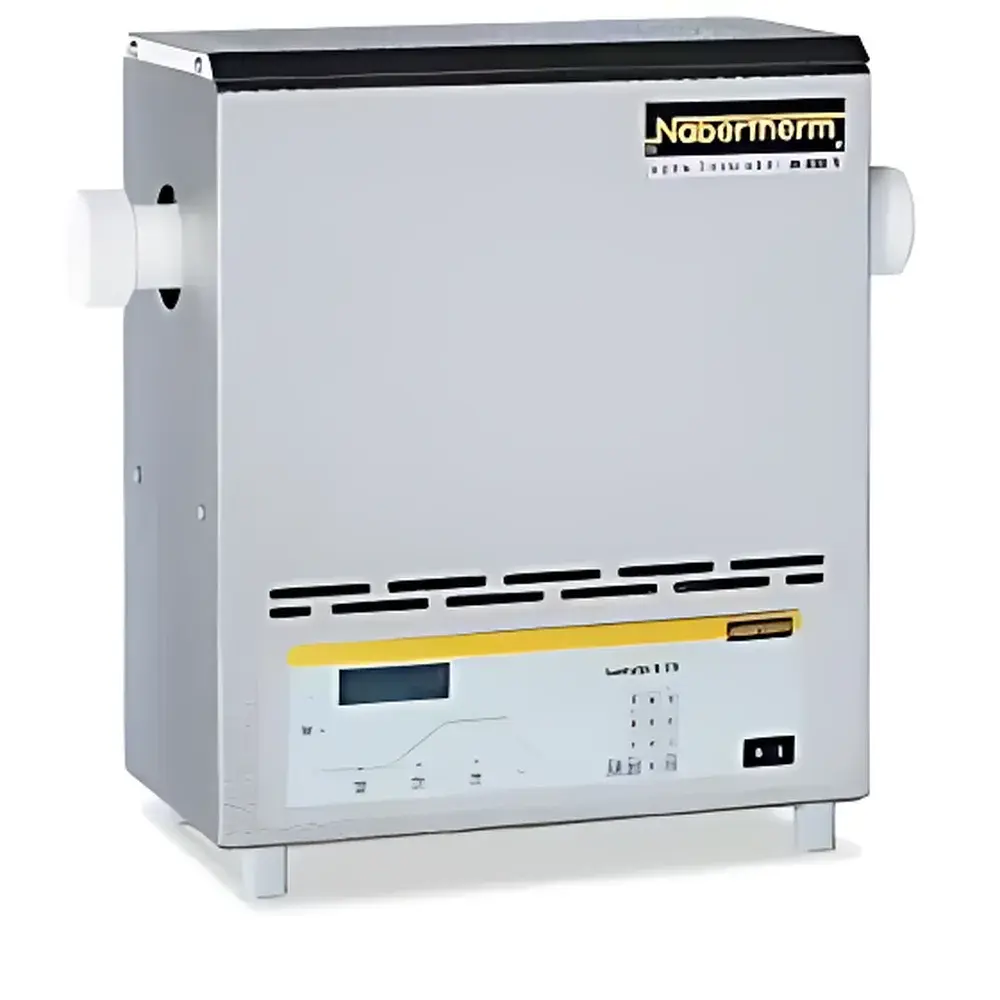
Nabertherm R 50/250/12 Compact Tube Furnace
| Origin | Germany |
|---|---|
| Manufacturer Type | Authorized Distributor |
| Origin Category | Imported |
| Model | R 50/250/12 |
| Instrument Type | Tube Furnace |
| Max Temperature | 1200 °C or 1300 °C |
| Temperature Control Accuracy | ±1 °C |
| Max Power | 6.5 kW |
| Heating Time to Max Temp | 60 min |
| Heating Method | Resistance Wire |
| Tube Outer Diameter Range | 50–120 mm |
| Electrical Supply | 1-phase or 3-phase, depending on model |
| Weight | 20–230 kg (model-dependent) |
| Compliance | EN 60519-2 (thermal protection class 2), CE-marked |
Overview
The Nabertherm R 50/250/12 Compact Tube Furnace is a precision-engineered benchtop thermal processing system designed for controlled atmosphere, vacuum, or inert-gas applications in research laboratories and quality control environments. Based on resistive heating principles, the furnace employs high-stability resistance wire windings embedded within thermally insulated ceramic fiber walls to deliver uniform radial heat distribution along the tube axis. Its modular design supports operational flexibility across a wide range of thermal protocols — from annealing and sintering to crystal growth and catalyst activation — with maximum operating temperatures of either 1200 °C (R-series, type 12) or 1300 °C (R-series, type 13). The furnace’s compact footprint and rigid stainless-steel housing (brushed finish, corrosion-resistant grade) ensure stable positioning on standard laboratory benches while maintaining mechanical integrity under repeated thermal cycling.
Key Features
- Robust construction using brushed stainless-steel housing compliant with EN 60519-2 safety standards for industrial heating equipment
- Precision temperature regulation via S-type thermocouple feedback and silent solid-state relay control, achieving ±1 °C stability at setpoint
- Standard configuration includes one C530 high-purity alumina ceramic working tube and two ceramic fiber end plugs for thermal sealing and gas containment
- Overtemperature protection system with independent thermal limiter (Class 2 per EN 60519-2), automatically disconnecting power if internal temperature exceeds user-defined threshold
- Cascade temperature control option available for models with heating zones >750 mm: measures both furnace chamber and working tube interior temperatures for improved thermal uniformity
- HiProSystem multi-zone controller (optional) enables independent regulation of up to three axial heating zones — critical for gradient thermal treatments and reproducible process scaling
- Electrical interface supports both single-phase (up to 3.6 kW) and three-phase (up to 6.5 kW) supply configurations, with integrated circuit breakers and grounding compliance
Sample Compatibility & Compliance
The R-series tube furnaces accommodate cylindrical samples and substrates housed within standardized ceramic (C530), quartz, or metallic working tubes — all compatible with vacuum systems (down to 10⁻³ mbar) and controlled gas lines (N₂, Ar, H₂, forming gas). Internal tube diameters range from 50 mm to 120 mm, with heating lengths spanning 250 mm to 1000 mm, enabling adaptation to diverse sample geometries and throughput requirements. All units are CE-marked and conform to IEC/EN 61000 electromagnetic compatibility directives. For regulated environments, the furnace architecture supports integration into GLP/GMP workflows through optional data logging interfaces and audit-trail-capable controllers meeting FDA 21 CFR Part 11 requirements when paired with validated software platforms.
Software & Data Management
While the base R-series operates via analog/digital front-panel controls, Nabertherm offers optional digital controllers (e.g., THERMOCOMFORT series) featuring RS485/Modbus RTU communication, real-time temperature profiling, and programmable ramp-soak cycles. These controllers support CSV export of time-temperature logs and can be synchronized with LIMS or MES systems via OPC UA gateways. Process parameters — including setpoints, ramp rates, dwell times, and alarm thresholds — are password-protected and version-controlled. Firmware updates follow ISO/IEC 17025-aligned validation protocols, ensuring traceability and repeatability across calibration intervals.
Applications
- Materials science: oxide reduction, metal alloy homogenization, thin-film annealing, and precursor decomposition studies
- Chemistry: catalytic reaction screening under defined thermal gradients and atmospheres
- Electronics: wafer-level thermal treatment, solder reflow simulation, and MEMS packaging conditioning
- Geoscience: mineral phase transformation experiments under controlled redox conditions
- Pharmaceutical development: excipient stability testing and API crystallinity modulation
- Academic research: teaching labs requiring reliable, repeatable high-temperature exposure with minimal infrastructure demands
FAQ
What is the recommended maintenance interval for the C530 ceramic tube?
Ceramic tubes should be inspected visually before each use; replacement is advised after 200–300 h of cumulative operation at ≥1100 °C or upon detection of microcracks, discoloration, or dimensional warping.
Can this furnace be operated under vacuum without additional accessories?
No — vacuum operation requires a separately configured vacuum flange kit, pressure gauge, and compatible pump system; these are listed under “R-series Vacuum & Gas Supply Systems” in the Nabertherm Accessories Catalog.
Is the furnace suitable for hydrogen-atmosphere processing?
Yes, provided the working tube material is rated for H₂ service (e.g., high-purity alumina or specific quartz grades), and the furnace is installed in a ventilated hood with hydrogen leak detection per EN 61511.
Does the R 50/250/12 support programmable multi-step temperature profiles out of the box?
Basic ramp-hold functionality is included with the standard controller; full 16-segment programmable profiles require upgrade to the THERMOCOMFORT digital controller with USB or Ethernet interface.
How is temperature uniformity verified across the hot zone?
Nabertherm provides factory calibration certificates specifying ΔT ≤10 K over the specified uniformity zone (e.g., 80 mm for R 50/250/12); users may perform periodic verification using calibrated multi-point thermocouples per ASTM E220.



