
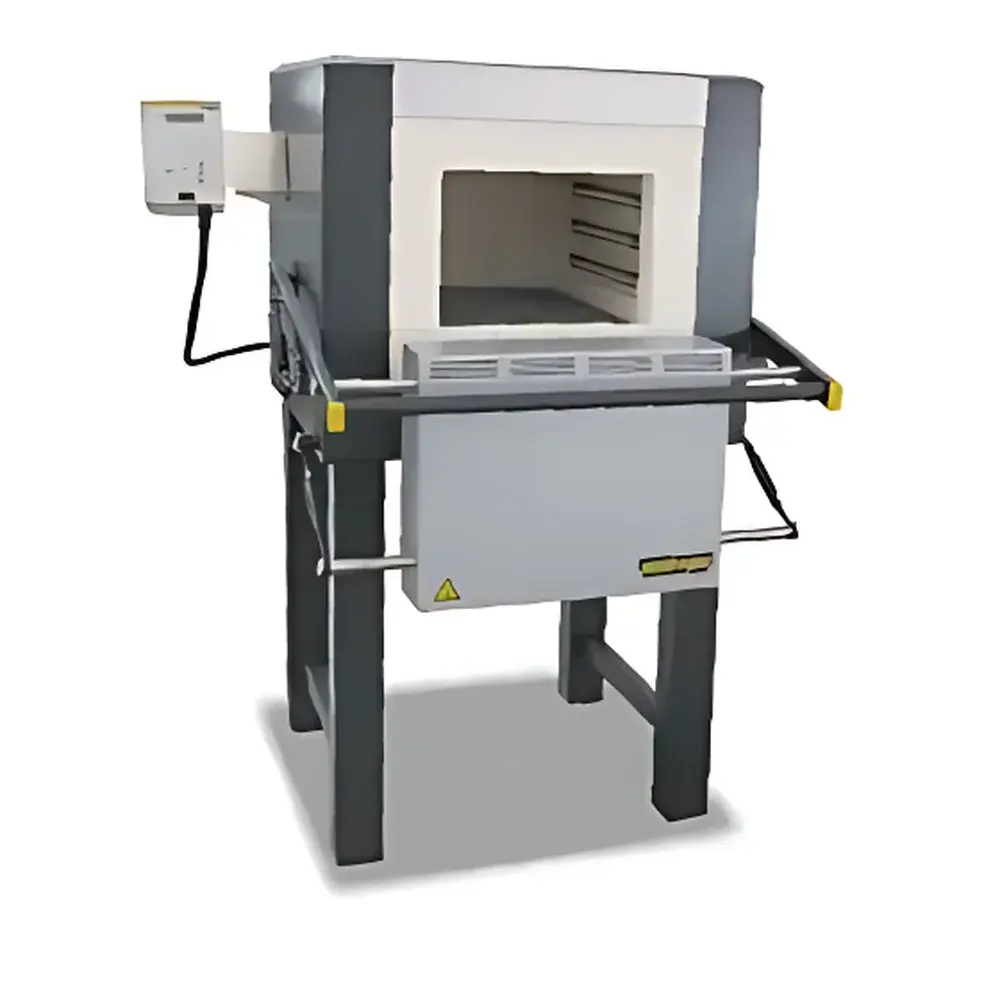
Nabertherm N 7/H – N 87/H Vertical Muffle Furnace for Annealing and Quenching
| Origin | Germany |
|---|---|
| Manufacturer Type | Authorized Distributor |
| Origin Category | Imported |
| Model Range | N 7/H – N 87/H |
| Instrument Type | Box-Type Muffle Furnace |
| Max Temperature | 1280 °C |
| Temperature Control Accuracy | ±1 °C |
| Max Power | 20 kW |
| Ramp Time to Max Temp | 120 min |
| Heating Configuration | Triple-Sided (Left, Right & Bottom) |
| Internal Volume | 7–61 L |
Overview
The Nabertherm N 7/H – N 87/H series comprises vertically oriented, high-performance muffle furnaces engineered for precise thermal processing in demanding laboratory and pilot-scale environments. These furnaces operate on the principle of radiant heat transfer within a fully insulated chamber, isolating samples from direct contact with heating elements and combustion byproducts—ensuring contaminant-free, reproducible thermal treatments. Designed specifically for annealing, stress-relieving, hardening, and quenching applications—including controlled-atmosphere processing of reactive metals such as titanium—the series meets stringent requirements in materials science, metallurgy, pharmaceutical R&D, and quality control laboratories. Each unit features a robust ceramic fiber–reinforced lightweight refractory brick lining, optimized for rapid thermal response and long-term dimensional stability under repeated thermal cycling up to 1280 °C.
Key Features
- Triple-sided heating configuration (left wall, right wall, and floor-mounted elements) ensures uniform temperature distribution across the entire working chamber, minimizing axial and radial gradients—critical for consistent annealing outcomes.
- Heating elements mounted on ceramic support tubes allow unobstructed radiant emission; silicon carbide (SiC) protective plates shield bottom heaters from mechanical impact and thermal degradation.
- Multi-layer insulation system composed of low-conductivity lightweight refractory bricks and ceramic fiber modules delivers exceptional thermal retention and energy efficiency, reducing standby losses and improving ramp repeatability.
- Vertically hinged door opens downward (standard) or upward (optional), facilitating ergonomic loading/unloading of crucibles, trays, or custom fixtures—especially beneficial during sequential heat-treatment workflows.
- Integrated exhaust port positioned on rear wall (standard from model N 31/H onward) enables connection to fume extraction systems or inert gas purge lines, supporting ASTM E831-compliant outgassing protocols and ISO 9001-aligned process documentation.
- Modular design supports seamless integration of optional accessories: annealing boxes for protective atmosphere processing, roller conveyors for continuous throughput, and integrated quench stations with temperature-controlled oil or polymer baths.
Sample Compatibility & Compliance
The N 7/H – N 87/H series accommodates a broad range of sample geometries and material classes—including metallic alloys (e.g., Ti-6Al-4V, Inconel, stainless steels), ceramics, composites, and pharmaceutical excipients requiring thermal stabilization. All models comply with IEC 61000-6-3 (EMC emissions) and IEC 61000-6-2 (immunity), and are CE-marked per the EU Machinery Directive 2006/42/EC and Low Voltage Directive 2014/35/EU. When equipped with optional programmable controllers featuring audit trail functionality and user-level access control, the furnaces support GLP/GMP-aligned validation per FDA 21 CFR Part 11 requirements for electronic records and signatures.
Software & Data Management
Furnaces may be paired with Nabertherm’s THERMOCOMFORT® controller family (e.g., TCC 2000, TCC 3000), offering 16-segment programmable ramps, real-time PID tuning, and digital I/O interfaces for external quench triggers or gas flow synchronization. Data logging is performed at configurable intervals (down to 1 s resolution), with CSV export via USB or Ethernet. Optional software packages (e.g., THERMOLOG®) provide full traceability—including operator ID, timestamped setpoint changes, deviation alerts, and thermal profile replay—enabling compliance with ISO/IEC 17025 clause 7.8.2 on result reporting integrity.
Applications
- Controlled-atmosphere annealing of biomedical-grade titanium implants per ASTM F136 specifications.
- Stress-relief heat treatment of additively manufactured Ni-based superalloy components prior to non-destructive evaluation.
- Pre-sintering of ceramic green bodies in dental and orthopedic device manufacturing.
- Thermal calibration of thermocouples and reference materials under ISO/IEC 17025-accredited conditions.
- Decomposition kinetics studies of battery cathode precursors (e.g., LiCoO₂, NMC) using programmed temperature profiles.
- Residue ashing of pharmaceutical dosage forms per USP and EP 2.4.16 guidelines.
FAQ
What is the maximum recommended operating temperature for continuous use?
The furnace is rated for continuous operation at 1250 °C; 1280 °C is specified as the absolute upper limit for short-duration cycles (≤30 min) and requires adherence to Nabertherm’s thermal soak protocol.
Can this furnace be used under inert or reducing atmospheres?
Yes—when fitted with an annealing box (e.g., AB 100 series) or connected to a mass-flow-controlled N₂/H₂/Ar system via the rear exhaust port, it supports processes compliant with AMS 2750E pyrometric requirements.
Is remote monitoring supported?
Ethernet-enabled controllers (TCC 3000+) support Modbus TCP and OPC UA integration, allowing centralized supervision via LIMS or SCADA platforms.
What maintenance intervals are recommended for heating elements and insulation?
Annual visual inspection of SiC plates and ceramic fiber integrity is advised; element replacement frequency depends on thermal cycling load but typically exceeds 5,000 hours at ≤1200 °C.
Does the furnace meet fire safety standards for installation in shared lab spaces?
All models include Class H insulation, dual overtemperature protection (independent limit controller + mechanical cutout), and surface temperature limits ≤60 °C at 50 mm distance—meeting EN 60519-2 requirements for electrical equipment in industrial heating applications.



