
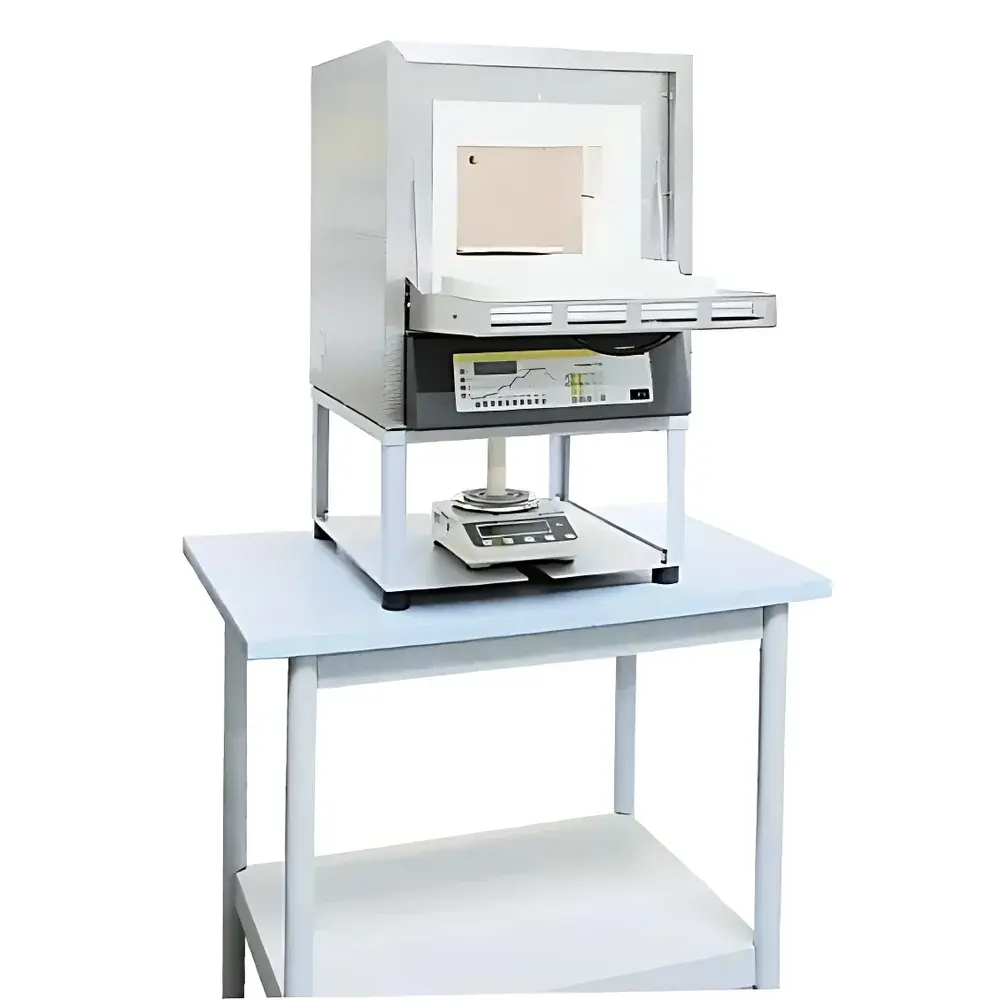
Nabertherm L 9/11/SW & LT 9/12/SW Integrated Thermogravimetric Muffle Furnace System with Precision Weighing and TGA Software
| Brand | Nabertherm |
|---|---|
| Origin | Germany |
| Model | L 9/11/SW, L 9/12/SW, LT 9/11/SW, LT 9/12/SW |
| Type | Box-type muffle furnace with integrated thermogravimetric measurement |
| Max. temperature | 1100 °C or 1200 °C |
| Internal dimensions (W×D×H) | 230 × 240 × 170 mm |
| Chamber volume | 9 L |
| External dimensions (W×D×H) | 480 × 550 × 800 mm (L-series) or 480 × 550 × (800+290) mm (LT-series) |
| Power supply | 3.0 kW, single-phase |
| Weight | 55 kg (L), 75–90 kg (LT) |
| Heat-up time to max. temperature | 75–90 min |
| Weighing system options | EW-1500 (d = 0.01 g, max = 1500 g incl. lever), EW-3000 (d = 0.01 g, max = 3000 g), EW-6000 (d = 0.10 g, max = 6000 g) |
| Lever weight | 850 g |
| Minimum load | 0.5 g (EW-1500/EW-3000), 5.0 g (EW-6000) |
| Repeatability | ±0.01 g (EW-1500/EW-3000), ±0.10 g (EW-6000) |
Overview
The Nabertherm L 9/11/SW and LT 9/12/SW Integrated Thermogravimetric Muffle Furnace System is a purpose-engineered laboratory platform for precise, real-time combustion loss (loss-on-ignition, LOI) analysis under controlled thermal conditions. Unlike conventional standalone furnaces, this system integrates a high-stability muffle furnace, a mechanically decoupled precision weighing unit, and dedicated thermogravimetric acquisition software into a single synchronized architecture. It operates on the fundamental principle of thermogravimetry—measuring mass change as a function of temperature or time under defined atmospheric conditions (e.g., ambient air, inert gas, or controlled airflow). The furnace employs dual-sided ceramic heating plates with embedded resistance wire elements, ensuring uniform radial and axial temperature distribution across the 9 L chamber while protecting heating components from volatile condensates and sample splatter. Vacuum-formed high-purity alumina-silica fiber insulation provides thermal efficiency and long-term dimensional stability at temperatures up to 1200 °C.
Key Features
- Dual configuration options: L-series with counterbalanced flip-up door (optimized for manual sample loading/unloading), LT-series with vertical lift door (minimizes operator exposure to radiant heat and eliminates contact with hot surfaces)
- Ceramic heating plates with recessed heating elements—resistant to chemical attack and thermal shock, enabling reliable operation in aggressive combustion environments
- Robust stainless steel outer casing and vacuum-formed fiber insulation module rated for continuous use at 1200 °C
- Adjustable air inlet on furnace door and rear-mounted exhaust port for controlled oxidative or semi-oxidative atmospheres
- Quiet solid-state electronic relay control with overtemperature protection per EN 60519-2 Class 2 (independent thermal cut-off at preset limit)
- Pre-integrated ceramic lever system (850 g tare mass) with standardized mounting interface for seamless coupling to optional precision balances
- Three scalable weighing modules available: EW-1500 (0.01 g readability, 1500 g capacity), EW-3000 (0.01 g, 3000 g), and EW-6000 (0.10 g, 6000 g)—each certified for static and dynamic stability under thermal drift compensation
Sample Compatibility & Compliance
This system accommodates crucibles, boats, and custom holders compatible with standard laboratory ceramics (alumina, silica, platinum) and refractory metals. It supports gravimetric analysis of heterogeneous solids including municipal solid waste ash, cementitious materials, coal fly ash, activated carbon, catalysts, polymers, and mineralogical samples per ASTM E1131, ISO 11358, and USP <41> guidelines for loss-on-drying and ignition. The furnace chamber design complies with DIN EN 60519-2 safety requirements for industrial heating equipment, and the integrated weighing architecture meets GLP-relevant criteria for traceable mass measurement—particularly when paired with balances featuring internal calibration and audit-trail logging. Optional catalytic exhaust aftertreatment units enable compliance with local emissions regulations during extended organic combustion cycles.
Software & Data Management
The supplied thermogravimetric acquisition software runs on Windows-based host PCs and synchronizes furnace temperature (via integrated Pt100 sensor) and real-time mass data (via RS-232 or USB interface) at user-selectable intervals (1–60 s). Data streams are time-stamped, logged in CSV and proprietary binary formats, and visualized as overlaid TGA curves (mass % vs. temperature/time). Calibration routines support multi-point mass verification and thermal drift correction using reference weights. Exported datasets conform to ASTM E1641-compliant metadata structure—including instrument ID, operator name, date/time stamps, atmospheric settings, and alarm event logs. For regulated environments, optional software validation packages support 21 CFR Part 11 compliance through electronic signatures, role-based access control, and immutable audit trails.
Applications
- Quantification of organic content in soils, sludges, and biomass feedstocks via standardized LOI protocols
- Residue analysis in cement, lime, and gypsum production for quality control of calcination degree
- Thermal stability assessment of flame retardants, polymer composites, and battery electrode materials
- Moisture, volatiles, and fixed carbon determination in coal and coke per ISO 562 and ASTM D3172
- In-process monitoring of catalyst deactivation and coke burn-off kinetics in petrochemical R&D
- Validation of incineration efficiency in waste-to-energy pilot studies
FAQ
What distinguishes this system from a standard muffle furnace with an external balance?
This platform features mechanical and thermal isolation between furnace and weighing unit, active drift compensation algorithms, and hardware-synchronized data acquisition—eliminating hysteresis, convection-induced artifacts, and timing misalignment inherent in ad-hoc setups.
Can the system operate under inert or reducing atmospheres?
Yes—by connecting optional gas purge kits (N2, Ar, or forming gas) to the adjustable inlet and routing exhaust through a sealed vent line, users can perform controlled-atmosphere TGA without compromising balance stability.
Is software validation documentation available for GMP environments?
Nabertherm provides IQ/OQ templates and can supply URS-aligned validation support packages upon request, including test scripts for temperature uniformity, mass repeatability, and data integrity verification.
How is thermal expansion of the ceramic lever compensated during prolonged heating?
The lever geometry and mounting kinematics are engineered to minimize parasitic torque; combined with real-time zero-tracking algorithms in the software, this ensures sub-milligram stability over 8-hour combustion cycles.
Are replacement parts such as heating plates and insulation modules available with documented lot traceability?
All critical consumables—including ceramic heating assemblies and fiber modules—are supplied with serial-numbered certificates of conformance and thermal aging test reports per EN 14411.



