
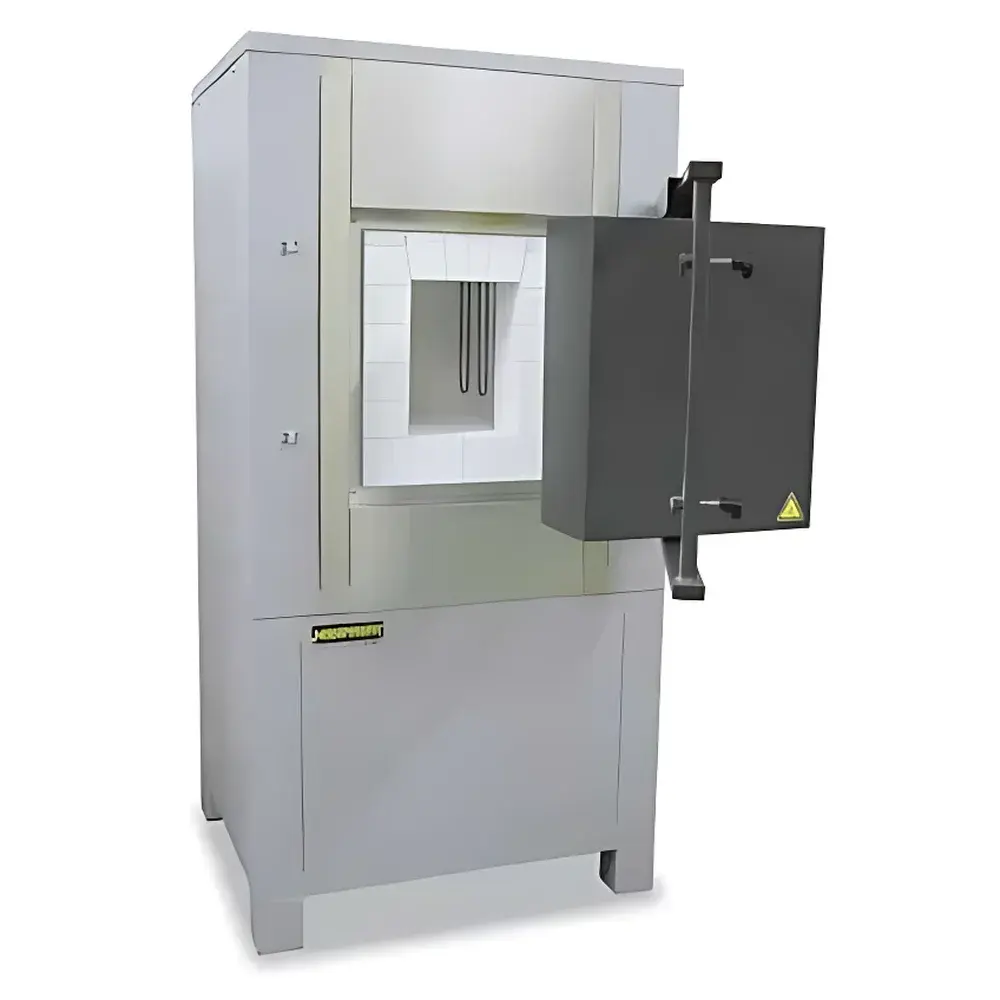
Nabertherm HFL16/16–HFL160/17 Vertical High-Temperature Furnace for Melting Tests and Refractory Applications
| Brand | Nabertherm |
|---|---|
| Origin | Germany |
| Model Range | HFL16/16 – HFL160/17 |
| Max Temperature | 1600 °C or 1700 °C |
| Chamber Volume | 16–160 L |
| Heating Element | Molybdenum Disilicide (MoSi₂) |
| Insulation | Lightweight Refractory Brick with Rear Thermal Barrier |
| Thermocouple Type | Type B |
| Overtemperature Protection | Integrated Limit Controller |
| Exhaust Port | 30 mm Ø at Top Lid |
| Power Supply | 3-phase, 12–21 kW |
| Weight | 500–1190 kg |
| Compliance | CE, EN 61000-6-3, EN 61000-6-4, IEC 61000-4-2 |
Overview
The Nabertherm HFL16/16–HFL160/17 is a vertically oriented, high-temperature muffle furnace engineered for demanding thermal processes—including glass melting, ceramic sintering, refractory testing, and metallurgical fusion studies—where exposure to aggressive vapors (e.g., alkali-rich glass fumes, acidic off-gases) necessitates exceptional thermal integrity and chemical resistance. Its defining architectural feature is the monolithic insulation system composed of lightweight, low-conductivity refractory bricks, specifically formulated to withstand prolonged exposure to corrosive atmospheres without structural degradation or excessive heat loss. Unlike conventional fiber-based insulation, this brick-lined cavity maintains dimensional stability up to 1700 °C while minimizing thermal bridging and ensuring uniform axial temperature distribution—critical for reproducible melt homogeneity and phase transformation analysis. The furnace operates on the principle of radiant heating via high-emissivity MoSi₂ heating elements mounted in the chamber walls, delivering stable, controllable thermal profiles under both ambient-air and protective-atmosphere conditions.
Key Features
- Vertical chamber geometry optimized for gravity-assisted sample loading and melt containment during high-viscosity solid–liquid transitions
- Two-tier temperature capability: 1600 °C (HFLxx/16 series) and 1700 °C (HFLxx/17 series), certified per DIN EN 60584-2 for Type B thermocouple accuracy
- Molybdenum disilicide (MoSi₂) heating elements with integrated ceramic support sleeves—resistant to oxidation and thermal shock up to rated maximum
- Refractory brick insulation system with rear thermal barrier layer, reducing external surface temperature to <60 °C at full operating load
- Standard 30 mm-diameter vapor exhaust port integrated into the top lid, compatible with condensate traps and scrubber interfaces
- Dual-stage overtemperature protection: primary controller with independent limit thermostat and mechanical cut-off switch
- Modular electrical interface supporting 3-phase supply (400 V ±10%, 50/60 Hz); power ratings scalable from 12 kW (HFL16) to 21 kW (HFL160)
Sample Compatibility & Compliance
The HFL series accommodates crucibles and sample holders made from platinum–rhodium, alumina, silicon carbide, and graphite—compatible with ISO 80000-5 thermal metrology standards. Its sealed chamber design supports optional inert gas purging (N₂, Ar) or reducing atmospheres (5% H₂/N₂), enabled by standardized 6 mm Swagelok® inlet/outlet ports and vacuum-rated gasketed door seals. All models comply with EU Machinery Directive 2006/42/EC, Electromagnetic Compatibility Directive 2014/30/EU, and Low Voltage Directive 2014/35/EU. Optional configurations meet GLP audit requirements through traceable calibration certificates (DIN EN ISO/IEC 17025) and configurable event logging for temperature ramp, hold, and cool-down sequences.
Software & Data Management
Furnaces are supplied with Nabertherm’s THERMOCOM control platform, offering programmable multi-step profiles (up to 32 segments), real-time PID tuning, and RS485 Modbus RTU or Ethernet TCP/IP connectivity. Data export supports CSV and XML formats; time-stamped temperature logs include controller status flags (e.g., “heating,” “soak,” “cooling,” “alarm”). Optional FDA 21 CFR Part 11 compliance package includes electronic signatures, audit trail activation, and role-based user access control—validated for GMP environments requiring documented process repeatability.
Applications
- High-temperature viscosity measurement of molten glasses and slags using rotating spindle or falling sphere methods
- Sintering trials of advanced ceramics (ZrO₂, Si₃N₄, AlN) under controlled oxygen partial pressure
- Thermal stability assessment of refractory linings per ASTM C24–22 and ISO 1893
- Pre-fusion conditioning of analytical reference materials prior to XRF or ICP-OES digestion
- Heat treatment of metal alloys requiring precise soak times above 1500 °C (e.g., Ni-based superalloys, Mo–Re systems)
- Development of encapsulated phase-change materials for concentrated solar thermal storage
FAQ
What atmosphere options are supported inside the HFL chamber?
Ambient air, inert gas (N₂, Ar), or reducing mixtures (e.g., 5% H₂ in N₂) — all enabled via standard gas inlet/outlet ports and optional pressure-regulated mass flow controllers.
Can the furnace be integrated into an automated lab workflow?
Yes — via Modbus RTU or Ethernet TCP/IP, the THERMOCOM controller supports SCADA integration, PLC synchronization, and third-party scheduling software (e.g., LabVIEW, DeltaV).
Is calibration documentation included with shipment?
Each unit ships with a factory calibration certificate for the Type B thermocouple and controller output, traceable to PTB (Physikalisch-Technische Bundesanstalt) standards.
How is cooling managed after high-temperature operation?
Optional axial cooling fans (mounted externally) accelerate convective heat removal; combined with programmable ramp-down rates, they reduce cooldown time by up to 40% versus passive cooling.
What safety certifications apply to the HFL series?
CE marking per applicable EU directives; additionally tested to UL 61010-1 (3rd Ed.) and CSA C22.2 No. 61010-1 for North American installation compliance.



