
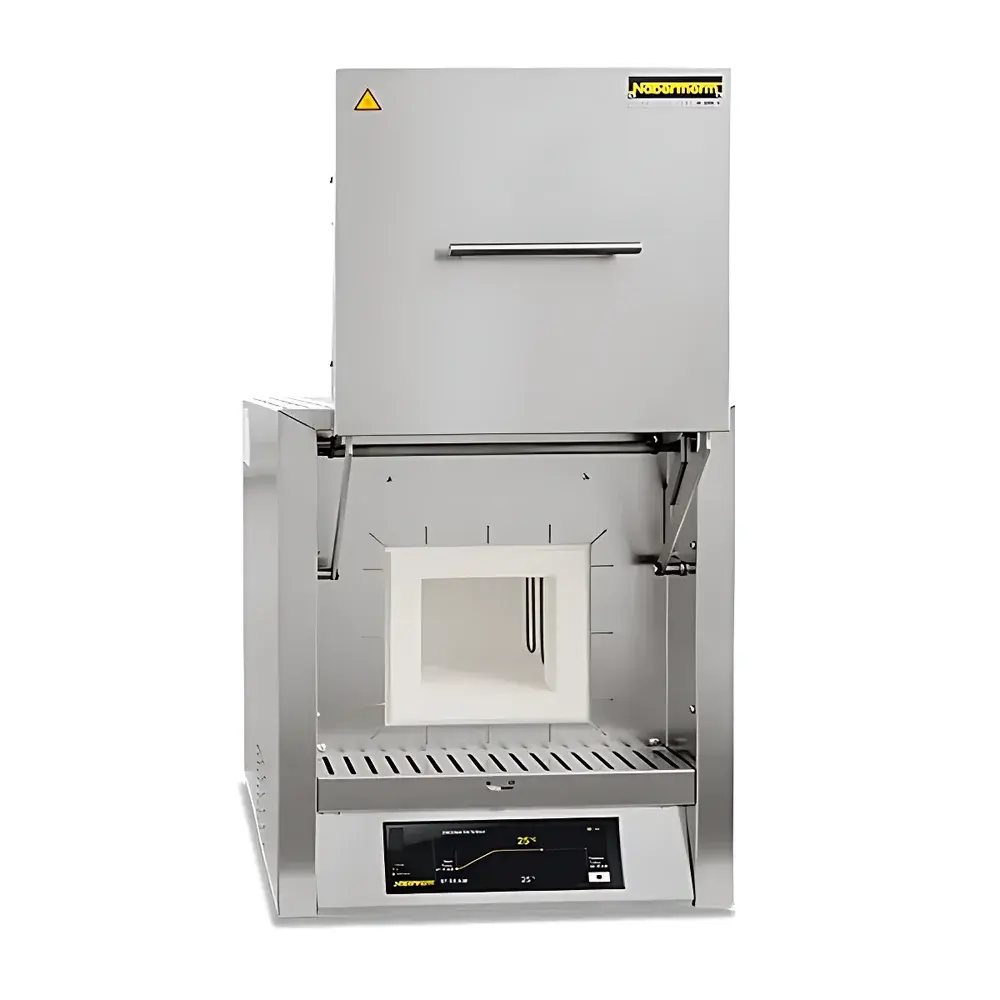
Nabertherm HTCT01/14 and HTCT08/16 High-Temperature Muffle Furnaces
| Brand | Nabertherm |
|---|---|
| Origin | Germany |
| Model | HTCT01/14, HTCT08/16 |
| Max Temperature | 1400 °C / 1500 °C / 1600 °C |
| Chamber Dimensions (W×D×H) | 110×120×120 mm to 170×290×170 mm |
| Chamber Volume | 1.5 L to 8.0 L |
| External Dimensions (W×D×H) | 340×300×460 mm to 450×620×570 mm |
| Power Supply | 1-phase or 3-phase |
| Rated Power | 3.5 kW to 13.0 kW |
| Weight | 18 kg to 60 kg |
| Heating Element | Silicon Carbide (SiC) rods |
| Construction | Double-walled stainless steel housing with fiber insulation |
| Door Type | Top-opening (HTCT series) or front-opening (HTC series) |
| Compliance | EN 60519-2 (thermal protection class 2), optional overtemperature limiter |
Overview
The Nabertherm HTCT01/14 and HTCT08/16 are high-precision laboratory muffle furnaces engineered for demanding thermal processing applications requiring stable, uniform temperatures up to 1600 °C. Designed and manufactured in Germany, these furnaces operate on the principle of resistive heating via silicon carbide (SiC) rod elements—known for rapid thermal response, excellent stability at elevated temperatures, and long service life under cyclic operation. The HTCT series features a top-opening door configuration that minimizes operator exposure to radiant heat during loading/unloading, while maintaining consistent temperature gradients across the chamber. Dual-layer stainless steel housing with optimized ceramic fiber insulation ensures low external surface temperatures (<55 °C at ambient conditions), structural rigidity, and energy efficiency. Each unit is calibrated for reproducible thermal profiles and built to meet stringent European safety standards for industrial and research-grade thermal equipment.
Key Features
- High-temperature capability: Selectable maximum operating temperatures of 1400 °C, 1500 °C, or 1600 °C—depending on model variant—with continuous operation rated up to 1550 °C for HTCT../16 models.
- Robust SiC heating elements: Engineered for fast ramp rates (e.g., ~40 minutes to reach 1400 °C from ambient) and minimal thermal drift during extended dwell cycles.
- Double-walled construction: Outer shell fabricated from brushed stainless steel; inner chamber lined with low-conductivity, high-purity ceramic fiber insulation for uniform heat distribution and reduced thermal loss.
- Thermal safety architecture: Integrated solid-state relay switching system with independent overtemperature protection limiter compliant with EN 60519-2 (Class 2 thermal protection), enabling automatic cutoff at user-defined limit temperatures to safeguard both furnace integrity and sample integrity.
- Modular loading system: Stackable square crucible trays accommodate up to three layers; compatible with standard alumina or quartz crucibles; optional lids for controlled atmosphere processing.
- Flexible ventilation interface: Adjustable air inlet on furnace door and dedicated exhaust port on top cover support manual or automated gas purging systems (e.g., N₂, Ar, forming gas) for oxidation-sensitive processes.
Sample Compatibility & Compliance
These furnaces accommodate a wide range of inert and semi-reactive samples—including metal oxides, ceramics, catalysts, geological specimens, and refractory powders—within standard crucibles (Al₂O₃, ZrO₂, Pt, or graphite). Chamber geometry supports vertical sample stacking without airflow obstruction. All HTCT models comply with EU Machinery Directive 2006/42/EC and Electromagnetic Compatibility Directive 2014/30/EU. Optional configurations include CE-marked gas-tight variants suitable for GLP/GMP environments where traceable thermal history and environmental control are required. While not inherently FDA 21 CFR Part 11–compliant, data logging integration (via optional RS485 or Ethernet interface) enables audit-ready record generation when paired with validated third-party software platforms meeting regulatory documentation requirements.
Software & Data Management
Standard operation utilizes Nabertherm’s proprietary THERMOCOMFORT® controller with intuitive rotary encoder interface and multi-segment programmable ramp-soak profiles. Optional digital interfaces (RS485 Modbus RTU or Ethernet TCP/IP) enable remote monitoring and control via SCADA or LIMS integration. Real-time temperature logging—including setpoint, actual chamber temperature, and heating element status—is supported through Nabertherm’s free THERMOLOG software (Windows-based), which exports timestamped CSV files for post-process analysis. Full event logging—including power interruptions, overtemperature events, and door-open duration—is retained in non-volatile memory for quality assurance audits. Firmware updates are performed via USB and conform to IEC 62443 cybersecurity baseline recommendations for laboratory instrumentation.
Applications
- Thermal gravimetric analysis (TGA) sample pre-treatment and ashing protocols per ASTM E1131 and ISO 11358.
- Sintering of advanced ceramics (e.g., SiC, AlN, YSZ) under controlled atmospheres.
- Calcination of catalyst precursors and battery cathode materials (e.g., LiCoO₂, NMC).
- Heat treatment of metallurgical samples for microstructural development prior to SEM/EDS analysis.
- Residue determination in pharmaceutical excipients per USP and EP 2.2.33.
- Calibration reference furnace applications where traceable temperature uniformity (±3 °C at 1400 °C) and stability (±1 °C over 2 hours) are critical.
FAQ
What is the difference between HTCT and HTC furnace series?
HTCT models feature a top-hinged lift door for safer access and reduced radiant exposure; HTC variants use a front-opening horizontal door optimized for horizontal sample placement.
Can the HTCT08/16 be operated on single-phase power?
No—only HTCT01/16 and HTCT01/14 support 1-phase supply; all larger models (HTCT03/xx and HTCT08/xx) require 3-phase connection due to higher power demand.
Is fiber insulation safe at 1600 °C?
Yes—the high-purity polycrystalline alumina-silica fiber used meets ISO 16890 classification for continuous use up to 1700 °C and exhibits negligible outgassing under vacuum or inert gas conditions.
How often should SiC heating rods be replaced?
Under typical laboratory cycling (≤5 cycles/week), SiC rods maintain nominal resistance for ≥2 years; replacement is indicated when ramp rate degrades by >15% or visible cracking occurs.
Does Nabertherm provide IQ/OQ documentation packages?
Yes—factory-validated Installation Qualification (IQ) and Operational Qualification (OQ) protocols are available upon request for regulated industries, including calibration certificates traceable to DKD/DAkkS standards.



