
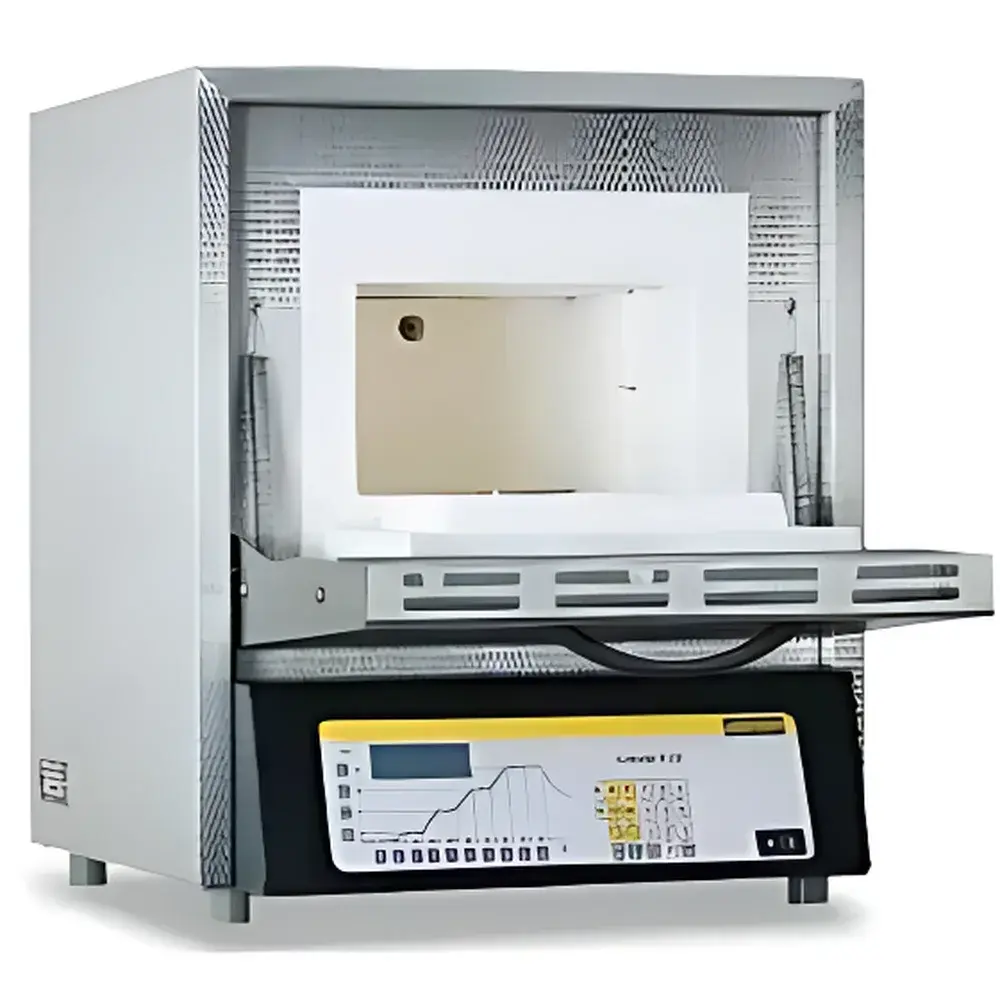
Nabertherm L1/12–LT40/12 Series Professional Muffle Furnace with Flip-Up or Lift-Type Door
| Origin | Germany |
|---|---|
| Type | Box-Type Muffle Furnace |
| Max. Temperature | 1100 °C or 1200 °C |
| Temperature Accuracy | ±1 °C |
| Max. Power | 6 kW |
| Heating Rate to Max. Temperature | ≤40 min |
| Heating Method | Dual-Side Ceramic Heating Plates (Triple-Side for L24/11–LT40/12 models) |
| Internal Volume | 1–40 L |
| Compliance | EN 60519-2, IEC 61000-6-3, CE Marked |
Overview
The Nabertherm L1/12–LT40/12 series represents a rigorously engineered line of laboratory muffle furnaces designed for precision thermal processing in research, quality control, and routine analytical workflows. Built in Germany to DIN-certified manufacturing standards, these furnaces operate on resistive heating principles using embedded resistance wire within high-purity ceramic heating plates—ensuring uniform temperature distribution, long-term thermal stability, and immunity to chemical volatiles or splashes. The dual-configuration door system—freely selectable between flip-up (L-series) and lift-type (LT-series)—addresses distinct operational safety and ergonomics requirements: the flip-up variant facilitates horizontal sample placement and retrieval under gravity-assisted access, while the lift-type design eliminates direct contact with hot external surfaces during vertical opening, reducing operator exposure and improving workflow integration in automated or high-throughput lab environments. All models feature vacuum-reinforced fibrous insulation modules and a double-walled stainless steel housing (brushed AISI 304), resulting in low external surface temperatures (<55 °C at ambient conditions) and enhanced energy efficiency.
Key Features
- Thermally robust ceramic heating plates with embedded NiCr resistance wire—resistant to corrosion, thermal shock, and contaminant deposition from ash, fluxes, or organic residues
- Vacuum-formed, low-conductivity fiber insulation (density ≥128 kg/m³) ensuring rapid heat-up, minimal thermal lag, and stable isothermal zones across the entire chamber volume
- Double-layer stainless steel housing with precision-machined door seals and adjustable air inlet on the door + rear-mounted exhaust port for controlled atmosphere management
- Integrated solid-state relay (SSR) switching with zero-crossing control—enabling silent, wear-free power modulation and extended controller lifetime
- Overtemperature protection via independent mechanical limit thermostat (EN 60519-2 Class 2), set to disconnect power at user-defined safety thresholds (e.g., 50 °C above nominal max)
- Optional inert or reactive gas purging interface (ISO-KF 25 or G¼” thread) compatible with manual or programmable mass flow controllers
Sample Compatibility & Compliance
These furnaces accommodate a broad range of crucible materials—including alumina, silicon carbide, platinum, and quartz—as well as standard ceramic, metal, and graphite sample holders. Chamber dimensions (internal: 90–320 mm W × 100–490 mm D × 100–250 mm H) support ASTM E1111 (ash content), ISO 562 (volatile matter), USP (loss on drying), and EN 15407 (waste incineration residue analysis) protocols. The furnace architecture complies with electromagnetic compatibility (IEC 61000-6-3), electrical safety (EN 61000-6-4), and industrial heating equipment directives (EN 60519-2). Optional overtemperature cut-off and data logging capabilities meet GLP/GMP documentation requirements when paired with validated Controltherm MV software.
Software & Data Management
The optional Controltherm MV software package provides full PID-based process programming, real-time temperature profiling, and audit-trail-compliant data export (CSV, PDF, XML). It supports up to 32 programmable ramp-soak segments per recipe, automatic calibration offset application, and synchronized timestamped logging of chamber temperature, power consumption, and alarm events. When configured with a certified USB-to-RS485 converter and Nabertherm’s MV-USB interface module, the system satisfies FDA 21 CFR Part 11 requirements for electronic records and signatures—including user-level access control, electronic signature capture, and immutable audit logs.
Applications
- Thermal gravimetric analysis (TGA) pre-conditioning and residue quantification
- Ash content determination in food, pharmaceuticals, polymers, and environmental samples (AOAC 942.05, ISO 2171)
- Ceramic sintering, catalyst calcination, and metallurgical annealing under air or inert atmospheres
- Residue-on-ignition (ROI) testing for soil, sludge, and wastewater solids
- Pre-drying and conditioning of reference materials prior to elemental analysis (ICP-OES, XRF)
- Calibration of thermocouples and RTDs per ASTM E230/E230M
FAQ
What distinguishes the L-series (flip-up) from the LT-series (lift-type) door configuration?
The L-series features a horizontally pivoting door ideal for placing flat or stacked samples; the LT-series employs a vertically lifting mechanism that maintains full clearance above the chamber opening—critical for handling tall crucibles or integrating robotic sample handlers.
Can this furnace be operated under nitrogen or argon atmospheres?
Yes—each unit includes a standard G¼” threaded purge port on the rear wall and an adjustable air inlet on the door, enabling controlled inert gas displacement. Optional catalytic afterburners or exhaust chimneys are available for volatile organic compound (VOC) abatement.
Is temperature uniformity data available for validation purposes?
Nabertherm provides DIN 17007-compliant uniformity maps (±3 °C at 1100 °C, ±5 °C at 1200 °C in 3-point measurement) upon request; IQ/OQ documentation packages are offered for regulated laboratories.
Does the furnace support remote monitoring via Ethernet or Wi-Fi?
Native Ethernet connectivity is not included, but third-party Modbus TCP gateways can be integrated via the RS485 port for SCADA or LIMS interoperability.
What maintenance intervals are recommended for the heating elements and insulation?
Ceramic heating plates require no scheduled replacement under normal operation; annual visual inspection of fiber insulation integrity and door gasket compression is advised. No lubrication or consumable parts are required.



