
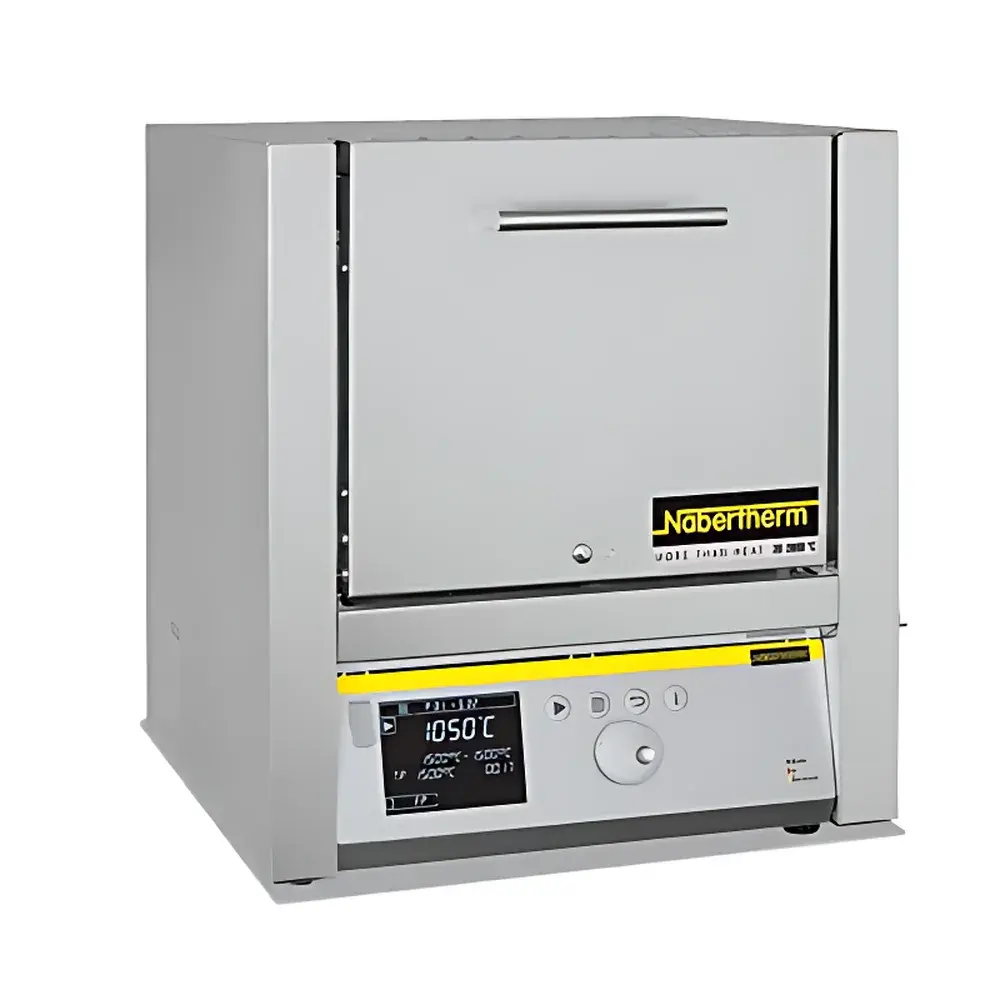
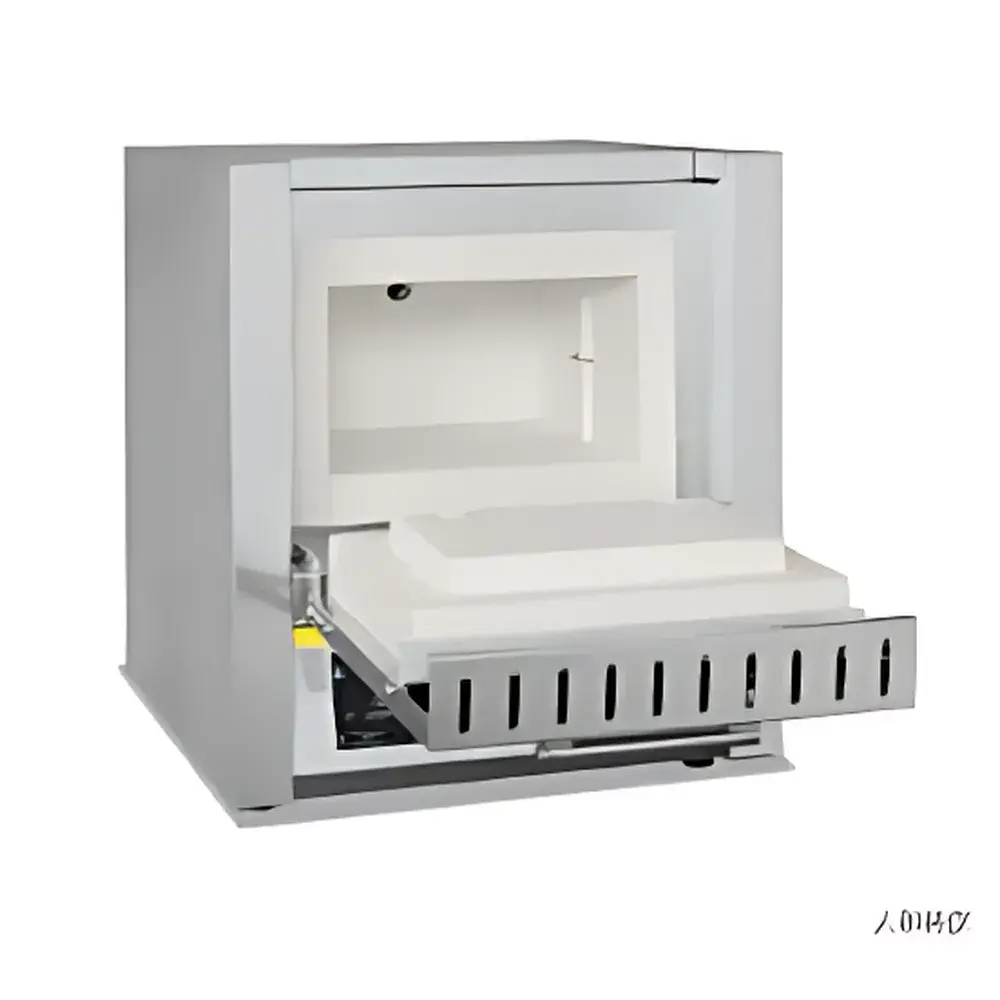
Nabertherm L15/11/C450 Benchtop Muffle Furnace
| Brand | Nabertherm |
|---|---|
| Origin | Germany |
| Model | L15/11/C450 |
| Instrument Type | Box-Type Muffle Furnace |
| Max Temperature | 1100 °C |
| Temperature Uniformity | ±3 °C |
| Max Power | 3.5 kW |
| Heating Time to Max Temp | 90 min |
| Heating Method | Electric (Dual-Sided Ceramic Heating Panels) |
| Internal Dimensions (W×D×H) | 230 × 340 × 170 mm |
| Chamber Volume | 9 L |
| External Dimensions (W×D×H) | 415 × 555 × 515 mm |
| Weight | 40 kg |
| Phase | Single-Phase |
Overview
The Nabertherm L15/11/C450 is a precision-engineered benchtop muffle furnace designed for routine laboratory thermal processing where reproducibility, safety, and long-term operational stability are critical. Operating on the principle of radiant heat transfer within an electrically heated, gas-tight ceramic chamber, it isolates samples from direct contact with heating elements—ensuring contamination-free calcination, ashing, sintering, and heat treatment. Its dual-sided ceramic heating panels embed resistance wires within high-purity alumina-silica matrices, delivering uniform thermal distribution while resisting chemical attack from volatile residues or splashes. The furnace complies with EN 60519-2 for industrial electroheating equipment safety, incorporating dual thermal protection: a primary C450 programmable controller and a redundant mechanical overtemperature limiter (Class 2 thermal cut-off). Constructed with a double-walled stainless steel housing (brushed finish), the design minimizes external surface temperature rise during extended operation—enhancing lab ergonomics and reducing ambient heat load.
Key Features
- Dual-sided ceramic heating panels with embedded NiCr resistance wire—resistant to corrosion and mechanical degradation from aggressive volatiles
- High-efficiency insulation using non-combustible, low-conductivity ceramic fiber—optimized for thermal retention and energy efficiency
- Robust double-shell stainless steel casing (V2A-grade) with reinforced structural joints—ensuring dimensional stability and mechanical durability
- Adjustable air inlet integrated into the door frame and rear exhaust port—enabling controlled atmosphere management without compromising chamber integrity
- Low-noise solid-state relay (SSR) switching—eliminating mechanical contactor wear and enabling precise power modulation
- Optional outward-opening door (L-version)—facilitating horizontal loading of flat or oversized specimens without vertical clearance constraints
- Integrated overtemperature protection per EN 60519-2: independent Class 2 thermal limiter with manual reset and fail-safe disconnection at preset threshold
Sample Compatibility & Compliance
The L15/11/C450 accommodates crucibles, boats, and trays made from alumina, silicon carbide, quartz, or high-purity graphite—compatible with ashing of biological tissues, pharmaceutical excipients, foodstuffs, and environmental filters per AOAC 943.01, ISO 11885, and USP . Its sealed muffle architecture prevents cross-contamination during multi-sample runs and supports inert or reactive gas purging via dedicated 6 mm OD stainless steel inlet ports (not compatible with exhaust chimney configurations). The furnace meets CE marking requirements under the EU Machinery Directive 2006/42/EC and Electromagnetic Compatibility Directive 2014/30/EU. For GLP/GMP environments, optional VCD software enables audit-trail-capable process logging compliant with FDA 21 CFR Part 11 when paired with NTLog-enabled USB data capture.
Software & Data Management
The C450 microprocessor controller provides 20-segment programmable ramp-soak profiles with adjustable rate limits (°C/min), hold times, and cycle repetition. Real-time temperature display includes deviation indication and status flags for heater fault, sensor break, or limiter activation. Process data—including setpoint, actual temperature, time, and SSR duty cycle—is recorded to USB flash drives via the NTLog interface (included). Optional VCD software (sold separately) extends functionality: remote monitoring via Ethernet/RS485, automated report generation in PDF/CSV, alarm event logging with timestamps, and integration into centralized LIMS or MES platforms. All firmware updates are performed via USB—no proprietary service tools required.
Applications
This furnace serves as a core thermal platform across academic, regulatory, and industrial laboratories. Typical use cases include: quantitative ash determination in feedstuffs (AOAC 942.05), residual carbon analysis in polymers (ASTM D5630), pre-firing of ceramic green bodies (ISO 10545-10), annealing of thin-film substrates, metallographic sample preparation (ASTM E3), and thermal decomposition studies in materials science. Its 9 L chamber volume and 230 × 340 × 170 mm usable space support standard platinum, porcelain, and nickel crucibles (e.g., 100 mL porcelain crucibles fit with 25 mm clearance). The 1100 °C maximum operating temperature enables full oxidation of organic matrices without residue carryover—critical for trace metal analysis by ICP-MS or AAS.
FAQ
What inert gases are compatible with the L15/11/C450’s purge system?
Nitrogen, argon, and helium are fully supported; hydrogen requires special risk assessment and additional explosion-proof certification per local regulations.
Can the exhaust chimney be used simultaneously with the catalytic converter?
No—exhaust configurations are mutually exclusive: either chimney-only, chimney + fan, chimney + catalyst, or flame torch. Combinations violate pressure balance and invalidate safety certification.
Is the C450 controller upgradeable to support Ethernet communication?
No—the C450 has RS485 and USB only; Ethernet capability requires the optional VCD interface module connected externally.
What is the recommended maintenance interval for ceramic fiber insulation?
Under normal ashing conditions (15%, or contaminated with alkali salts or halides.
Does the furnace support TUS (Temperature Uniformity Survey) validation per AMS2750E?
Yes—its dual thermocouple inputs (process + safety) and ±3 °C uniformity specification meet Zone 2 requirements for laboratory-scale furnaces; full TUS requires external calibrated sensors and mapping per AMS2750E Table 10.
Related Products



