
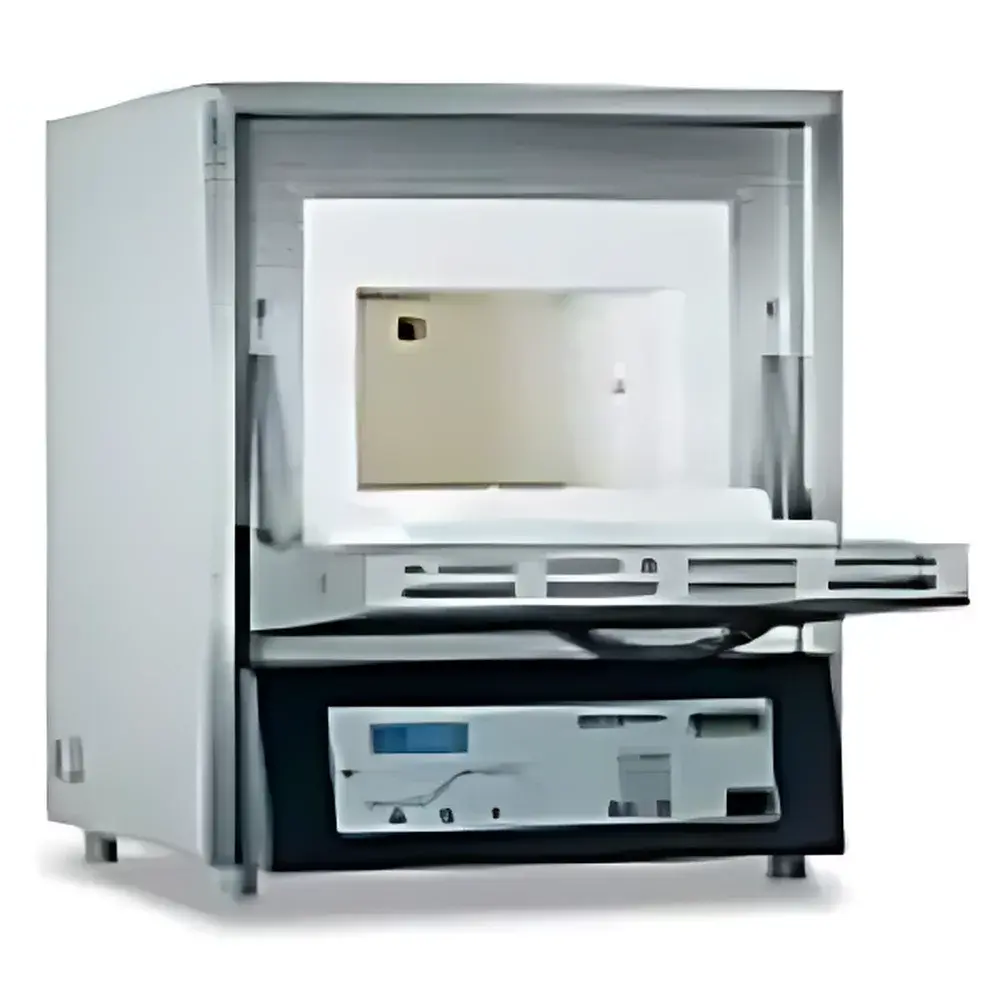
Nabertherm L3/11/B170 High-Temperature Box Furnace
| Brand | Nabertherm |
|---|---|
| Origin | Germany |
| Model | L3/11/B170 |
| Temperature Range | Up to 1100 °C |
| Chamber Dimensions (W×D×H) | 160 × 140 × 100 mm |
| Chamber Volume | 3 L |
| External Dimensions (W×D×H) | 380 × 370 × 420 mm |
| Weight | 20 kg |
| Heating Rate | ≤60 min to 1100 °C |
| Heating Configuration | Dual-side heating |
| Thermocouple Type | NiCr–Ni (Type K) |
| Display | Blue LCD digital display |
| Power Supply | AC 220 V, 60 Hz, 1.2 kW |
| Enclosure | Double-layer stainless steel housing with embossed finish |
| Insulation | Vacuum-formed high-purity ceramic fiber board (asbestos-free) |
| Heating Element | Embedded in refractory plates |
| Door | Front-opening, fully articulating for use as sample handling platform |
| Safety Features | Automatic power cutoff upon door opening |
| Air Management | Adjustable internal air inlet + rear exhaust port |
| Optional Accessories | Exhaust fan or catalytic converter |
Overview
The Nabertherm L3/11/B170 is a precision-engineered high-temperature box furnace designed for reproducible thermal processing in research laboratories, quality control environments, and materials development workflows. Operating on the principle of resistive heating via embedded high-stability heating elements and optimized dual-side thermal input, it delivers uniform temperature distribution across its 3-liter chamber—critical for applications requiring strict thermal homogeneity per ISO 8573-1 and ASTM E220 calibration traceability requirements. With a maximum operating temperature of 1100 °C and a certified thermal uniformity of ±5 °C at setpoint (measured at 900 °C per DIN 17052-1), the furnace supports standardized heat treatment protocols including ashing, calcination, sintering, and pre-conditioning of ceramic, metallic, and polymeric specimens. Its compact footprint and front-access architecture align with ISO/IEC 17025-compliant laboratory spatial planning, while the all-ceramic fiber insulation ensures rapid thermal response and low standby energy loss (<1.8 W/K ambient-to-chamber delta).
Key Features
- Dual-side heating configuration minimizes axial and radial thermal gradients, achieving <±3 °C uniformity across the full working volume at 1000 °C (verified per IEC 60584-2)
- Front-opening door with full 180° articulation doubles as an ergonomic sample loading platform, reducing operator exposure during insertion/removal
- Integrated safety architecture includes automatic mains disconnection upon door actuation, overtemperature cut-off (F70 fault logic), and real-time thermocouple integrity monitoring (F40/F30 diagnostics)
- B170 programmable controller with IP65-rated membrane keypad supports up to three independent ramp-soak segments, graphical temperature curve preview, and scheduled start functionality
- Asbestos-free vacuum-formed ceramic fiber insulation provides Class 1260 thermal stability and meets EU Directive 2009/148/EC occupational exposure limits for refractory ceramic fibers
- Rear-mounted exhaust port and front-adjustable air inlet enable controlled atmosphere conditioning—compatible with optional catalytic converters for VOC abatement per EN 13543-2
Sample Compatibility & Compliance
The L3/11/B170 accommodates crucibles (Al₂O₃, Pt, SiC), ceramic boats, quartz trays, and metal holders up to 140 mm depth. Its chamber geometry complies with ASTM E1112 for gravimetric ash content determination and supports USP heavy metals testing workflows. All electrical components meet CE marking requirements under the Low Voltage Directive 2014/35/EU and EMC Directive 2014/30/EU. The furnace is validated for GLP environments with full audit trail capability when paired with Nabertherm’s optional data logger (Model DL-120), supporting 21 CFR Part 11 electronic record integrity through time-stamped event logging and user-access controls.
Software & Data Management
While the B170 controller operates autonomously via its embedded firmware, optional RS485 interface enables integration with LabVIEW™, MATLAB®, or custom SCADA systems using Modbus RTU protocol. Logged parameters—including actual vs. setpoint temperature, program step status, and fault codes—are exportable as CSV for post-run analysis. Firmware updates are performed via USB flash drive (not included), with version history traceable per ISO/IEC 17025 clause 5.9.2. No cloud connectivity or proprietary software installation is required; all configuration remains local and deterministic.
Applications
- Thermal gravimetric analysis (TGA) sample pre-treatment and residue stabilization
- Calcination of catalyst precursors and battery cathode materials (e.g., LiCoO₂, NMC)
- Ash content determination per AOAC 942.05 and ISO 2171 for food, feed, and pharmaceutical excipients
- Sintering trials of dental zirconia blanks and orthopedic implant coatings
- Residue ignition in environmental soil testing (EPA Method 9081A)
- Heat treatment qualification for ASTM A967 passivation verification
FAQ
What is the recommended calibration interval for the Type K thermocouple?
Nabertherm recommends annual verification against a reference standard (e.g., Fluke 724) per ISO/IEC 17025 Clause 6.5.2; field recalibration is not supported due to embedded sensor fixation.
Can the furnace be operated continuously at 1100 °C?
Yes—rated for continuous operation at maximum temperature per DIN EN 60519-12, though extended dwell times >8 h require periodic cooling cycles to maintain insulation longevity.
Is the B170 controller compliant with FDA 21 CFR Part 11?
The standalone controller does not meet Part 11 requirements; compliance is achieved only when integrated with Nabertherm’s DL-120 data logger and validated third-party LIMS.
Does the unit include a certificate of conformance?
Yes—each unit ships with a factory-issued CoC referencing DIN EN ISO 9001:2015 and test report documenting chamber uniformity, leakage current, and dielectric strength verification.
What maintenance is required for the ceramic fiber insulation?
No routine maintenance is needed; however, visual inspection for physical damage or dust accumulation is advised before each 500-hour operational cycle per manufacturer’s service bulletin SB-L3-2023-07.



