
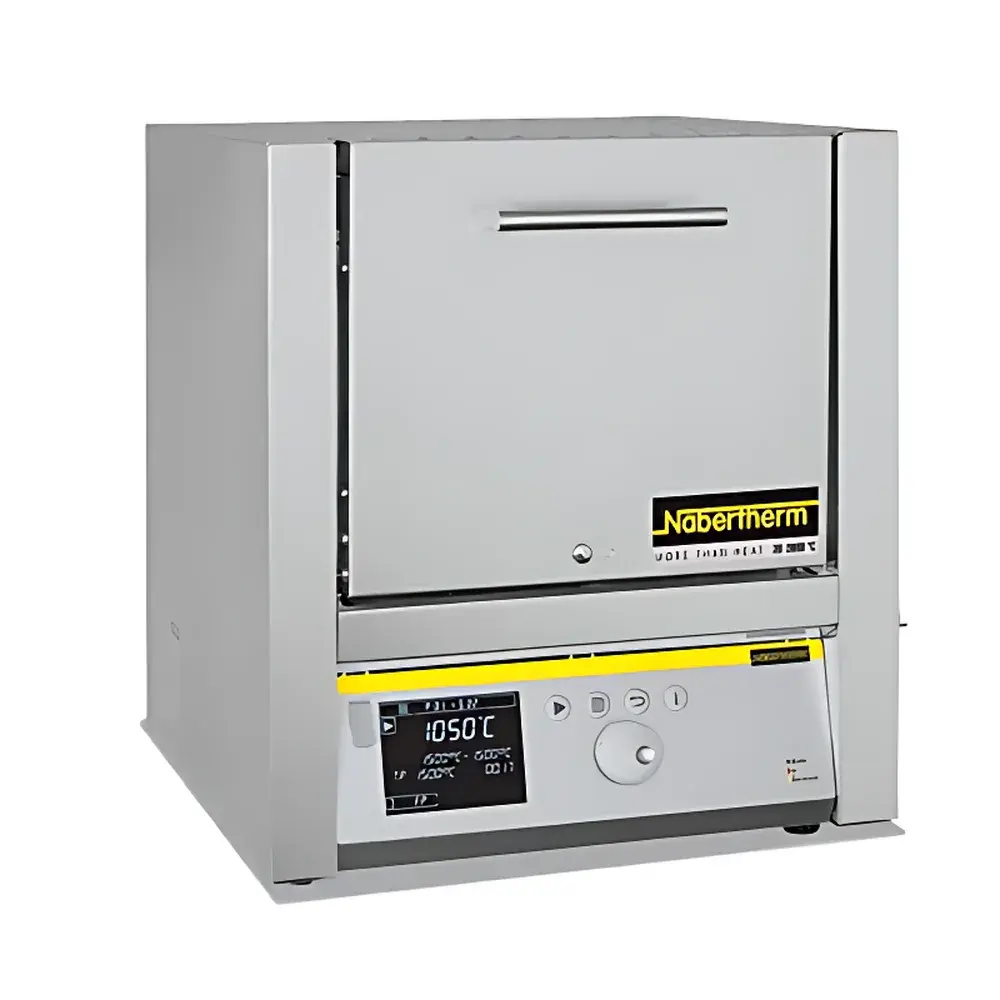
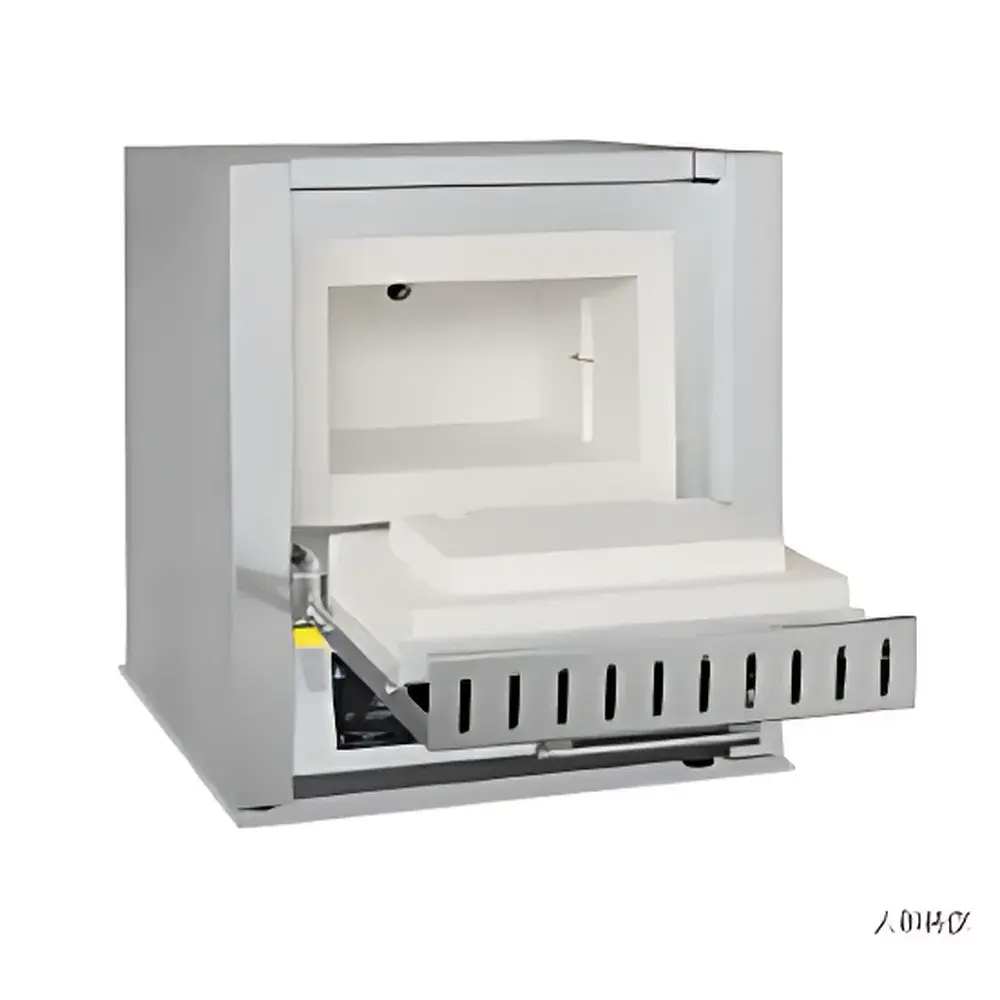
Nabertherm L3 11 B410 Benchtop Muffle Furnace
| Brand | Nabertherm |
|---|---|
| Origin | Germany |
| Model | L3 11 B410 |
| Type | Box-Type Muffle Furnace |
| Max. Operating Temperature | 1100 °C |
| Temperature Uniformity | ±3 °C |
| Rated Power | 1.2 kW |
| Heating Time to 1100 °C | 60 min |
| Internal Dimensions (W×D×H) | 160 × 140 × 100 mm |
| Chamber Volume | 3 L |
| External Dimensions (W×D×H) | 385 × 330 × 405 mm |
| Weight | 20 kg |
| Heating Method | Electric (Dual-Sided Ceramic Heating Panels with Embedded Resistance Wires) |
| Insulation | High-Density Ceramic Fiber |
| Housing | Double-Walled Stainless Steel (Brushed Finish) |
| Controller | B410 Programmable 4-Stage Digital Controller with USB Data Logging (NTLog Basic Software) |
Overview
The Nabertherm L3 11 B410 is a compact, benchtop muffle furnace engineered for precision thermal processing in research laboratories, quality control environments, and academic institutions. Designed in accordance with EN 60519-2 for electrical safety in industrial heating equipment, it employs a dual-sided ceramic heating panel architecture—each panel embedding high-stability resistance wire within alumina-based ceramic—to deliver uniform radiant heat distribution while isolating the heating elements from volatile or corrosive process atmospheres. The furnace chamber is fully enclosed by high-purity ceramic fiber insulation, minimizing thermal mass and enabling rapid, energy-efficient heating cycles up to 1100 °C. Its double-walled stainless steel housing ensures mechanical rigidity and suppresses external surface temperatures during operation, enhancing operator safety and lab integration. The unit complies with IEC 61000-6-3 (EMC emission standards) and supports inert or reactive gas purging via dedicated inlet ports—enabling controlled-atmosphere applications without compromising structural integrity or controller functionality.
Key Features
- Dual-sided ceramic heating panels with embedded resistance wires ensure symmetrical heat flux and minimize thermal gradients across the 3 L chamber.
- Ceramic fiber insulation (non-combustible, low thermal conductivity) provides high thermal efficiency and long service life under repeated thermal cycling.
- B410 programmable controller with 4-stage ramp-soak profiles, real-time temperature display, and USB data logging via NTLog Basic software (compatible with Windows OS).
- Integrated overtemperature protection limiter (Class 2 thermal cut-off per EN 60519-2), independently wired from the main control circuit for fail-safe shutdown.
- Adjustable air inlet on door and rear exhaust port support passive or forced atmosphere management; optional catalytic converter or exhaust chimney available with B410-synchronized activation.
- Optional external door hinge (L-type) facilitates horizontal loading of delicate or oversized samples without vertical clearance constraints.
- Low-noise solid-state relay switching eliminates mechanical contactor wear and ensures stable power delivery during extended thermal holds.
Sample Compatibility & Compliance
The L3 11 B410 accommodates standard crucibles (alumina, quartz, silicon carbide), ceramic boats, and metallic holders up to 160 mm wide × 140 mm deep × 100 mm high. It supports ashing of organic matrices (e.g., foodstuffs, pharmaceuticals per USP ), calcination of catalyst precursors, sintering of oxide ceramics, and heat treatment of small metal specimens. All materials processed must remain chemically inert below 1100 °C in air or compatible protective atmospheres (N₂, Ar, forming gas). The furnace meets GLP documentation requirements when used with NTLog Basic and USB-archived process logs. Optional catalytic exhaust units comply with VOC abatement guidelines (e.g., VDI 3477) and enable odorless off-gas handling during organic decomposition. Gas inlet fittings are rated for ≤0.5 bar pressure and must be isolated from exhaust pathways per EN 1539 design principles.
Software & Data Management
NTLog Basic software enables time-stamped recording of setpoint, actual temperature, and elapsed time directly to USB flash drives—generating CSV files suitable for audit-ready traceability. When paired with the optional VCD (Virtual Control Device) software package, users gain remote monitoring, multi-furnace synchronization, and automated report generation compliant with FDA 21 CFR Part 11 (electronic signature and audit trail features require validated installation and user access controls). Process parameters—including ramp rates, soak durations, and gas flow triggers—are stored in non-volatile memory and retain configuration after power interruption. Firmware updates are delivered via Nabertherm’s secure customer portal and require physical USB interface connection.
Applications
- Residue analysis and total ash determination in food, feed, and environmental samples (AOAC 942.05, ISO 2171).
- Pre-treatment of catalyst supports and battery electrode materials prior to XRD or BET characterization.
- Thermal gravimetric analysis (TGA) sample conditioning and reference material annealing.
- Small-batch sintering of dental zirconia, ferrites, and functional ceramics.
- Heat treatment of calibration standards, thermocouple wires, and laboratory glassware annealing fixtures.
- Controlled oxidation studies of thin-film coatings and nanomaterials under static or dynamic gas flow.
FAQ
What is the maximum recommended continuous operating temperature?
The L3 11 B410 is rated for continuous operation at 1100 °C. Sustained use above this limit will accelerate degradation of heating elements and insulation.
Can the furnace be operated under reducing or inert atmospheres?
Yes—via the standard gas inlet port. However, exhaust routing must be physically separated from gas supply lines, and catalytic or flame-based exhaust abatement systems cannot operate concurrently with active gas purging.
Is the B410 controller compatible with third-party SCADA or LIMS platforms?
Native Modbus RTU or Ethernet/IP integration is not supported; however, CSV log exports from NTLog Basic can be ingested into most LIMS environments via scheduled import scripts.
What maintenance intervals are recommended for optimal performance?
Ceramic fiber insulation requires no routine replacement under normal use. Heating panels should be inspected annually for cracking or discoloration; thermocouple calibration is advised every 6 months when used for regulated testing.
Are replacement parts such as heating panels or controllers available globally?
All core components—including B410 controllers, ceramic heating panels (P/N 691600507), and catalytic exhaust modules—are stocked by Nabertherm’s authorized distributors in EEA, North America, and APAC regions with lead times under 4 weeks.



