
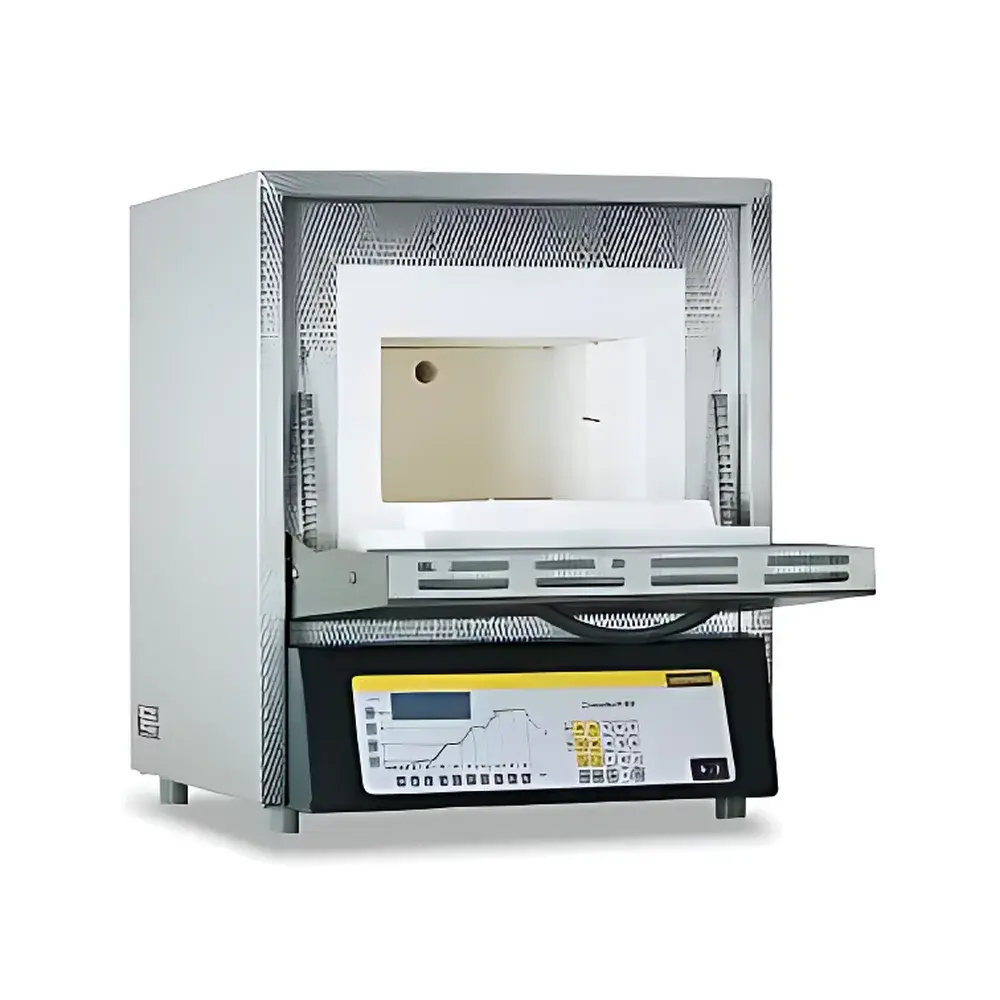
Nabertherm L5/11/P330 Tilting-Door Laboratory Muffle Furnace
| Brand | Nabertherm |
|---|---|
| Origin | Germany |
| Model | L5/11/P330 |
| Max Operating Temperature | 1100 °C |
| Internal Dimensions (W×D×H) | 200 × 170 × 130 mm |
| Chamber Volume | 5 L |
| External Dimensions (W×D×H) | 440 × 470 × 520 mm |
| Power Supply | 1-phase, 2.4 kW |
| Weight | 35 kg |
| Heating Time to Max Temp | ≤60 min |
| Controller | P330 Programmable Touchscreen Controller (9 programs, 40 segments, graphical color display, 1 °C/1 min resolution, skip function, manual MV control, self-optimizing PID, clock, kWh meter, runtime counter, programmable socket, gas inlet port, exhaust port, adjustable air inlet) |
Overview
The Nabertherm L5/11/P330 is a precision-engineered tilting-door laboratory muffle furnace designed for routine thermal processing in research laboratories, quality control environments, and materials development facilities. Built upon Nabertherm’s decades of German engineering expertise in high-temperature instrumentation, this furnace operates on resistive heating principles using embedded resistance wires within ceramic heating plates—ensuring uniform temperature distribution, long-term stability, and protection against chemical volatiles or splashes. Its muffle design isolates the heating chamber from the external environment, enabling contamination-free thermal treatment of samples under ambient or controlled-atmosphere conditions. The unit complies with EN 60519-2 for industrial electroheating equipment safety, featuring dual thermal protection: an operational PID controller and an independent overtemperature cut-off device (Class 2 thermal protection per EN 60519-2). The robust double-walled stainless steel housing—constructed from brushed-grade austenitic steel—reduces surface temperature rise while maintaining structural rigidity and corrosion resistance.
Key Features
- Tilting-door configuration (standard L-type) enables ergonomic sample loading/unloading without direct contact with hot surfaces; optional lift-type door (LT) available for vertical access
- Ceramic heating plates with fully embedded NiCr resistance wire—immune to oxidation, corrosion, and chemical attack from fumes or condensates
- Vacuum-formed high-purity alumina-silica fiber insulation modules providing low thermal mass, rapid heat-up, and minimal energy loss
- Dual-layer insulated chamber wall and door construction, achieving <60 °C external surface temperature at maximum operating temperature
- Adjustable air inlet on door and rear-mounted exhaust port for passive or forced ventilation; optional catalytic exhaust system or fan-equipped chimney available
- Integrated gas inlet port (rear wall) compatible with inert (N₂, Ar), reducing (H₂/N₂), or oxidizing atmospheres; supports manual or automated gas dosing systems
- Silent solid-state electronic relay switching—eliminates mechanical wear and audible click noise during cycling
Sample Compatibility & Compliance
The L5/11/P330 accommodates crucibles, sintering boats, ceramic setters, and small metal components up to 5 L volume. Its 1100 °C capability supports ashing (ASTM D3174, ISO 1171), calcination (ISO 787-17), loss-on-ignition (LOI) analysis, pre-firing of ceramics, and thermal stability screening per ICH Q1A(R3). The furnace meets essential CE marking requirements under the EU Machinery Directive 2006/42/EC and Low Voltage Directive 2014/35/EU. Its P330 controller supports audit-ready operation: timestamped event logging, programmable start delay (for off-peak electricity scheduling), and runtime/kWh consumption tracking—facilitating GLP-compliant recordkeeping and energy usage reporting. Overtemperature protection adheres strictly to EN 60519-2 Clause 7.2.2 (thermal protection class 2), ensuring fail-safe interruption independent of controller functionality.
Software & Data Management
The P330 controller features a 4.3-inch color TFT touchscreen with intuitive icon-based navigation and tactile feedback. It stores up to nine multi-segment heating programs (max. 40 segments per program), each configurable with ramp rates (°C/min), soak times (min), and setpoint tolerances. All parameters—including MV output, actual vs. setpoint temperature, program status, and error codes—are displayed in real time. The interface supports manual override via digital keypad input (1 °C or 1 min resolution), segment skipping, and immediate manual power adjustment (MV control). A built-in RS485 interface enables integration into lab-wide SCADA or LIMS platforms via Modbus RTU protocol. Optional software packages provide remote monitoring, CSV export of temperature profiles, and electronic signature support aligned with FDA 21 CFR Part 11 requirements for regulated environments.
Applications
- Gravimetric analysis: ash content determination in foodstuffs, polymers, coal, and biomass (AOAC 923.03, ISO 2171)
- Thermal pre-treatment of catalysts, battery electrode materials, and metal oxides prior to XRD or SEM characterization
- Heat treatment of dental porcelain, investment casting molds, and technical ceramics
- Residue quantification in pharmaceutical excipients and active ingredients (USP <281>)
- Calibration verification of thermocouples and reference materials (e.g., NIST SRM 720)
- Controlled atmosphere sintering of ferrites, piezoelectrics, and bioceramics using optional gas manifold kits
FAQ
What is the standard temperature uniformity specification across the working zone?
Nabertherm specifies ±5 °C at 1100 °C (measured per DIN 17052-1 at three points: center, front-top corner, rear-bottom corner) with door closed and furnace stabilized for ≥30 min.
Can the P330 controller be upgraded to support Ethernet or USB data export?
The base P330 includes RS485 only; Ethernet connectivity requires the optional P330-ETH module (sold separately), which adds TCP/IP support and web-based configuration.
Is the furnace suitable for use with flammable or toxic process gases?
Yes—when equipped with the certified gas manifold kit (including pressure regulator, flowmeter, and flame arrestor), and installed in accordance with EN 746-2 Annex B for thermochemical processes.
Does the tilting door mechanism require periodic lubrication or maintenance?
No—the counterbalanced tilt hinge uses maintenance-free stainless steel bearings and requires no scheduled lubrication; full-cycle life exceeds 50,000 operations.
How is traceability ensured during GxP-regulated thermal validation studies?
The P330 logs all critical events (start/stop, alarms, parameter changes) with timestamps and user IDs; optional validation package includes IQ/OQ documentation templates compliant with ASTM E2500 and EU Annex 15.



