
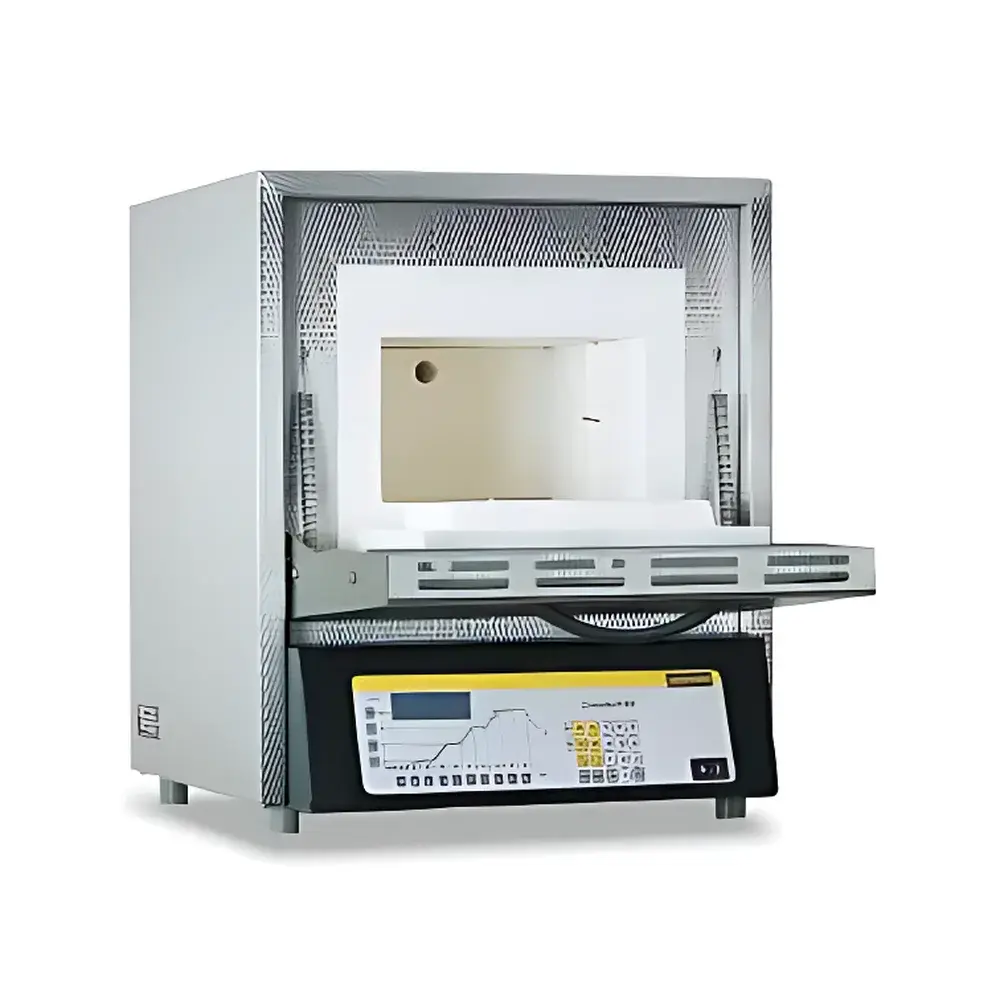
Nabertherm L5/12/B180 Tilting-Door Laboratory Muffle Furnace
| Brand | Nabertherm |
|---|---|
| Origin | Germany |
| Model | L5/12/B180 |
| Max Operating Temperature | 1200 °C |
| Internal Dimensions (W×D×H) | 200 × 170 × 130 mm |
| Chamber Volume | 5 L |
| External Dimensions (W×D×H) | 440 × 470 × 520 mm |
| Power Supply | 2.4 kW, Single-phase |
| Net Weight | 35 kg |
| Heating Time to Max Temp | ~75 min |
| Controller Type | B180 Programmable Digital Controller with Color Graphic Display |
| Door Configuration | Optional Tilting Door (Standard for L5/12) |
| Compliance | EN 60519-2 Class 2 Thermal Protection |
Overview
The Nabertherm L5/12/B180 is a precision-engineered laboratory muffle furnace designed for routine thermal processing in research, quality control, and materials development environments. Utilizing resistive heating via embedded high-purity ceramic heating plates—configured for dual-sided heating (with optional triple-sided configuration available on select L5/12 variants)—the furnace delivers uniform temperature distribution across its 5-liter chamber. Its muffle architecture isolates the heating elements from the process atmosphere, ensuring contamination-free thermal treatment of samples during calcination, ashing, sintering, heat treatment, and binder burnout. The unit operates up to 1200 °C with high thermal stability (±1 °C at setpoint under steady-state conditions) and repeatability, making it suitable for applications requiring strict adherence to ASTM E1112, ISO 8573-1, and USP thermal validation protocols. The tilting-door configuration (standard on this variant) enables ergonomic loading/unloading of crucibles and substrates without direct exposure to radiant heat—a critical safety and workflow advantage in high-throughput lab settings.
Key Features
- Dual-sided (or optional triple-sided) ceramic heating plates with embedded resistance wire—chemically inert, resistant to volatiles and splashes, and engineered for long-term thermal stability.
- Vacuum-reinforced fiber insulation modules provide low thermal mass, rapid heat-up (~75 min to 1200 °C), and minimized external surface temperature (<50 °C at ambient +25 °C).
- Robust double-walled stainless steel housing with brushed finish (DIN 1.4301 / AISI 304), ensuring structural integrity and corrosion resistance over extended service life.
- Tilting door mechanism (L-type) with adjustable air inlet and rear-mounted exhaust port—enabling controlled atmosphere management and integration with fume extraction systems.
- Integrated thermal safety architecture compliant with EN 60519-2: includes Class 2 overtemperature protection limiter, redundant thermocouple monitoring, and fail-safe cut-off logic.
- Optional auxiliary interfaces: protective gas inlet (rear wall), catalytic exhaust afterburner, forced-air cooling module, and programmable kWH consumption metering.
Sample Compatibility & Compliance
The L5/12/B180 accommodates standard porcelain, alumina, and quartz crucibles (up to Ø90 mm × H100 mm), as well as flat substrates and small metal components. Its sealed muffle chamber supports inert (N₂, Ar), reducing (H₂/N₂), or mildly oxidizing atmospheres when equipped with gas regulation accessories. The furnace meets essential regulatory requirements for GLP and GMP-aligned laboratories: controller firmware supports audit-trail-enabled operation (via optional RS485/Modbus interface), and all thermal profiles are timestamped and exportable in CSV format. It is compatible with ISO/IEC 17025 calibration workflows and supports IQ/OQ documentation packages per manufacturer-supplied protocols.
Software & Data Management
The B180 controller features a 3.5-inch color graphic LCD with intuitive touch-and-keypad input. It stores one multi-segment program (up to 2 segments), supports manual override, skip-step execution, and start-time scheduling (e.g., off-peak energy utilization). Key software capabilities include: real-time status display (heating rate, elapsed time, segment countdown), MV output monitoring, self-optimizing PID tuning, and programmable event triggers (e.g., fan activation, valve sequencing). While the base B180 lacks built-in Ethernet or USB, an optional RS485 interface enables connection to LabVIEW, MATLAB, or custom SCADA systems for centralized thermal process logging and remote supervision.
Applications
- Residue analysis and quantitative ashing per AOAC 942.05 and EPA Method 3010A.
- Thermal pre-treatment of catalysts, battery electrode materials, and ceramic green bodies prior to sintering.
- Calibration of thermocouples and RTDs in accordance with IEC 60584-2.
- Heat treatment of metallurgical specimens (annealing, stress relieving) under controlled ambient conditions.
- Pre-combustion conditioning of filters and sampling media for gravimetric particulate analysis (ISO 12103-1).
- Low-mass thermal cycling tests for electronic component substrates and MEMS packaging validation.
FAQ
What is the maximum recommended continuous operating temperature?
The L5/12/B180 is rated for continuous operation at 1200 °C; sustained use above this limit will accelerate insulation degradation and void warranty coverage.
Can the furnace be used under vacuum or positive pressure?
No—the unit is not rated for vacuum or pressurized operation. It is designed exclusively for ambient-pressure, free-convection or forced-gas-atmosphere applications.
Is the B180 controller compliant with FDA 21 CFR Part 11?
Out-of-the-box, the B180 does not include electronic signature or full audit-trail functionality required for Part 11 compliance; however, validated third-party middleware solutions are available for integration into regulated environments.
What maintenance intervals are recommended for optimal performance?
Inspect door gasket integrity and clean chamber interior every 50 operating hours; verify thermocouple calibration annually or per internal QA schedule; replace fiber insulation only if physical damage or >15% increase in power consumption is observed.
Does Nabertherm supply installation qualification (IQ) documentation?
Yes—factory-issued IQ/OQ templates and traceable calibration certificates (including furnace mapping data) are provided upon request and may be customized to site-specific SOPs.



