
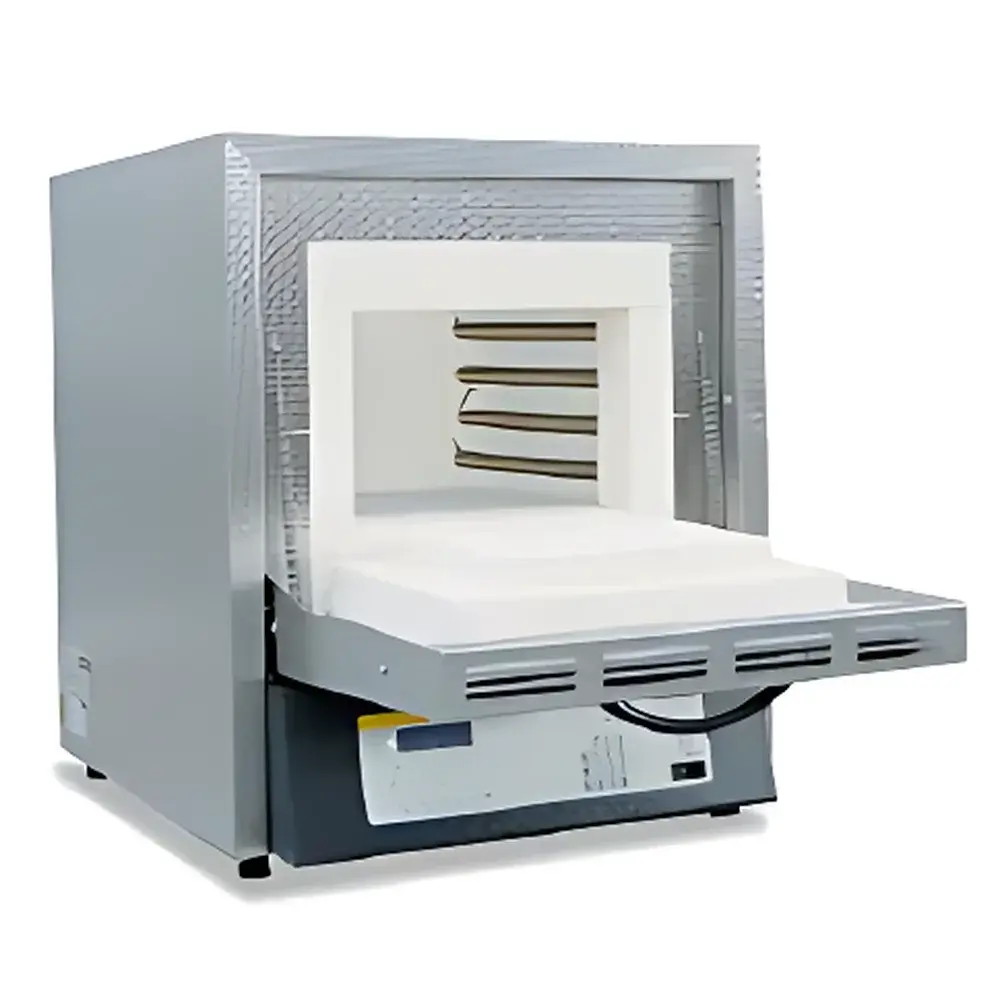
Nabertherm L5/13-LT 15/13 Box-Type Muffle Furnace
| Brand | Nabertherm |
|---|---|
| Origin | Germany |
| Model | L5/13-LT 15/13 |
| Type | Box-Type Muffle Furnace |
| Max Temperature | 1300 °C |
| Temperature Control Accuracy | ±1 °C |
| Max Power | 2.4 kW |
| Heating Time to Max Temp | 45 min |
| Heating Method | Dual-Side Radiant Heating |
| Internal Dimensions (W×D×H) | 260 × 340 × 170 mm |
| External Dimensions (W×D×H) | 530 × 625 × 630 mm |
| Net Weight | 70 kg |
| Voltage Supply | Single-Phase 230 V |
| Safety Class | Thermal Protection Level 2 per EN 60519-2 |
| Gas Inlet Port | Rear Wall Mounted |
| Exhaust Port | Rear Wall Mounted |
| Optional Door Configuration | Top-Hinged (LT) or Front-Hinged (L) |
Overview
The Nabertherm L5/13-LT 15/13 is a precision-engineered, laboratory-grade box-type muffle furnace designed for controlled high-temperature thermal processing in research, quality control, and routine analytical applications. Operating up to 1300 °C, it employs dual-side radiant heating via high-stability resistance heating elements mounted on ceramic support tubes—ensuring uniform temperature distribution across the entire working chamber and minimizing thermal gradients. The furnace chamber is constructed from multi-layer lightweight refractory bricks, providing excellent thermal insulation and energy efficiency while maintaining structural integrity under repeated thermal cycling. Its double-walled stainless steel housing—featuring brushed finish—reduces external surface temperature during operation and enhances mechanical stability. Designed in accordance with EN 60519-2 for industrial electroheating equipment safety, the unit incorporates redundant thermal protection: an independent overtemperature limiter (thermal protection level 2) automatically disconnects power if the controller fails, safeguarding both the furnace and sample integrity.
Key Features
- Dual-side radiant heating system with ceramic-supported heating elements for long service life and reproducible thermal profiles
- Robust multi-layer lightweight refractory brick lining ensuring low heat loss and stable cavity temperature homogeneity
- Top-hinged (LT) or front-hinged (L) door configuration—selectable based on workflow ergonomics and safety requirements
- Adjustable air inlet integrated into the door and dedicated exhaust port on the rear wall for controlled atmosphere management
- Low-noise operation enabled by solid-state relay (SSR) switching and optimized thermal design
- Optional exhaust chimney, fan-assisted ventilation, or catalytic afterburner integration for volatile or hazardous off-gas handling
- Integrated gas inlet port on rear wall compatible with manual or automated gas dosing systems (e.g., N₂, Ar, forming gas)
- Compliant with IEC/EN 60519-2 safety standards; includes thermal cut-off, grounding continuity verification, and insulated terminal blocks
Sample Compatibility & Compliance
The L5/13-LT 15/13 accommodates a broad range of sample forms—including crucibles (alumina, quartz, silicon carbide), ceramic boats, metal holders, and standard ASTM/ISO-compliant test specimens—within its 15 L internal volume (260 × 340 × 170 mm). It supports standardized thermal procedures such as ash content determination (ASTM D3174, ISO 1171), loss on ignition (LOI) analysis (ASTM C114), calcination of catalyst precursors, sintering of advanced ceramics, and pre-treatment of environmental samples prior to elemental analysis (EPA Method 3010A). All electrical and thermal safety features conform to CE marking requirements, and the furnace architecture facilitates audit readiness for GLP and GMP environments—particularly when paired with optional data logging and 21 CFR Part 11–compliant software modules.
Software & Data Management
While the base model operates with a programmable digital controller (PID-based, 3-stage ramp-soak profile capability), optional connectivity enables integration into centralized lab informatics platforms. An RS485 interface supports Modbus RTU communication for remote monitoring and parameter synchronization across multiple units. When equipped with Nabertherm’s THERMOCOM software suite, users gain access to full traceability: timestamped temperature logs, operator ID tagging, electronic signature support, and automatic report generation compliant with FDA 21 CFR Part 11 Annex 11 requirements. Audit trails include event-driven records of setpoint changes, door openings, overtemperature alarms, and calibration interventions—ensuring full compliance with ISO/IEC 17025 and pharmaceutical quality systems.
Applications
- Thermal gravimetric analysis (TGA) sample preparation and pre-conditioning
- Ash residue quantification in coal, biomass, polymers, and foodstuffs
- Calcination of metal oxide nanoparticles and battery cathode materials
- Sintering of dental zirconia, alumina substrates, and functional ceramics
- Heat treatment of metallurgical specimens per ASTM E112 and ISO 643
- Residue testing in pharmaceutical excipients (USP ) and packaging materials
- Pre-firing of catalyst supports and sensor elements in R&D laboratories
FAQ
What is the maximum recommended continuous operating temperature?
The furnace is rated for continuous operation at 1300 °C. Prolonged use above this limit may compromise heating element longevity and refractory integrity.
Is the unit suitable for inert or reducing atmospheres?
Yes—equipped with rear-mounted gas inlet and exhaust ports, it supports nitrogen, argon, hydrogen/nitrogen mixtures, and other process gases when used with appropriate gas delivery and safety interlocks.
Can the temperature controller be calibrated in-house?
The integrated controller accepts external reference thermocouples (Type S or B) for field verification; full calibration requires traceable standards and is typically performed by accredited service labs per ISO/IEC 17025.
Does the furnace meet electromagnetic compatibility (EMC) requirements for shared lab environments?
Yes—it complies with EN 61326-1 for laboratory equipment and includes filtered power input to minimize conducted emissions.
What maintenance intervals are recommended for optimal performance?
Visual inspection of door gasket integrity and heating element condition every 200 operating hours; annual thermocouple verification and refractory assessment advised under heavy usage conditions.



