
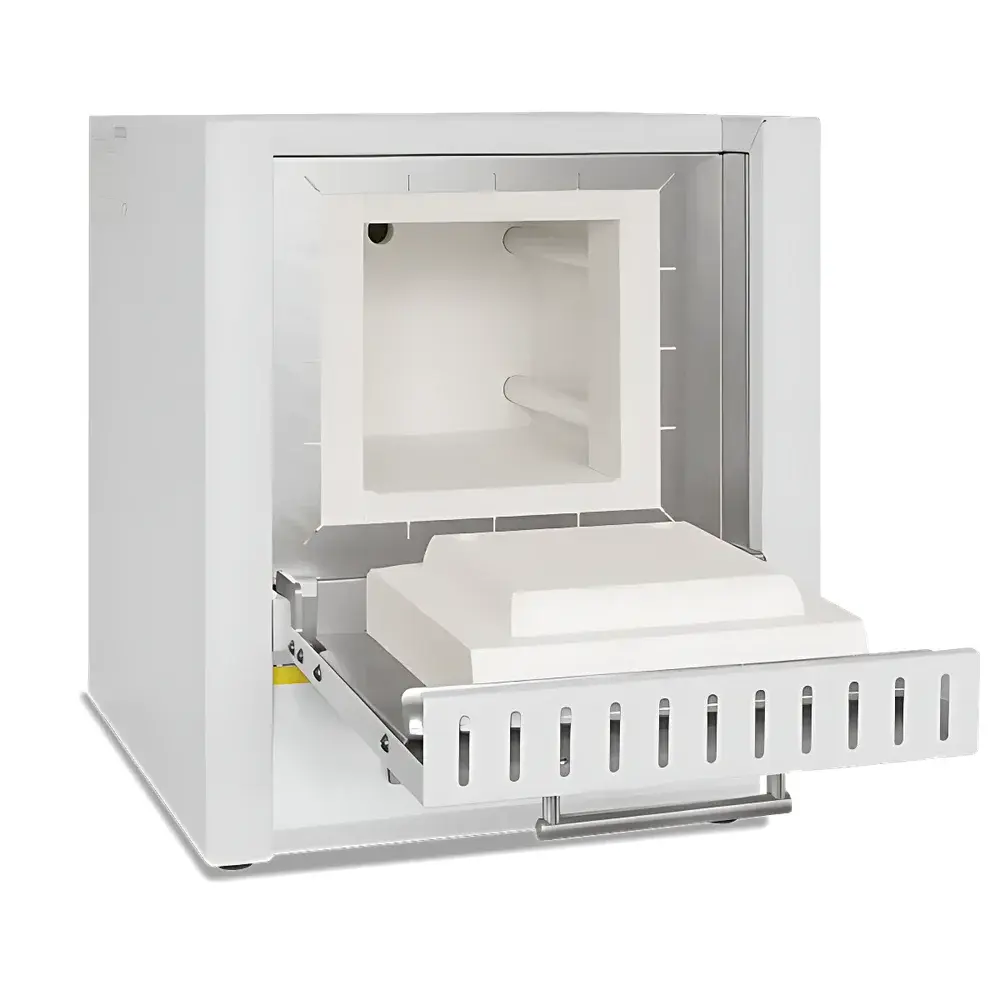
Nabertherm LE1/11–LE14/11 Compact Muffle Furnace
| Brand | Nabertherm |
|---|---|
| Origin | Germany |
| Model | LE1/11–LE14/11 |
| Max Temperature | 1100 °C |
| Operating Temperature | 1050 °C |
| Heating Configuration | Dual-sided, heating elements embedded in quartz tubes |
| Insulation | Multi-layer ceramic fiber board |
| Enclosure | Double-walled brushed stainless steel |
| Door Type | Front-opening |
| Exhaust Port | Rear wall-mounted |
| Overtemperature Protection | EN 60519-2 compliant, Class 2 thermal protection with adjustable cutoff temperature |
| Gas Inlet | Rear-mounted manual gas connection |
| Control System | Controltherm MV software-enabled process control and data logging |
| Power Supply | Single-phase |
| Weight | 10–40 kg (model-dependent) |
| Dimensions & Volume | Model-specific (e.g., LE1/11: 90×115×110 mm internal, 1290×280×430 mm external, 1.5 L volume, 1.5 kW) |
Overview
The Nabertherm LE1/11–LE14/11 series comprises compact, high-reliability muffle furnaces engineered for precise thermal processing in research laboratories, quality control environments, and small-scale production settings. Designed around a robust dual-sided heating architecture, these furnaces utilize resistance-heating elements hermetically sealed within fused quartz tubes—ensuring long-term stability, minimal oxidation, and consistent heat distribution across the chamber. With a maximum operating temperature of 1100 °C and a continuous service limit of 1050 °C, the series meets stringent requirements for ashing, calcination, sintering, heat treatment of ceramics and metals, and thermal gravimetric pre-conditioning. The furnace chamber is insulated with multi-layer high-purity ceramic fiber board, minimizing thermal mass while achieving rapid ramp rates and excellent temperature uniformity (±5 °C at 1000 °C, per Nabertherm calibration protocol). The double-walled stainless steel enclosure—fabricated from brushed AISI 304—reduces external surface temperature to <50 °C during operation, enhancing lab safety and reducing ambient heat load.
Key Features
- Dual-sided heating configuration with quartz-encapsulated NiCr alloy heating elements for uniform thermal field and extended service life
- Front-opening door mechanism optimized for ergonomic sample loading and unloading in confined benchtop spaces
- Rear-mounted exhaust port compatible with optional catalytic converters or forced-air extraction systems for controlled off-gas management
- Integrated overtemperature protection system compliant with EN 60519-2 (Thermal processing equipment — Safety requirements), featuring adjustable Class 2 thermal cutoff
- Manual gas inlet port on rear wall for inert or reactive atmosphere applications (e.g., N₂, Ar, forming gas); no integrated mass flow controller included
- Compact footprint and low structural mass (10–40 kg, depending on model) enabling flexible integration into fume hood setups or shared instrumentation benches
- Control electronics housed in a side-mounted or door-integrated compartment (LE1/11, LE2/11, LE4/11) to conserve vertical clearance
Sample Compatibility & Compliance
The LE1/11–LE14/11 series accommodates crucibles, boats, and trays up to 220 × 300 × 220 mm (LE14/11), supporting standard alumina, silica, and platinum ware. Chamber geometry permits unrestricted radiant heat transfer, eliminating convective interference common in fan-assisted ovens. All models are CE-marked and conform to IEC 61000-6-3 (EMC emission) and IEC 61000-6-2 (immunity) standards. The overtemperature limiter satisfies EN 60519-2 Category 2 requirements for thermal processing equipment used in non-industrial laboratory contexts. While not intrinsically rated for hazardous area use, optional purge configurations enable operation under nitrogen blanket conditions per ISO 8573-1 Class 3 air purity guidelines when paired with certified gas supply lines.
Software & Data Management
Process execution and thermal profile documentation are managed via the Controltherm MV software package—a Windows-based application supporting real-time temperature monitoring, programmable multi-step ramp/soak sequences, and timestamped data export in CSV format. The interface logs controller status, setpoint deviations, alarm events, and overtemperature interventions with audit-trail capability. Data files include metadata such as operator ID, furnace serial number, and environmental timestamp—supporting GLP-aligned record retention. Though not natively 21 CFR Part 11 compliant, the software permits integration with third-party electronic lab notebook (ELN) systems via OPC UA or Modbus TCP protocols for validated environments requiring electronic signature and change control.
Applications
- Ash content determination per AOAC 942.05, ASTM D3174, and ISO 1171 for coal, biomass, food, and pharmaceutical excipients
- Calcination of catalyst precursors, metal oxides, and battery cathode materials (e.g., LiCoO₂, Ni-rich NMC)
- Pre-sintering of dental porcelain, technical ceramics, and metal injection molding (MIM) feedstocks
- Residue ignition testing for USP and Ph. Eur. 2.2.16 procedures
- Thermal cleaning of quartz and alumina components prior to semiconductor or analytical instrumentation use
- Calibration verification of thermocouples and RTDs using fixed-point reference materials (e.g., Zn, Al, Cu)
FAQ
What is the recommended maintenance interval for heating elements and insulation?
Heating elements require inspection every 200 operational hours above 900 °C; ceramic fiber insulation should be assessed annually for compression or cracking—replacement intervals vary by usage intensity and thermal cycling frequency.
Can the furnace operate under vacuum or positive pressure?
No. The LE series is designed exclusively for ambient-pressure or inert-gas-purged atmospheres. Vacuum or pressurized operation voids warranty and compromises structural integrity.
Is firmware update support available for legacy units?
Yes. Nabertherm provides firmware updates through authorized service partners; Controltherm MV software version compatibility is documented in the product lifecycle bulletin (PLB-LE-2023-01).
Does the unit include a thermocouple calibration certificate?
A factory-assembled Type S thermocouple is supplied; traceable calibration certificates (ISO/IEC 17025 accredited) are available as optional add-ons upon order.
What electrical infrastructure is required for installation?
Single-phase 230 V ±10%, 50/60 Hz supply with dedicated circuit breaker (min. 16 A for LE14/11); grounding resistance must not exceed 10 Ω per VDE 0100-540.



