
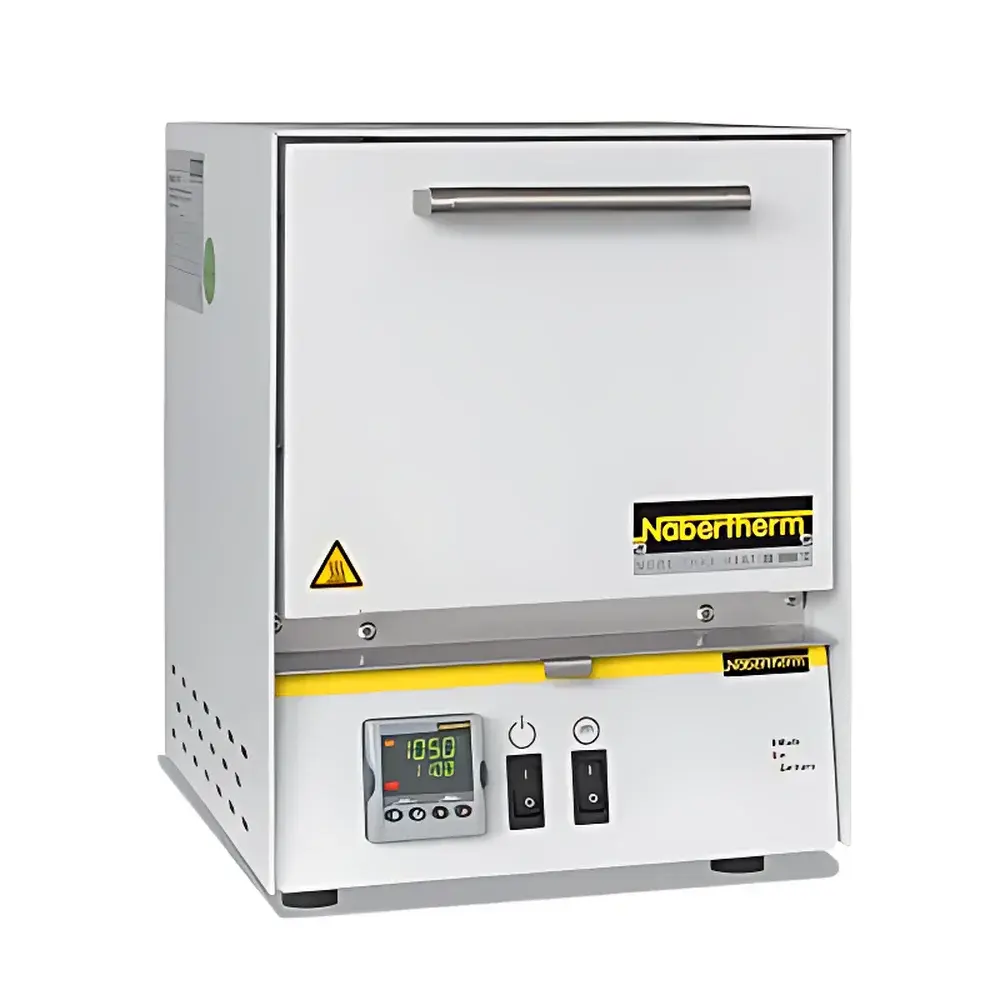
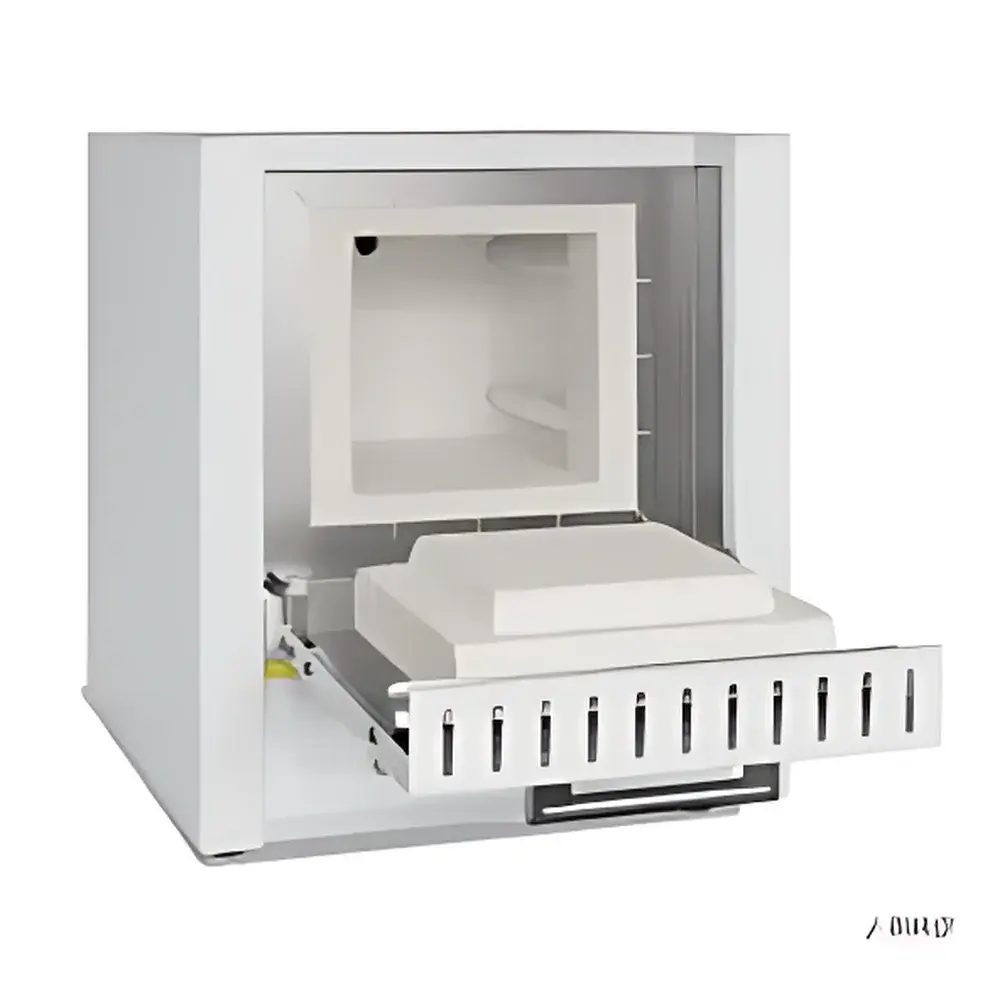
Nabertherm LE14 11 R7 Benchtop Muffle Furnace
| Brand | Nabertherm |
|---|---|
| Origin | Germany |
| Model | LE14 11 R7 |
| Type | Box-Type Muffle Furnace |
| Max Temperature | 1100 °C |
| Temperature Uniformity | ±3 °C |
| Rated Power | 2.9 kW |
| Heating Time to Max Temp | 40 min |
| Internal Dimensions (W×D×H) | 220 × 300 × 220 mm |
| Chamber Volume | 14 L |
| External Dimensions (W×D×H) | 440 × 535 × 540 mm |
| Weight | 25 kg |
| Heating Method | Electric (Quartz-Sheathed Resistive Elements) |
| Control System | R7 Single-Stage Programmer |
Overview
The Nabertherm LE14 11 R7 is a compact, benchtop muffle furnace engineered for precision thermal processing in research laboratories, quality control environments, and academic institutions. Designed according to DIN EN 60519-2 safety standards, it operates on the principle of radiant heat transfer within an electrically heated, fully insulated chamber—ensuring uniform temperature distribution and minimal thermal loss. Its maximum operating temperature of 1100 °C supports a wide range of high-temperature applications including ashing, calcination, heat treatment of ceramics and metals, and pre-treatment of samples prior to elemental analysis. The furnace features a dual-layer stainless steel housing with structured corrugated finish, providing mechanical stability while reducing external surface temperature during operation. Heating elements are encapsulated in quartz tubes—enhancing oxidation resistance, simplifying maintenance, and extending service life. The front-opening door design facilitates safe sample loading/unloading, while integrated rear exhaust ports allow for controlled atmosphere or fume management.
Key Features
- Robust double-walled stainless steel construction with low-thermal-conductivity insulation made from non-combustible ceramic fiber
- Quartz-sheathed heating elements mounted on both side walls for symmetrical heat distribution and improved temperature homogeneity
- R7 single-stage temperature controller with digital display and manual setpoint adjustment; compliant with basic laboratory process repeatability requirements
- Integrated overtemperature protection device (Class 2 thermal cut-off per EN 60519-2), independently wired to prevent overheating of both furnace chamber and specimens
- Low-noise operation enabled by solid-state relay switching and optimized thermal mass design
- Front-access door with ergonomic handle and positive-latching mechanism; rear-mounted exhaust port for optional ventilation integration
- Compact footprint (440 × 535 × 540 mm) suitable for standard laboratory benches; net weight of 25 kg ensures stable positioning without anchoring
Sample Compatibility & Compliance
The LE14 11 R7 accommodates standard crucibles, porcelain boats, and quartz or alumina sample holders up to 220 × 300 × 220 mm in dimension. It is compatible with inert, oxidizing, and mildly reducing atmospheres when used with optional gas inlet kits (e.g., nitrogen or argon purging). While not certified for Class I Div 1 hazardous locations, its electrical architecture conforms to IEC 61000-6-3 (EMC emission limits) and IEC 61000-6-2 (immunity). For regulated environments—including GLP and GMP-aligned labs—the furnace may be operated under documented procedures that include calibration traceability (e.g., using NIST-traceable thermocouples), routine performance verification, and logbook-based usage tracking. Optional accessories such as catalytic exhaust units support compliance with local occupational health and safety regulations regarding VOC emissions.
Software & Data Management
The R7 controller does not incorporate data logging or PC connectivity as standard. However, analog output signals (0–10 V or 4–20 mA) can be interfaced with external chart recorders or SCADA systems for continuous temperature monitoring. For laboratories requiring audit-ready records, third-party USB thermocouple loggers (e.g., Omega OM-DAQPRO-5300 series) may be deployed alongside the furnace to capture time-stamped thermal profiles. When paired with optional exhaust accessories—such as the catalytic converter (P/N 631000812) or gas-fired flare unit—electrical interlock circuits ensure activation only upon correct cable connection and power sequencing, supporting procedural integrity in validated workflows.
Applications
- Gravimetric ash content determination in food, pharmaceutical, and environmental samples (aligned with AOAC 942.05, ASTM D3174, ISO 1171)
- Pretreatment of catalysts, battery electrode materials, and refractory powders prior to XRD or SEM analysis
- Thermal annealing of metallic alloys, sintering of oxide ceramics, and devitrification studies of glass compositions
- Residue ignition in clinical chemistry protocols and soil testing methodologies
- Calibration reference furnace for secondary thermocouple verification at temperatures up to 1100 °C
- Education-focused demonstrations of thermal decomposition kinetics and phase transformation behavior
FAQ
What is the recommended calibration frequency for the LE14 11 R7?
Annual calibration using a NIST-traceable reference thermometer is advised for routine QC use; more frequent verification (e.g., quarterly) is recommended in GLP/GMP settings.
Can this furnace operate under vacuum or controlled gas flow?
No vacuum capability is built-in, but optional gas inlet fittings enable purging with inert or reactive gases—subject to user-installed pressure regulation and leak testing.
Is the R7 controller compliant with FDA 21 CFR Part 11?
No—the R7 lacks electronic audit trails, user authentication, or secure data export; it is intended for non-regulated or semi-quantitative applications.
What maintenance is required for quartz-sheathed heating elements?
Visual inspection every 200 operating hours; replacement is straightforward due to modular mounting and absence of cement-based insulation degradation.
Does the furnace include a cooling-down ramp function?
No—the R7 controller supports only hold-at-setpoint operation; forced-air or passive cooling must be managed externally per experimental protocol.



