
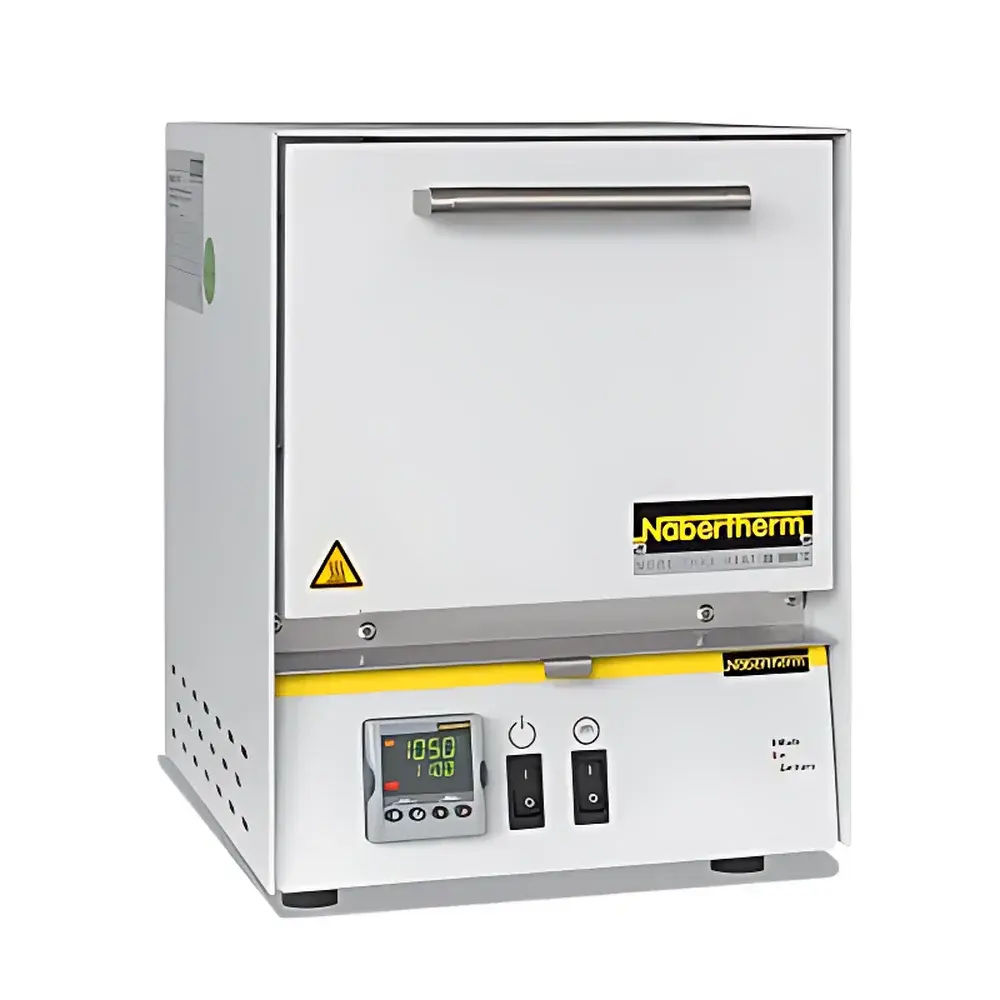
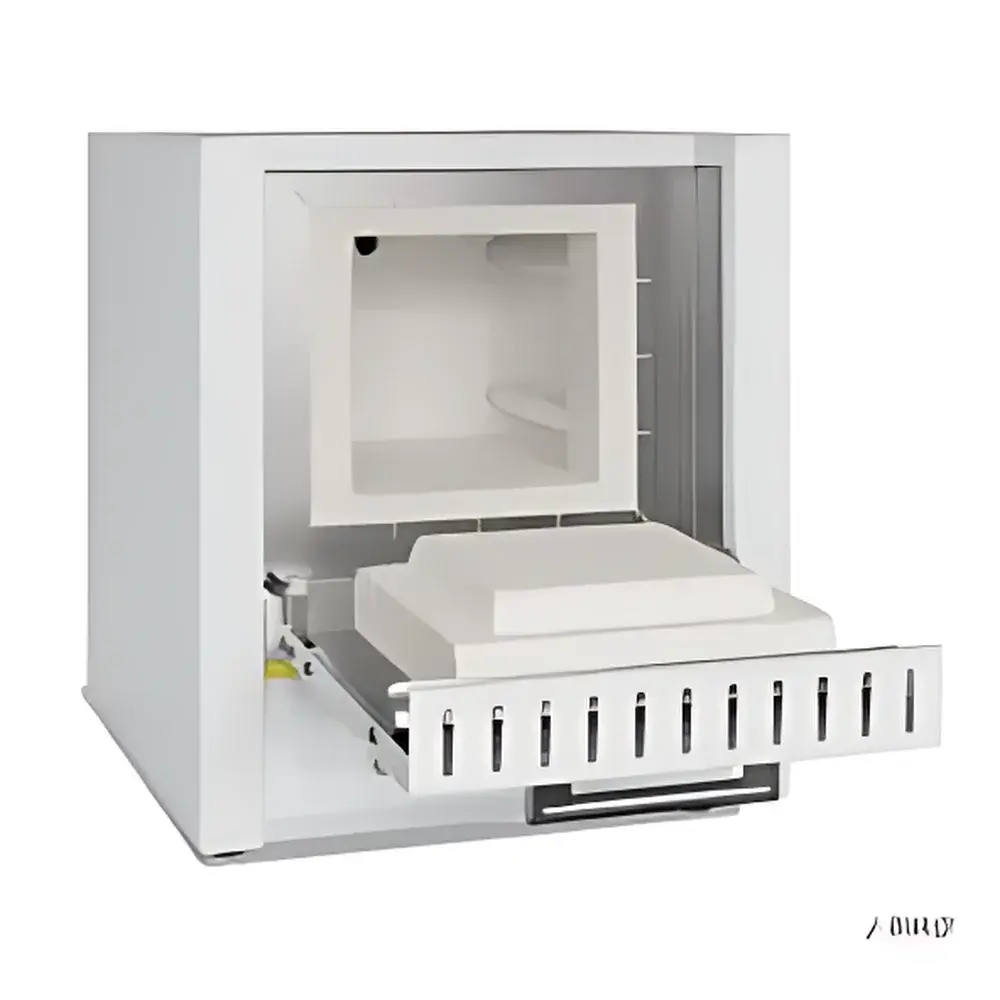
Nabertherm LE6 11 R7 Benchtop Muffle Furnace
| Brand | Nabertherm |
|---|---|
| Origin | Germany |
| Model | LE6 11 R7 |
| Instrument Type | Box-Type Muffle Furnace |
| Maximum Temperature | 1100 °C |
| Operating Temperature | Up to 1050 °C |
| Temperature Uniformity | ±3 °C |
| Heating Power | 1.8 kW |
| Ramp Time to Max Temp | 35 min |
| Internal Dimensions (W×D×H) | 170 × 200 × 170 mm |
| Chamber Volume | 6 L |
| External Dimensions (W×D×H) | 390 × 435 × 490 mm |
| Weight | 18 kg |
| Heating Method | Electric, Dual-Sided Quartz-Tube-Enclosed Resistive Elements |
| Insulation | High-Purity Ceramic Fiber (Non-Combustible) |
| Safety Compliance | EN 60519-2, Thermal Protection Class 2 |
| Controller | R7 Single-Stage Programmable Temperature Controller |
| Door Type | Front-Opening Hinged Door |
| Exhaust Port | Rear Wall Integrated |
| Optional Gas Inlet | For Inert or Reactive Atmosphere Purging |
Overview
The Nabertherm LE6 11 R7 is a compact, benchtop muffle furnace engineered for precision thermal processing in academic, pharmaceutical, and industrial quality control laboratories. It operates on the principle of radiant heat transfer within an electrically heated, fully insulated chamber—designed to isolate samples from combustion byproducts and external contaminants. The furnace achieves a maximum operating temperature of 1100 °C with a stable working range up to 1050 °C, making it suitable for ashing, calcination, sintering, and heat treatment of ceramics, metals, and inorganic materials. Its dual-sided heating configuration—featuring resistive heating elements fully enclosed in fused quartz tubes—ensures symmetrical thermal distribution and eliminates direct contact between heating components and insulation, significantly extending service life and simplifying maintenance. Constructed with a double-walled stainless steel housing (brushed finish), the LE6 11 R7 maintains low external surface temperatures (<60 °C at ambient conditions), enhancing operator safety and reducing laboratory HVAC load.
Key Features
- Dual-zone quartz-tube-encapsulated heating elements provide uniform thermal distribution and prevent fiber contamination of the chamber.
- High-density, non-combustible ceramic fiber insulation ensures rapid heat-up (≤35 min to 1100 °C), low thermal mass, and excellent energy efficiency.
- R7 single-stage controller mounted beneath the front-opening door offers intuitive manual setpoint operation with integrated overtemperature protection (EN 60519-2 compliant, Class 2 thermal cutoff).
- Front-hinged door enables unobstructed sample loading; rear-mounted exhaust port supports passive or active off-gas management.
- Robust mechanical design: 18 kg total weight, compact footprint (390 × 435 × 490 mm), and reinforced chamber geometry ensure long-term dimensional stability under thermal cycling.
- Integrated gas inlet port allows purging with inert (e.g., N₂, Ar) or reactive (e.g., H₂/N₂ mixtures) atmospheres—critical for oxidation-sensitive or reduction-based processes.
Sample Compatibility & Compliance
The LE6 11 R7 accommodates standard crucibles, boats, and trays up to 170 × 200 × 170 mm in internal volume (6 L). It complies with EN 60519-2 for electrical safety in industrial heating equipment and meets fundamental requirements for GLP-aligned thermal processing workflows. While not inherently 21 CFR Part 11–compliant (due to its analog R7 controller), it supports audit-ready documentation when paired with external data loggers and validated SOPs. The furnace is routinely deployed in applications requiring adherence to ASTM E1529 (fire testing), ISO 1171 (ash content determination), USP (residue on ignition), and pharmacopeial ashing protocols. Optional accessories—including catalytic scrubbers, exhaust chimneys with fans, and high-temperature ceramic support plates—extend compliance into regulated environments involving volatile organic emissions or controlled-atmosphere processing.
Software & Data Management
The R7 controller provides manual temperature setpoint adjustment with visual LED indication and built-in thermal cut-off logic. For enhanced traceability, Nabertherm recommends integration with third-party USB or RS485 data loggers (e.g., Testo 176 T4, Omega OM-DAQPRO-5300) to record time-stamped temperature profiles. When used in GMP or ISO 17025-accredited labs, the furnace can be incorporated into instrument qualification protocols (IQ/OQ/PQ) using calibrated reference thermocouples and documented calibration certificates. Although the base unit lacks network connectivity or embedded software, its modular architecture supports seamless retrofitting of digital controllers (e.g., Nabertherm’s THERMOCOM series) for automated ramp-soak programs and electronic record retention.
Applications
- Pharmaceutical and food safety labs: Residue-on-ignition (USP ), total ash analysis (AOAC 942.05), and pre-digestion of biological matrices.
- Materials science research: Sintering of oxide ceramics, annealing of thin-film substrates, and thermal gravimetric pre-conditioning.
- Environmental testing labs: Determination of loss-on-ignition (LOI) in soil and sediment samples per EPA Method 9081.
- Metallurgy and foundry QA: Heat treatment of small alloy specimens, flux drying, and binder burnout prior to casting.
- University teaching labs: Demonstrating phase transitions, decomposition kinetics, and stoichiometric oxide formation under controlled thermal profiles.
FAQ
What is the maximum continuous operating temperature?
The LE6 11 R7 is rated for continuous operation at 1050 °C; 1100 °C is the absolute upper limit and should only be used for short-duration procedures.
Can this furnace be used under inert atmosphere?
Yes—the rear-mounted gas inlet port supports connection to regulated inert gas lines (e.g., nitrogen or argon) for oxygen-free processing.
Is the R7 controller programmable?
No—the R7 is a single-stage manual controller; multi-step ramp/soak functionality requires upgrading to the THERMOCOM or THERMOCONTROL series.
What safety certifications does it hold?
It conforms to EN 60519-2 for industrial electroheating equipment and includes dual independent overtemperature protection circuits.
Are replacement heating elements field-serviceable?
Yes—quartz-encased elements and ceramic fiber insulation are designed for tool-free access and modular replacement without specialized tools.



