
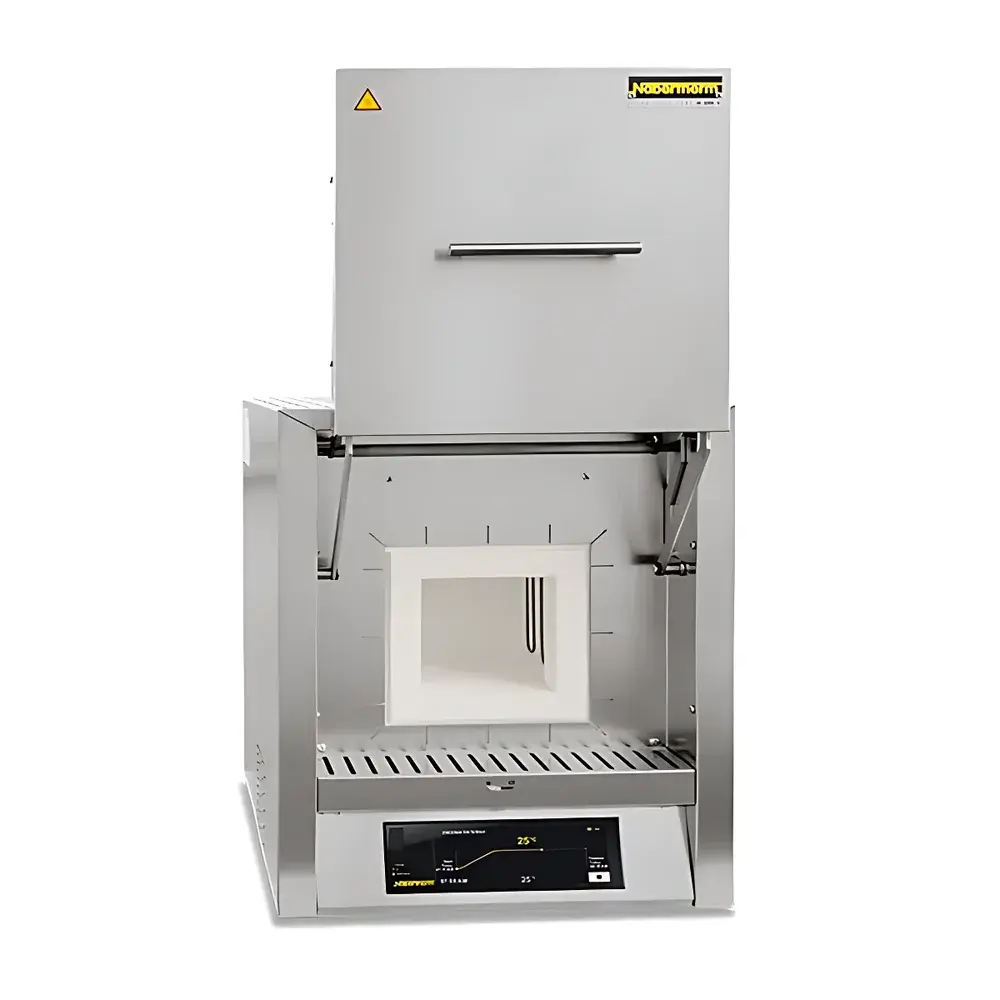
Nabertherm LHT 02/16 – LHT 08/18 High-Temperature Box Furnace
| Brand | Nabertherm |
|---|---|
| Origin | Germany |
| Model Range | LHT 02/16, LHT 04/16, LHT 08/16, LHT 02/17, LHT 04/17, LHT 08/17, LHT 02/18, LHT 04/18, LHT 08/18 |
| Max Operating Temperature | 1600 °C / 1750 °C / 1800 °C |
| Chamber Volume | 2 L / 4 L / 8 L |
| Internal Dimensions (W×D×H) | 90×150×150 mm to 150×300×150 mm |
| External Dimensions (W×D×H) | 470×630×760 mm to 470×810×760 mm |
| Power Supply | 1-phase (3.0–3.6 kW) or 3-phase (5.2–9.0 kW) |
| Heating Element | MoSi₂ (Molybdenum Disilicide) |
| Thermal Insulation | High-purity ceramic fiber |
| Temperature Sensor | Type B thermocouple |
| Overtemperature Protection | EN 60519-2 compliant dual-stage safety limiter (Class 2 thermal protection) |
| Cooling | Dual-wall steel housing with forced-air cooling |
| Gas Interface | Standard flanged inlet for inert or reducing atmospheres |
| Control System | SCR-based phase-angle power regulation with Controltherm MV software integration |
Overview
The Nabertherm LHT 02/16 – LHT 08/18 series comprises a family of precision-engineered high-temperature box furnaces designed for demanding laboratory and pilot-scale thermal processing applications. These units operate on the principle of resistive heating via molybdenum disilicide (MoSi₂) elements, delivering stable, uniform temperature profiles up to 1800 °C in controlled atmospheres. Engineered in Germany to DIN and IEC standards, each model features a monolithic ceramic fiber chamber housed within a double-walled stainless-steel enclosure—optimized for rapid heat-up, low external surface temperature (<60 °C at ambient), and long-term dimensional stability under thermal cycling. The LHT series is routinely deployed in advanced materials research, including sintering of technical ceramics (e.g., zirconia dental frameworks), annealing of refractory metals, ashing of certified reference materials (CRMs), and pre-sintering of battery cathode precursors. Its compact footprint, top-hinged lift door, and modular load configuration support seamless integration into ISO 17025-accredited laboratories and GLP-compliant QA/QC workflows.
Key Features
- Molybdenum disilicide (MoSi₂) heating elements rated for continuous operation at 1600 °C, 1750 °C, or 1800 °C — offering exceptional oxidation resistance and predictable aging behavior
- High-density, low-conductivity ceramic fiber insulation (Al₂O₃–SiO₂ composition) ensuring thermal efficiency >75% and minimal heat loss during soak cycles
- Dual-layer stainless-steel housing (brushed AISI 304) with integrated forced-air cooling ducts — maintaining outer surface temperatures ≤60 °C even at maximum setpoint
- Top-opening vertical lift door with gas-tight sealing and adjustable counterbalance mechanism — enabling safe, ergonomic loading/unloading of fragile samples
- Modular square-section alumina crucibles (stackable up to three layers), compatible with standard ASTM C655 and ISO 2739 specimen geometries
- Phase-angle-controlled silicon-controlled rectifier (SCR) power regulation — delivering precise, ripple-free voltage to heating elements for ±1 °C thermal stability over 24-hour holds
- Redundant safety architecture: primary PID controller + independent Class 2 overtemperature limiter per EN 60519-2, with mechanical cut-off at preset deviation threshold
Sample Compatibility & Compliance
The LHT series accommodates a broad range of sample forms—including powders, green bodies, pressed pellets, wires, and small machined components—within its 2 L to 8 L working volume. Chamber geometry supports uniform radiant heating with axial symmetry, minimizing thermal gradients (<±3 °C across load zone at 1600 °C). Optional inert gas purging (via standardized 1/4" VCR fitting) enables processing under nitrogen, argon, or forming gas (5% H₂/95% N₂), meeting ASTM E1112 and ISO 8501 requirements for oxide-sensitive materials. All models comply with CE marking directives (2014/35/EU Low Voltage Directive, 2014/30/EU EMC Directive), and their control architecture satisfies audit-trail and electronic signature prerequisites for FDA 21 CFR Part 11–aligned environments when paired with Controltherm MV software.
Software & Data Management
Controltherm MV is a Windows-based process management suite supporting full-cycle thermal protocol definition, real-time monitoring, and tamper-evident data archiving. Users define multi-step ramps, soaks, and cool-down profiles with time- and temperature-triggered events (e.g., gas flow activation, door interlock release). The system logs all operational parameters—including thermocouple voltage, SCR firing angle, chamber pressure (when optional transducer installed), and alarm status—at user-selectable intervals (1 s to 60 min resolution). Export formats include CSV, PDF reports with digital signatures, and XML for LIMS integration. Audit trails are immutable and timestamped to UTC; user access levels (operator, engineer, administrator) enforce role-based permissions aligned with ISO/IEC 17025 clause 7.7.
Applications
- Sintering of oxide and non-oxide technical ceramics (Al₂O₃, ZrO₂, SiC, Si₃N₄) per ISO 2739 and ASTM C1326
- Heat treatment of dental prosthetics and orthopedic implants under vacuum or protective atmosphere
- Thermal gravimetric analysis (TGA) sample preparation and residue quantification per ASTM E1131
- Calcination of catalyst supports and battery electrode materials (e.g., LiCoO₂, NMC precursors)
- Residue-on-ignition (ROI) testing for pharmaceutical excipients per USP
- Calibration of secondary temperature sensors using fixed-point cells (e.g., Ag, Cu, Co–C) in accordance with ISO/IEC 17025
FAQ
What atmosphere options are supported?
Standard configurations include air, inert gas (N₂, Ar), and reducing atmospheres (e.g., 5% H₂/N₂); vacuum operation requires optional vacuum pump interface and reinforced chamber seals.
Is the furnace suitable for GMP-regulated environments?
Yes—when operated with Controltherm MV software and configured with 21 CFR Part 11–compliant user authentication, electronic signatures, and audit-trail logging, it meets core GMP documentation requirements for thermal validation.
How is temperature uniformity verified?
Nabertherm provides factory calibration certificates traceable to PTB (Physikalisch-Technische Bundesanstalt); users may perform in-house uniformity mapping per ASTM E220 using up to nine calibrated thermocouples positioned across the working zone.
Can multiple LHT units be networked for centralized monitoring?
Yes—via Ethernet-enabled Controltherm MV servers, up to 32 furnaces can be managed from a single workstation with synchronized event logging and shared database archiving.
What maintenance is required for MoSi₂ elements?
No routine replacement is needed; elements exhibit gradual resistance increase over 1,000+ hours at max temperature. Annual visual inspection for sagging or localized oxidation is recommended, per Nabertherm Maintenance Bulletin LHT-MB-2023.



