
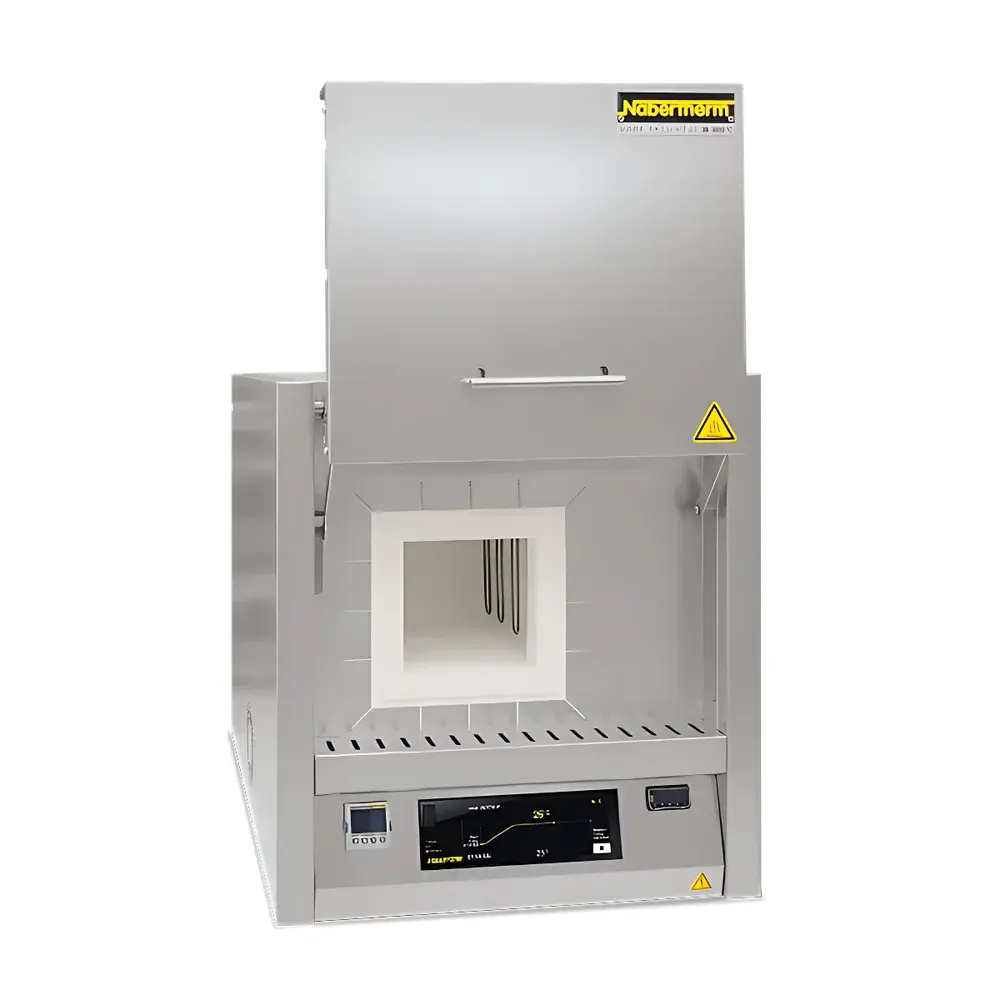
Nabertherm LHT/LB High-Temperature Bottom-Lifting Furnace
| Brand | Nabertherm |
|---|---|
| Origin | Germany |
| Model | LHT/LB |
| Max. Temperature | 1650 °C |
| Chamber Dimensions (Ø × H) | Ø185 × 185 mm (LHT 02/17 LB) / Ø260 × 260 mm (LHT 16/17 LB) |
| Chamber Volume | 2 L / 16 L |
| External Dimensions (W × D × H) | 390 × 590 × 765 mm / 650 × 1250 × 1980 mm |
| Power Supply | 3.4 kW (1-phase) / 12.0 kW (3-phase) |
| Weight | 50 kg / 410 kg |
| Heating Element | Molybdenum Disilicide (MoSi₂) |
| Temperature Uniformity | ≤ ±5 °C (at 1600 °C, steady state) |
| Control System | SCR-controlled S-type thermocouple with overtemperature protection per EN 60519-2 Class 2 |
| Optional | Protective Gas Inlet, Manual/Automatic Gas Supply, Adjustable Bottom Air Intake, Stackable Crucible Supports, Controltherm MV Process Software |
Overview
The Nabertherm LHT/LB series represents a class of high-precision bottom-lifting laboratory furnaces engineered for demanding thermal processing applications up to 1650 °C. Designed around the principle of vertical furnace chamber elevation—where the entire insulated hot zone is mechanically raised and lowered via a precision lead-screw actuator—the LHT/LB eliminates conventional door-based loading, thereby minimizing thermal shock, improving safety during high-temperature handling, and enabling reproducible placement of large or delicate samples directly onto the furnace base plate. Its core architecture integrates molybdenum disilicide (MoSi₂) heating elements embedded in a robust, low-thermal-mass ceramic fiber insulation matrix. This configuration ensures rapid heat-up rates, exceptional thermal stability (< ±0.5 °C drift over 24 h at setpoint), and superior radial and axial temperature uniformity—validated per DIN 17052-1 and ASTM E220—critical for sintering, annealing, ashing, and pre-firing protocols requiring strict thermal history control.
Key Features
- Bottom-lifting mechanism driven by a motorized, push-button-controlled lead screw with position feedback—ensuring repeatable, vibration-free vertical movement of the furnace chamber
- High-purity MoSi₂ heating elements mounted in a circumferential arrangement for optimal radiant heat distribution and minimized cold zones
- Double-layered ceramic fiber chamber construction (alumina-silica based) offering low thermal conductivity, high mechanical integrity, and resistance to thermal cycling fatigue
- Integrated air gap beneath the base plate and adjustable bottom gas inlets to support controlled convection and atmosphere management during inert or reducing processes
- Compliance with EN 60519-2:2015 for industrial electroheating equipment—featuring dual independent temperature monitoring: primary S-type thermocouple with silicon-controlled rectifier (SCR) power regulation and secondary overtemperature cut-off limiter set to Class 2 thermal protection level
- Stainless steel housing with brushed finish, top-mounted exhaust port (DN40), and optional flanged connections for integration into local exhaust ventilation (LEV) systems
Sample Compatibility & Compliance
The LHT/LB accommodates cylindrical crucibles, graphite boats, and refractory trays up to Ø260 mm × 260 mm height (LHT 16/17 LB model), supporting multi-layer stacking configurations—up to three tiers—with dedicated spacers ensuring unobstructed gas flow and thermal equilibration between layers. The furnace is compatible with argon, nitrogen, hydrogen, and forming gas atmospheres; all gas interfaces conform to ISO 8502-3 for leak-tightness and include manual needle valves or automated mass-flow controller (MFC) integration points. As a CE-marked device, it meets essential requirements of the EU Machinery Directive 2006/42/EC and Electromagnetic Compatibility Directive 2014/30/EU. For regulated environments, optional validation packages support IQ/OQ documentation aligned with ISO/IEC 17025 and GLP-compliant thermal mapping per ASTM E2203.
Software & Data Management
When equipped with the Controltherm MV software suite, the LHT/LB transforms into a fully traceable process instrument. MV enables creation and execution of multi-step thermal profiles—including ramp/soak/hold sequences, cooling rate modulation, and conditional logic triggers—while logging time-stamped temperature, power output, and status events at user-defined intervals (down to 1 s). All data are stored in encrypted CSV and XML formats with SHA-256 checksums. Audit trail functionality complies with FDA 21 CFR Part 11 requirements, including electronic signatures, role-based access control, and immutable record retention. Remote monitoring via Ethernet or RS485 Modbus RTU allows integration into centralized laboratory information management systems (LIMS) or MES platforms.
Applications
- Sintering of advanced ceramics (e.g., SiC, Al₂O₃, ZrO₂) and metal powders under controlled atmospheres
- Thermal treatment of battery electrode materials (cathode precursors, solid electrolytes) requiring precise oxygen partial pressure control
- High-temperature ashing of polymer composites and biological tissues per ISO 1171 and ASTM D3174
- Calibration and verification of thermocouples and radiation pyrometers at fixed-point temperatures (e.g., Ag, Cu, Co-C)
- Pre-firing of catalyst supports and porous substrates prior to impregnation or coating
- Research-scale crystal growth and phase transformation studies where thermal gradient minimization is critical
FAQ
What safety standards does the LHT/LB comply with?
It conforms to EN 60519-2:2015 (electroheating equipment safety), EN 61000-6-2 (EMC immunity), and EN 61000-6-4 (EMC emissions), with dual redundant temperature monitoring fulfilling Class 2 thermal protection requirements.
Can the furnace operate under vacuum conditions?
No—the LHT/LB is designed exclusively for atmospheric or positive-pressure protective gas operation; vacuum compatibility requires alternative furnace designs with welded seals and reinforced insulation.
Is the Controltherm MV software validated for GxP environments?
Yes—when deployed with appropriate configuration and change control documentation, MV supports 21 CFR Part 11 compliance, including electronic signatures, audit trails, and data integrity safeguards required for pharmaceutical and medical device manufacturing.
What maintenance is required for the MoSi₂ heating elements?
MoSi₂ elements require no periodic replacement under normal operating conditions; however, visual inspection for surface oxidation or cracking is recommended annually, and furnace calibration should be performed at least every six months using traceable reference standards.
How is temperature uniformity verified across the working volume?
Uniformity is validated using a 9-point thermocouple mapping procedure per ASTM E2203, conducted at multiple setpoints (e.g., 1000 °C, 1400 °C, 1600 °C) with the chamber loaded identically to routine operation.



